
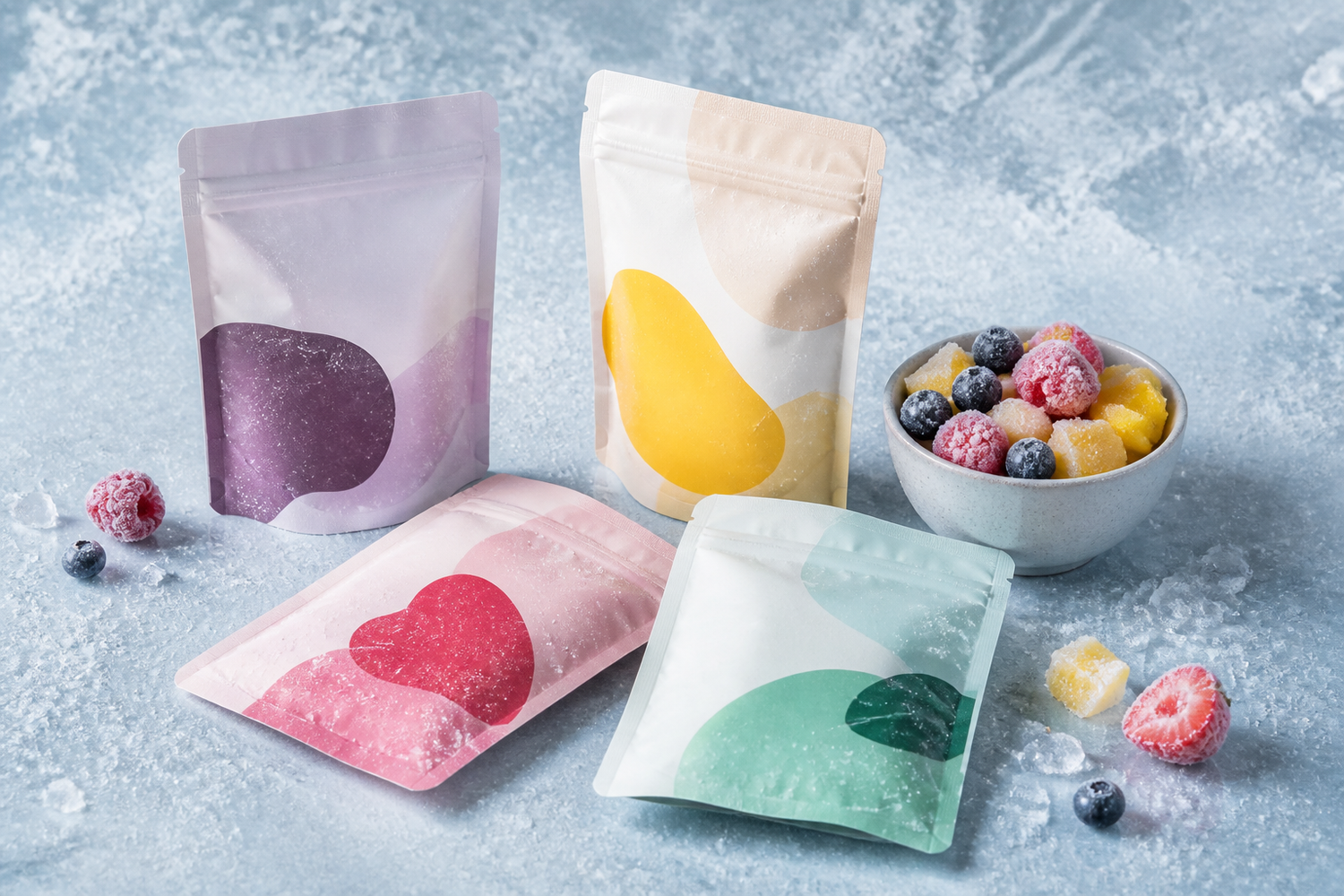
Frozen smoothie pouch packaging has to work as part of a system: fruit or puree, portion size, filling method, freezing step, case pack, storage, picking and customer use. A pouch that looks suitable at room temperature has not yet answered the questions that appear after filling and freezing.
This guide helps smoothie, frozen-fruit and meal-prep brands prepare a supplier and packer brief for a first run. It is not food-safety, cold-chain, shelf-life, material-selection or legal advice. The final package must be reviewed for the actual food, process, storage, distribution route and target market.

1. Define the portion and product form
Start with what goes inside each pouch. A loose blend of individually frozen fruit pieces, a compact frozen block, a puree base and a liquid concentrate place different demands on filling, headspace, sealing, handling and customer preparation.
Record the target net weight, count or recipe portion, largest piece dimensions, product temperature at filling, expected headspace and how the customer uses the pack. If the product is poured into a blender, include the desired opening width and whether the customer opens it fully frozen or after a controlled tempering step defined by the brand.
Also define the sale unit. One pouch may be sold alone, bundled as a weekly kit, packed in a retail carton or shipped in an insulated ecommerce box. The primary pouch and the secondary pack-out must be evaluated together.
2. Map filling, freezing and every handling handoff
Create a simple route from product preparation to customer opening. Note whether the product enters the pouch chilled, partially frozen or frozen; how air is managed; where the top seal is made; when the lot/date code is applied; how quickly the filled pack reaches frozen storage; and how it is arranged in a case.
Then mark the handling points: conveyor transfer, freezing, case packing, warehouse stacking, order picking, parcel packing, carrier handoffs, freezer restocking and customer opening. These points become inputs for the sample and pack-out plan.
The USDA notes that proper packaging helps maintain frozen-food quality and limit freezer burn. That general principle does not validate a commercial smoothie pack. Use it as a reason to define the actual route, not as a shortcut around testing.
3. Review intended use and low-temperature handling

FDA’s food types and conditions-of-use framework distinguishes food type and conditions such as frozen storage. Give the packaging supplier the actual product description, fat or acid characteristics relevant to technical review, filling process, frozen-storage condition and whether the pack is reheated or used only as a frozen ingredient.
The National Center for Home Food Preservation lists useful freezer-package characteristics including moisture-vapor resistance, durability, leak resistance, sealability and resistance to brittle cracking at low temperature. Commercial teams should translate those characteristics into project-specific material questions and tests rather than copying home-use guidance as a specification.
Ask what documentation supports the material for the intended use, which temperature range is being evaluated, and how folds, corners and seals will be observed after freezing and flexing. Avoid an unsupported “freezer proof” claim.
4. Build cold-flex, seal and leak checks around filled packs

A filled trial should identify the sample revision, product form, fill condition, seal settings, freezing history and conditioning before any test. Decide which locations will be inspected: top seal, side seals, corners, folds and any area where hard fruit pieces can press against the film.
The ASTM F02.20 list includes methods covering flexible-barrier seal strength, internal pressurization and puncture resistance. These methods do not create a universal smoothie-pouch protocol. Your packaging, quality and food teams should select applicable methods, specimen preparation and acceptance criteria.
A practical observation record may include visual seal condition, leakage, cold flexing, compression in the planned orientation, opening behavior and evidence of product or seal-zone contamination. A single clean sample is not enough evidence for a production claim; define sample counts and dispositions before the trial.
5. Test the real case or ecommerce pack-out
Place filled pouches in the actual carton, tote or insulated parcel configuration. Record pouch orientation, units per case, dividers, void fill, gel packs or dry ice decisions made by the qualified shipping team, carton dimensions and the expected time-temperature route.
The primary package test and the shipping validation are related but different. A pouch supplier can provide package inputs, but the brand and its logistics partners remain responsible for the cold-chain plan and any dangerous-goods requirements that apply to refrigerants.
After the route or simulation, inspect the same predefined locations and compare results with the control samples. If the product geometry, pouch size, case count or shipping configuration changes, decide whether the pack-out needs to be tested again.
6. Lock the SKU family and reorder record

Frozen smoothie programs often contain several recipes. A shared pouch body may simplify purchasing, but only when fill weight, product geometry, material, seals, label space and pack-out truly remain compatible. Record the fixed specification and every SKU-specific field.
Your quote-ready handoff should include:
- Product form, ingredient-piece range and target market.
- Fill weight, dimensions, headspace target and fill temperature or state.
- Filling, sealing, freezing, storage and distribution route.
- Pouch format, opening use case, case or parcel pack-out and units per case.
- SKU list, quantity per SKU, artwork status and lot/date requirements.
- Required material documentation, sample stages, test questions and acceptance owners.
Use Anacotte’s smoothie packaging collection to compare current format directions, including the frozen smoothie flat-pouch option. Then request a project-specific quote with the product, cold-chain and test details above.
Frequently asked questions
Can an empty pouch sample prove that it works for frozen smoothie packs?
No. Empty samples can help with size and artwork, but the filled product, seal process, freezing history and pack-out introduce additional questions.
Is one freezer-pouch structure right for every smoothie recipe?
No. Product form, ingredient geometry, filling, storage, distribution and intended use should be reviewed for the actual recipe and route.
Should seal strength be the only acceptance check?
No. A qualified plan may also consider visual seal condition, leakage, cold flexing, compression, opening behavior and pack-out observations. The team must define applicable methods and limits.
What should we send before asking for a quote?
Send the product form, portion, fill and freezing route, storage and shipping plan, pouch format, SKU quantities, artwork status, market and test questions. List unknowns rather than assuming them.

Leave a comment
This site is protected by hCaptcha and the hCaptcha Privacy Policy and Terms of Service apply.