
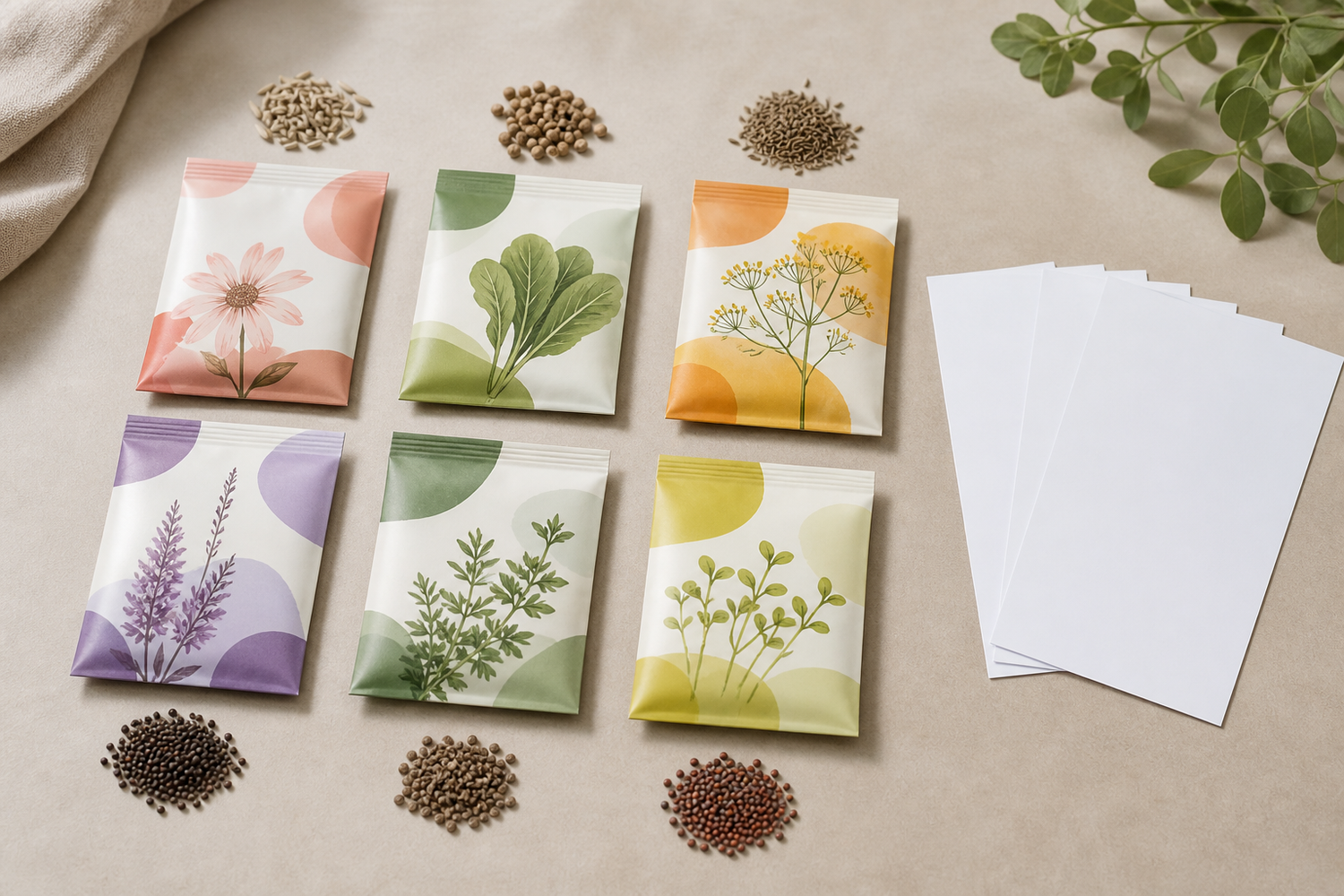
Custom seed packet packaging has to do more than hold a small amount of product. It must give a seed brand enough room for truthful, legible information, keep dozens of variety files under control, fit the filling method and support the storage questions that matter for the actual seed.
This guide is for U.S. seed brands, garden-kit operators and nursery marketers preparing a custom packet run. It is a packaging-planning resource, not legal, germination, storage or shelf-life advice. Confirm the final label and package with the responsible seed specialist, regulatory reviewer, filler and packaging supplier for the exact seed, treatment, pack size and sales route.

1. Define the seed, packet and sales route first
Start with the product identity rather than a preferred packet photo. Record whether the pack contains agricultural seed, vegetable seed, a flower variety, a mixture, treated seed or a promotional garden item. Then identify where it will be sold and shipped. A packet moving through U.S. interstate commerce can face different questions from a local giveaway, and state requirements may also apply.
The USDA Agricultural Marketing Service overview of the Federal Seed Act describes the law as a truth-in-labeling framework for agricultural and vegetable seed shipped in interstate commerce. It identifies major information areas such as kind or variety, purity and germination information in applicable cases, treatment information, and the interstate shipper’s identity. The detailed obligations depend on the seed and transaction, so do not turn a short web summary into a universal label template.
Give the packaging supplier a practical product card:
- Seed kind, variety or mixture and whether it is treated.
- Target count or net weight and expected fill variation.
- Seed dimensions, shape, sharp points, dust and flow behavior.
- Sales states or countries, retail channel and intended storage period.
- Manual or automated filling method and final sealing method.
- Number of varieties, quantity per design and target launch date.
These fields do not select a material by themselves. They let the seed owner, filler and supplier identify what still needs testing.
2. Build the copy map before the dieline is approved

A packet can look spacious in a flat artwork file and still become crowded after seals, tear notches, folds, hang holes and variable codes are included. Build a copy map before design work reaches final proof.
Under 7 CFR Part 201, required seed label information must be clearly legible, and the exact content varies by product and circumstance. Work with a qualified reviewer to identify every required field. Then classify each field by where and how it will appear:
- Fixed brand fields: brand name, shared contact information and recurring instructions.
- Variety fields: kind, variety, blend details, planting information and botanical artwork.
- Lot-controlled fields: lot identifier, test date, germination or purity information when applicable, treatment statements and other production-specific data.
- Retail fields: barcode, price-label clearance, hang-hole area and any retailer-required data.
- Production zones: seal margins, tear path, date or lot coding area, registration marks and safe zones.
Mark the owner of each field. The designer should not invent regulatory copy, the printer should not decide whether a germination statement is current, and the packaging supplier should not be treated as the legal approver simply because it supplies the dieline.
3. Turn a variety list into a controlled SKU matrix
Seed programs often expand from a few varieties into dozens of closely related files. That creates a version-control problem before it creates a printing problem. A SKU matrix keeps the differences visible.
Use one row per sellable packet. Suggested columns include internal SKU, seed kind, variety, mixture name, treated or untreated status, pack count or net weight, label-data owner, artwork file, barcode, print quantity, lot-code method, carton identifier and proof status.

Next, separate shared and variable artwork. A common packet size and visual system may support efficient digital-print planning, but every unique design still needs an explicit quantity and approved file. Do not assume that “5,000 total packets” tells a supplier how many packets belong to each of 20 varieties.
Use a naming system that prevents look-alike mistakes. Include the SKU, short variety name, market, language, revision and approval date in the controlled record. On proof sheets, place the internal SKU beside the customer-facing variety name so production and brand teams can compare both.
The most important approval question is simple: who confirms that the printed variety and lot-related fields match the seed that will actually be filled? Record that person and the source file. A color-approved proof is not automatically a data-approved proof.
4. Match format questions to the seed and handling route
Paper envelopes, flat flexible sachets and resealable pouches can serve different programs. Do not choose among them using “natural look,” “premium feel” or “moisture proof” alone. Describe the handling route and the failure you are trying to prevent.
Useful questions include:
- Will sharp or bulky seeds stress corners or seals?
- Does fine seed leak through an imperfect seal or create dust in the seal area?
- Will the packet be opened once, or should a larger refill pack reclose?
- Does the packet hang on a peg, sit inside a kit, travel in a mailer or stand on a shelf?
- Can the filler run the selected packet dimensions and seal layer?
- How much flat panel remains after the fill gives the packet volume?
Iowa State University Extension notes that seeds should be kept cool and dry and that storage conditions affect viability. That supports asking for a storage and package plan; it does not prove that a named laminate will preserve every seed for a stated period. The seed owner should define the storage window, conditions, germination checks and acceptance criteria.
5. Approve filled samples, not empty graphics

An empty printed packet can confirm color, registration and basic construction. It cannot show how a real seed fills the corners, changes the panel shape, behaves near the seal, or arrives after handling.
Build a sample plan with defined stages:
- Dieline proof: review dimensions, orientation, safe zones, bleed, seal margins and variable-code location.
- Unfilled physical sample: review material feel, opacity, tear behavior, hang-hole and sealing compatibility.
- Filled engineering sample: use the actual or representative seed and target fill to review capacity, seal cleanliness and panel readability.
- Storage sample: define conditions, duration, germination checks and the responsible technical owner.
- Distribution sample: pack the retail unit as it will ship and inspect abrasion, puncture, seal and code legibility afterward.
Record the seed lot, packet revision, material reference, filling method, seal settings, test conditions, sample count, observations and disposition. If the seed, treatment, fill, size, material, closure, storage or distribution route changes, decide whether the previous approval still applies.
6. Send one quote-ready matrix for the packet family
A useful request for quote should include:
- Seed types, treatments, target markets and sales channels.
- Packet dimensions, target count or weight and seed geometry.
- Filling and sealing method, coding method and required safe zones.
- Full SKU matrix with quantity per artwork, not just a total quantity.
- Artwork status, regulatory-copy status, barcode files and proof owners.
- Material questions, storage assumptions and required sample stages.
- Retail display needs, shipping configuration, target date and destination.
Review Anacotte’s custom flower and vegetable seed packet direction, then request a project-specific quote with the seed, label, SKU and test details above. Unknown values should be listed as open questions instead of guessed specifications.
Frequently asked questions
Can we reuse one packet layout for every seed variety?
A shared layout may be efficient, but every variety still needs enough space for its applicable information and a controlled proof. Confirm which fields are fixed, variable and lot-specific.
Does a moisture-barrier film guarantee seed viability?
No. Viability depends on the seed, initial condition, moisture, temperature, storage duration, sealing and other factors. Define a storage and germination verification plan for the actual product.
Who should approve the final seed packet proof?
Assign separate owners for regulatory and seed data, artwork and color, production feasibility, and final release. One visual approval should not silently cover every responsibility.
What should we prepare before asking for a quote?
Prepare the seed and treatment information, pack size, sales route, SKU quantities, label fields, artwork status, filling method, coding plan, timing and sample questions. A supplier can respond more precisely when open decisions are visible.

Leave a comment
This site is protected by hCaptcha and the hCaptcha Privacy Policy and Terms of Service apply.