
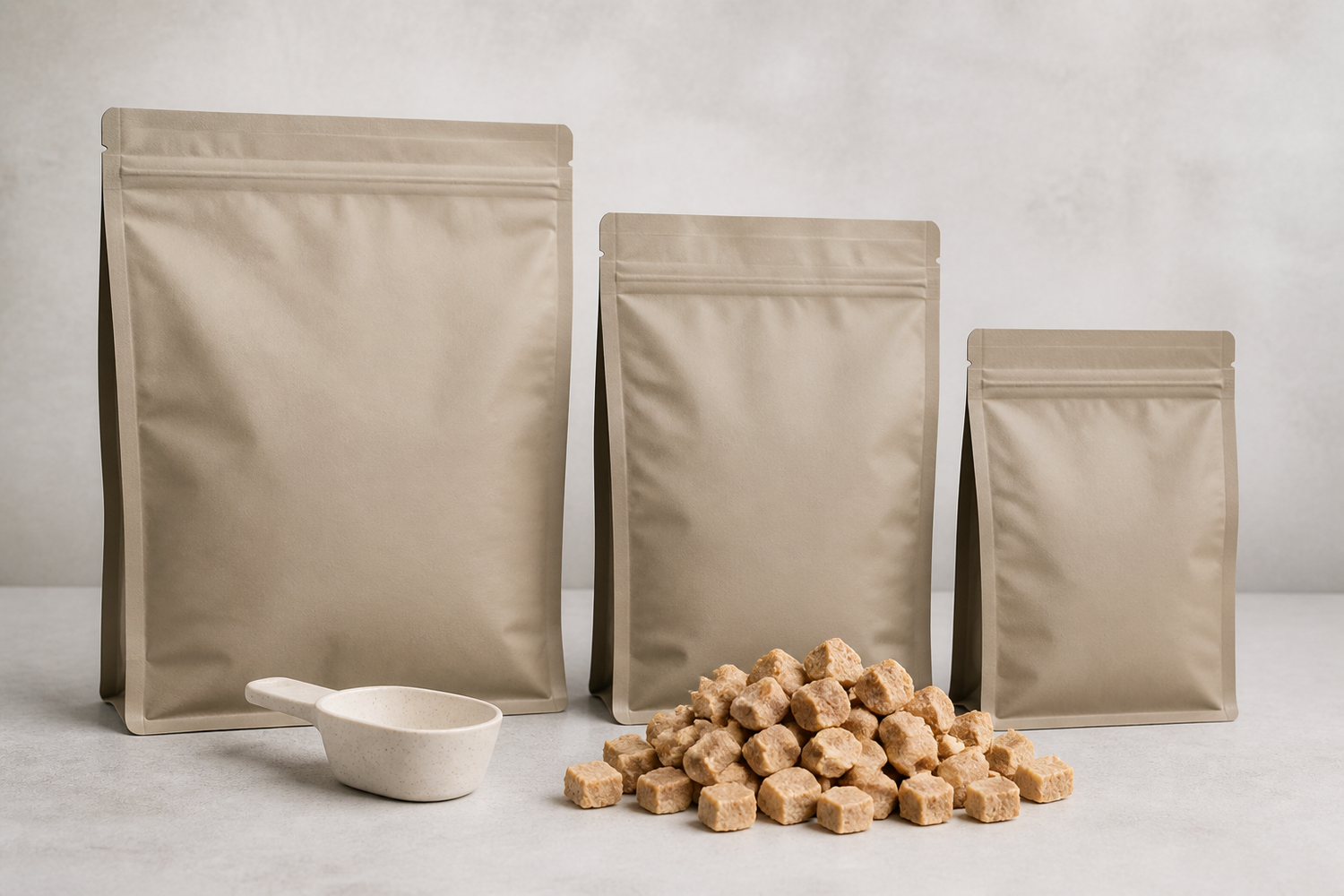
Freeze-dried dog food pouch packaging is often discussed as a barrier-material decision. A useful sample brief goes further. It connects the shape and volume of the food, the top seal, the zipper, repeated opening, crumbs, label space, lot-code traceability and the parcel that carries the finished pouch.
This guide is for U.S. pet-food and raw-diet brands preparing a flat-bottom pouch sample or pilot. It is not formulation, food-safety, shelf-life, veterinary, regulatory or legal advice. The product owner, manufacturer, packaging supplier, testing team and qualified regulatory reviewers should confirm the final package for the actual formula, process, market and distribution route.

1. Describe the product the pouch will actually hold
“One-pound freeze-dried dog food” is not a complete packaging brief. Two products with the same net weight can occupy very different volumes, shed different amounts of dust and place different stress on the pouch. Record the physical product before choosing dimensions.
Useful inputs include:
- Cube, nugget, patty, crumble or mixed-piece format.
- Typical and maximum piece dimensions.
- Target net weight and observed bulk volume.
- Fragility, sharp edges, fines and dust generated during handling.
- Known moisture, oxygen, light, aroma or grease sensitivities.
- Manual or automatic filling route and product temperature at packing.
- Retail, subscription, wholesale or ecommerce distribution.
These details help the technical team define what must be measured. They do not justify a universal laminate or shelf-life promise.
2. Size the pouch by volume, geometry and headspace

Start with a representative product-volume study. Fill several sample pouches using the real or technically representative product. Record settling, headspace, side-gusset expansion, bottom stability and the amount of usable panel area after filling.
A flat-bottom pouch may be useful when the brand wants a structured shelf presentation and generous panel space. The final width, depth and height still need to match the actual fill, equipment and case pack. Too little headspace can make sealing difficult; too much can produce an underfilled appearance and inefficient shipping.
Ask the supplier and packer to distinguish nominal capacity from recommended working fill. Confirm where the product must stop below the zipper and top seal, how the pouch will be opened for filling, and whether the bottom and side gussets unfold consistently.
Before approving artwork, mock up the filled pouch. A nutrition or ingredient panel that looks clear on a flat dieline can become distorted across a fold or crowded by the zipper once the pouch has volume.
3. Test the top seal and zipper as separate functions
The top heat seal protects an unopened pack. The zipper supports consumer use after opening. They are related, but they are not the same feature and should not share one vague “seal passed” result.

For the production seal, record the seal-zone requirement, how product and dust are kept away from the interface, the actual machine settings, sample location and inspection method. ASTM F88/F88M covers measurement of seal strength in flexible barrier materials. It does not provide one pass/fail force for every dog-food pouch. The project team must define whether the method applies and set its own conditioned sample plan and acceptance criteria.
For the zipper, run a use simulation that reflects the serving pattern:
- Open the top seal using the intended tear path.
- Scoop or pour the planned serving without damaging the zipper.
- Allow the expected crumbs or fines to contact the track.
- Clean and reclose the zipper using the proposed consumer instruction.
- Repeat for a defined number of openings over a defined time.
- Record closure feel, alignment, contamination, leakage observations and remaining product condition.
A zipper that closes cleanly on an empty sample may behave differently when light pieces, dust or fat residues reach the track. Use filled samples and record the conditions. Do not turn a short demonstration into a shelf-life conclusion.
4. Preserve label and lot-code traceability
The FDA animal-food labeling overview lists federal information categories including product identity, net quantity, manufacturer or distributor details and ingredients, while also noting that state requirements apply. AAFCO model regulations are widely used by states, but they are not a substitute for reviewing the laws where the product will be distributed.
Reserve physical space for the applicable principal display and information-panel content, feeding or rehydration directions, warnings, barcode, lot or batch code and best-by information. Confirm whether the variable code will be ink-jetted, laser-marked, labeled or preprinted, then test contrast and abrasion on the selected surface.
FDA’s pet-food storage guidance advises consumers to keep food in its original bag so the UPC, lot number, product name, manufacturer and best-by date remain available if there is a problem. That makes durable, readable variable data part of the package test, not an afterthought.
Keep the lot-code area away from folds, zipper ribs, heavy texture and frequently scuffed zones. After filling, repeated use and shipping simulation, verify that the code remains readable and connected to the correct SKU.
5. Run an opened-pack and parcel sample plan

A useful approval sequence separates what each sample can prove:
- Empty pouch review: dimensions, construction, print, zipper installation and tear path.
- Filled capacity review: product volume, headspace, pouch stance, panel readability and case-pack fit.
- Production-seal review: seal cleanliness, measured method, failure mode and documented process conditions.
- Opened-pack review: serving access, zipper cycles, crumb behavior, instruction clarity and code retention.
- Distribution review: finished pouch inside the intended secondary packaging and shipping configuration.
- Stability program: product-specific technical work under defined storage conditions; not replaced by the packaging checks above.
The ISTA 3A overview describes a general simulation procedure for individual packaged products moving through parcel-delivery systems. It can inform an ecommerce test discussion, but the responsible team must decide whether it fits the actual product, pouch, carton and route. Define the sample count, conditioning, sequence and acceptance criteria before testing.
Inspect more than leaks. Record crushed pieces, fines, scuffed print, zipper contamination, top-seal changes, code legibility, pouch deformation and movement inside the carton. If the product size, fill, film, zipper, case pack or route changes, decide whether the previous result still applies.
6. Send a quote-ready test matrix
A practical request for quote should include:
- Product category, formula owner, target market and intended use.
- Piece format, dimensions, fragility, fines, sensitivities and representative sample availability.
- Target net weight, measured bulk volume and working-fill observations.
- Pouch format, zipper and tear preferences, filling route and seal-zone requirements.
- SKU list, quantity per design, artwork status and variable code method.
- Applicable label-review owner and reserved information zones.
- Opened-pack use cycle, sample stages, distribution configuration and approval owners.
- Target date, ship-to location and unanswered technical questions.
Review Anacotte’s flat-bottom pouch direction for freeze-dried raw dog food, then request a project-specific quote with the product, fill, closure, label and test details above. Treat any product-page structure as a starting direction until the actual formula and process are validated.
Frequently asked questions
Is net weight enough to choose the pouch size?
No. Record bulk volume, piece geometry, settling, fines, working headspace and the packer’s seal-zone requirement. Use filled samples before approving dimensions.
Does a resealable zipper prove freshness after opening?
No. A zipper is one package feature. Product stability depends on the formula, initial condition, barrier, seal, storage, opening pattern and other factors. Validate the actual product under a defined program.
Can ASTM F88 test the zipper?
ASTM F88/F88M measures seal strength in flexible barrier materials. Do not assume it is a zipper-cycle test. Define a separate consumer-use method for the closure.
What should be ready before requesting samples?
Prepare representative product, target weight and volume, piece and dust observations, pouch and closure preferences, label zones, SKU quantities, filling route, shipping configuration and a written test matrix.


Leave a comment
This site is protected by hCaptcha and the hCaptcha Privacy Policy and Terms of Service apply.