
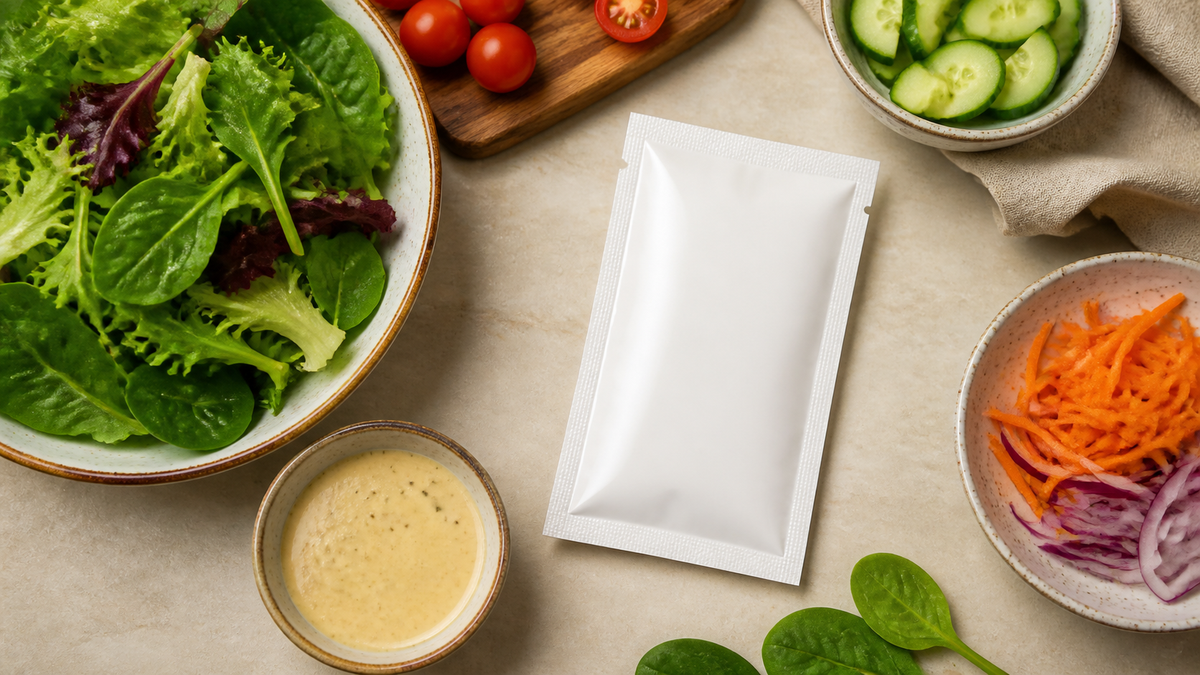
Salad dressing pouch packaging should start with the serving model: a single-use portion, a larger reclosable pack, or a controlled-dispensing format. Choosing by appearance alone can leave the portion size, viscosity, fill route, tear behavior, seal area, and case handling unresolved. The comparison below is a working brief for samples and quotes, not a universal “best pouch” recommendation.

Choose the serving model first
A single-serve packet has a different job from a family-size retail pouch. Use this table to frame the first supplier conversation:
| Serving model | Starting format hypothesis | Questions to confirm |
|---|---|---|
| Single-serve foodservice or meal-kit portion | Flat three-side-seal sachet with a tear edge and no zipper or spout. | Portion weight or volume, tear direction, case count, code zone, seal contamination, and handling after filling. |
| Multi-use retail or larger foodservice pack | Resealable stand-up pouch when the use routine requires repeated opening and storage. | Fill volume, viscosity, zipper access, pouch stance, headspace, reclosure behavior, and shelf or pack-out orientation. |
| Controlled dispensing from a larger pack | Stand-up spouted pouch when a cap and fitment support the intended pour routine. | Spout position, neck and cap fit, fill-line access, cap handling, pour angle, and filled-pack testing. |
Current market examples make the distinction concrete. Kraft’s Away From Home product page documents a 1.5 oz Italian dressing packet for foodservice. TricorBraun Flex’s catalog page shows flat and stand-up pouch options with closure and accessory choices. These examples establish serving and format patterns; they do not select a structure or prove the performance of a customer recipe.
When a flat sachet makes sense
The flat sachet is a useful starting point when the dressing is portioned for one opening and the buyer values compact case packing over reclosure. The rectangular pack should remain flat during filling and handling. A sealed perimeter, tear notches, and a defined fill window are more relevant to this use model than a bottom gusset or a spout.
Define the actual dose before asking for dimensions. A thick dressing, a separated oil-and-vinegar recipe, and a thinner pourable dressing may behave differently at the nozzle and around the seal area. Ask the filler how the sachet will be supported, where the product may reach the seal, and how the filled samples will be checked. A product page or a blank image cannot answer those questions by itself.

When to consider a zipper or spout
A larger pack may need a different opening routine. A resealable stand-up pouch can be considered when the customer will open the pack more than once and needs a defined reclosure action. The pouch must still be sized for the actual fill and storage pattern; a zipper is not a substitute for deciding how the product will be dispensed or stored.
A spouted pouch can be considered when controlled pouring is part of the use case, especially for a larger or more viscous pack. Confirm the fitment, cap, pour direction, nozzle access, and fill-line clearance before choosing it. If the customer only needs a single portion, the added fitment may introduce questions that the primary use model does not need.
For readers starting from a broad category question, the existing sauce packaging overview covers wider spout, sachet, and retort categories. This article keeps the decision narrower: single-serve dressing portions versus larger reclosable or controlled-dispense packs.
Connect the recipe to the fill and seal plan
Before a film or closure is finalized, document the recipe inputs that can affect the package review:
- Oil phase, acidity, solids, herbs, particulates, and any separation behavior.
- Viscosity at the intended fill temperature and during the expected storage range.
- Target fill weight or volume, headspace, nozzle approach, and line or co-packer constraints.
- Risk of product reaching the seal area, plus the proposed seal window and inspection method.
- Portion tear, zipper reclosure, or spout-and-cap behavior that the customer will actually use.
- Label, ingredient, allergen, net-quantity, lot/date-code, and market requirements owned by the responsible product team.
Keep “food-safe,” “oil-proof,” “freshness,” and shelf-life language out of the brief unless the exact structure, formula, market, and evidence support it. The article can describe questions for a supplier without making those conclusions in advance.

Use a proof sequence that matches the selling channel
A useful sample sequence moves from empty geometry to filled handling:
- Review the empty pack. Confirm the flat dimensions, seal bands, tear notches, zipper or fitment placement, and reserved code and artwork zones.
- Fill representative samples. Record recipe boundaries, fill temperature, fill weight or volume, headspace, and the actual equipment or hand-fill method.
- Inspect the opening feature. Test tear direction and opening force for a sachet, reclosure for a zipper pack, or cap and pour routine for a spouted pack. Treat these as observations until acceptance criteria are agreed.
- Check filled-pack handling. Use the channel’s likely case orientation and examine compression, movement, and contact with the seal area.
- Proof the final artwork. Review front and back panels on the real geometry, including ingredients, allergen statements, net quantity, lot/date-code area, barcode, and any instructions owned by the brand.

The test image shows a setup, not a passing result. A project record should connect the observed result to the formula, pouch structure, fill process, closure, sample count, and handling conditions. That record is more useful than a generic claim about a pouch being leak-proof or preserving freshness.
Prepare a quote-ready dressing pouch brief
Share these details with a packaging supplier or co-packer:
- Serving model: single-use, repeated-use, or controlled dispensing.
- Recipe profile, portion size, viscosity range, fill temperature, and any particles or separation to account for.
- Number of SKUs, target case count, sales channel, and expected pack orientation in storage or shipment.
- Flat sachet, zipper stand-up, or spouted format preference, with the reason for that choice.
- Required tear notch, zipper, spout, cap, hang hole, window, finish, dimensions, and code zones.
- Sample questions: seal contamination, opening or reclosure behavior, case compression, handling, and formula-contact documentation.
- Artwork status and the owner for ingredient, allergen, net-quantity, and market-specific copy.

FAQ: salad dressing pouch packaging
What pouch is best for salad dressing?
It depends on the serving model. A flat sachet is a starting hypothesis for a single-use portion; a zipper stand-up pouch may fit a repeated-use routine; and a spouted pouch may fit a larger controlled-pour pack. The recipe, fill process, closure behavior, and sales channel should decide the sample plan.
Can oil and vinegar use a flat pouch?
A flat pouch can be evaluated for an oil-and-vinegar portion, but the actual recipe, film structure, seal process, tear behavior, and target market documentation must be reviewed. The format alone does not establish oil resistance, freshness, shelf life, or food-contact compliance.
When is a spout worth testing?
Test a spout when the customer needs controlled dispensing from a larger or more viscous pack and can define the fitment, cap, fill route, and use routine. For a single portion, a tear-open sachet may be a simpler starting point.
See the Anacotte custom flat pouch for salad dressing as a geometry and application reference. For a broader liquid process discussion, review the hot-fill pouch quote guide, then share your portion size, recipe profile, fill route, and sales channel with Anacotte Packaging for a project-specific conversation.



댓글 남기기
이 사이트는 hCaptcha에 의해 보호되며, hCaptcha의 개인 정보 보호 정책 과 서비스 약관 이 적용됩니다.