
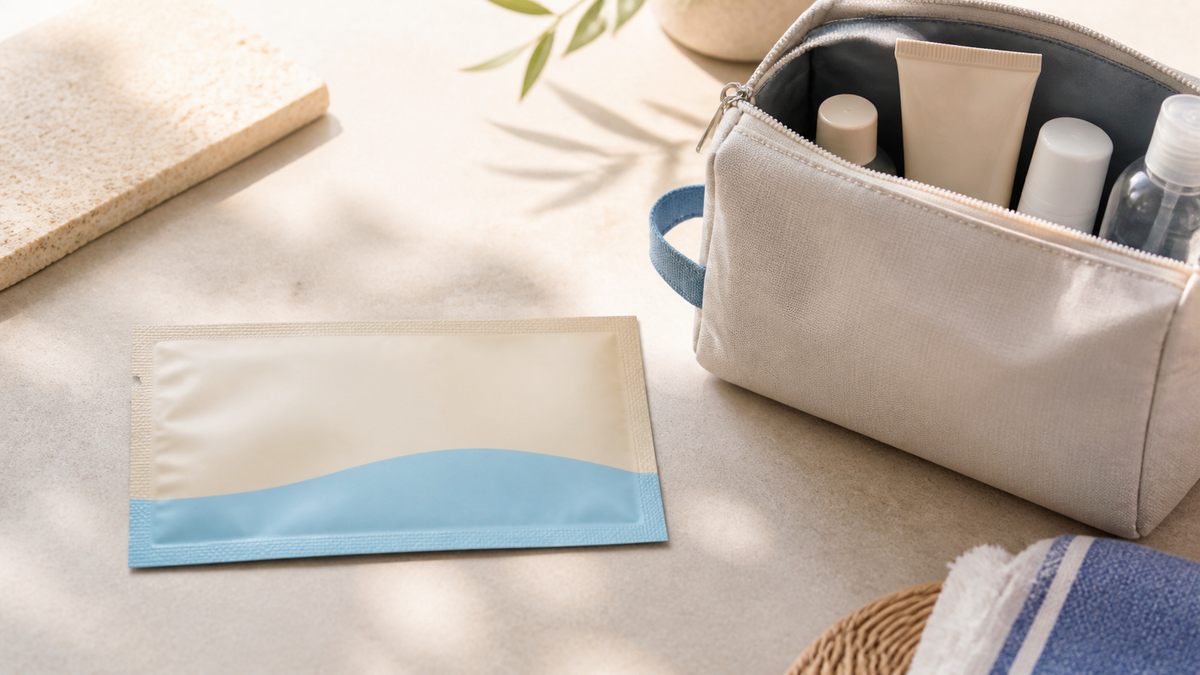
When a brand searches for sunscreen pouch packaging, the first decision is usually not the material. It is the use routine. A single-use travel or sample portion has a different job from a refill pack that may be opened, stored, and used again. Choose the format to test from that routine, then confirm the formula, fill, label, seal, and distribution inputs with the right project owners.

Start with the use pattern
A flat sachet is a reasonable starting hypothesis when the customer receives one portion, tears it open, uses the product, and does not need to close it again. It keeps the conversation focused on fill quantity, tear direction, seal area, panel space, and the case or kit that carries the portion.
A refillable pouch is a different operating model. It may need a larger fill, a controlled opening, a cap or zipper, space for repeated handling, and a plan for storage after the first use. A standing or spout format can be worth testing for that use case, but the presence of a gusset, fitment, or closure does not prove formula compatibility, leak performance, or product protection.
Use the comparison below to frame the first sample conversation:
| Project question | Flat sachet | Refillable pouch |
|---|---|---|
| Customer routine | One application or short trial; no reclosure assumed. | Repeated dispensing or a larger quantity kept for later use. |
| Opening | Tear notch or other one-time opening to confirm. | Opening, cap, fitment, or zipper must support the actual dispensing routine. |
| Panel planning | Small panel makes copy hierarchy and code placement important. | More surface may be available, but the filled shape can change the usable panel. |
| Pack-out | Sample kit, event pack, travel case, or small retail carton. | Retail shelf, refill shipment, or a secondary pack that protects the opened-format plan. |

Define the sunscreen before choosing the pouch
“Sunscreen” is not enough information for a packaging quote. Share the product state and the boundaries that can change the fill and seal discussion:
- Is the product a lotion, cream, gel, oil, stick, spray, or another form? FDA lists several sunscreen forms, and the directions can vary by form. Use the approved product description rather than letting the pouch supplier infer it.
- What is the target fill volume and acceptable tolerance? A one-application sachet and a refill pack should not be sized from the same nominal number without a real fill and headspace review.
- What is the viscosity range, fill temperature, and filling route? Record the filler, nozzle approach, line constraints, and how the perimeter seal will be kept clear.
- Will the customer squeeze, pour, spread, or dispense through a fitment? The opening should match the use gesture and the amount the customer is expected to use.
- What must happen after opening? If the answer is “nothing,” keep a flat sachet in the comparison. If the answer is “store and use again,” define the reclosure and handling requirement separately.

Reserve label space before artwork
For the U.S. market, sunscreen may be regulated as an over-the-counter drug. The FDA’s consumer guidance and OTC sunscreen labeling guide describe label, directions, warnings, and storage considerations for covered products. The package supplier can help reserve a usable panel, but the sunscreen brand and qualified regulatory owner must supply and approve the final copy. Do not treat a pouch mockup as a compliance review.
FDA guidance also explains that the product container should be protected from excessive heat and direct sun. That makes the handoff more useful when it includes the brand’s intended storage and distribution assumptions, not only a color direction. Put the copy owner, approved label revision, lot or expiration-code area, and required panel hierarchy in the brief before the final dieline is approved.

Use filled samples to compare the formats
Empty samples are useful for reviewing feel, dimensions, opening direction, and print area. A filled sample answers different questions. Run the comparison in the same sequence the customer, packer, and shipping route will use:
- Fill representative product. Record formula version, fill volume, fill temperature, sample age, and any visible settling or air space.
- Inspect the seal and opening. Check for product in the seal area, clean tear behavior, fitment or cap movement, pouch distortion, and panel readability.
- Repeat the intended use gesture. Tear and dispense a sachet or open, pour, close, and store the refillable sample. Note whether the format matches the real routine.
- Condition and handle the finished pack. Use the project’s agreed heat, direct-sun, storage, parcel, and case-pack assumptions. Do not substitute a generic “travel proof” or “leak proof” statement for a recorded test plan.
- Review the formed artwork. Confirm that product identity, required copy, codes, and warnings remain legible on the filled shape and do not cross a fold, seal, notch, zipper, or fitment.

Current market examples show that single-use sunscreen packets are a real route: Sicura’s SPF sample sachet page describes a one-application packet for samples and events, while Dynarex lists a single-use sunscreen packet. These pages are market examples only. They do not establish a structure, efficacy result, label approval, or compatibility for another formula.
When the Anacotte flat pouch is a useful starting point
Anacotte’s custom flat pouch for travel sunscreen and skincare is a useful geometry and application reference for a project that is considering a flat, portable portion. Treat the page as a conversation starter. Bring the actual formula type, target fill, opening direction, panel map, SKU count, artwork status, and intended travel or distribution routine before asking for a final construction.
For broader format context, compare the existing hair-mask spout-versus-sachet guide and stand-up versus flat pouch comparison. The sunscreen decision still needs its own fill, label, and use evidence.
What to send with a sunscreen pouch quote request
- Formula form, viscosity range, target fill, tolerance, and a representative sample route.
- Single-use or repeat-use routine, opening gesture, reclosure need, and intended storage after opening.
- Preferred flat, stand-up, or spout direction, along with dimensions, tear direction, cap/fitment preference, and case pack.
- U.S. label-copy owner, approved revision, panel map, lot/expiration-code area, and artwork status.
- Fill-line details, seal-zone requirements, sample count, and the conditions that matter in storage, travel, parcel, or retail handling.
- Questions that the sample must answer: compatibility review, seal integrity, opening, dispensing, formed-panel readability, and secondary-pack fit.
FAQ: sunscreen pouch packaging
Is a flat sachet always the best sunscreen pouch?
No. It is a starting hypothesis for a single-use or sample routine. A repeat-use product may need a different opening, closure, fill, and storage plan.
Can the product page confirm that a pouch is sunscreen-compatible?
No. The formula owner and packaging supplier should review the actual product, film, sealant, fitment, process, and conditions. A product image or supplier description is not a compatibility test.
Who owns the final U.S. sunscreen label?
The sunscreen brand and its qualified regulatory owner must approve the final market copy. The packaging team should reserve usable panel and code zones and review the formed, filled sample.
What should I do next?
Share your formula type, target fill, use routine, label-panel needs, and distribution assumptions with Anacotte Packaging to start a project-specific pouch conversation.

댓글 남기기
이 사이트는 hCaptcha에 의해 보호되며, hCaptcha의 개인 정보 보호 정책 과 서비스 약관 이 적용됩니다.