
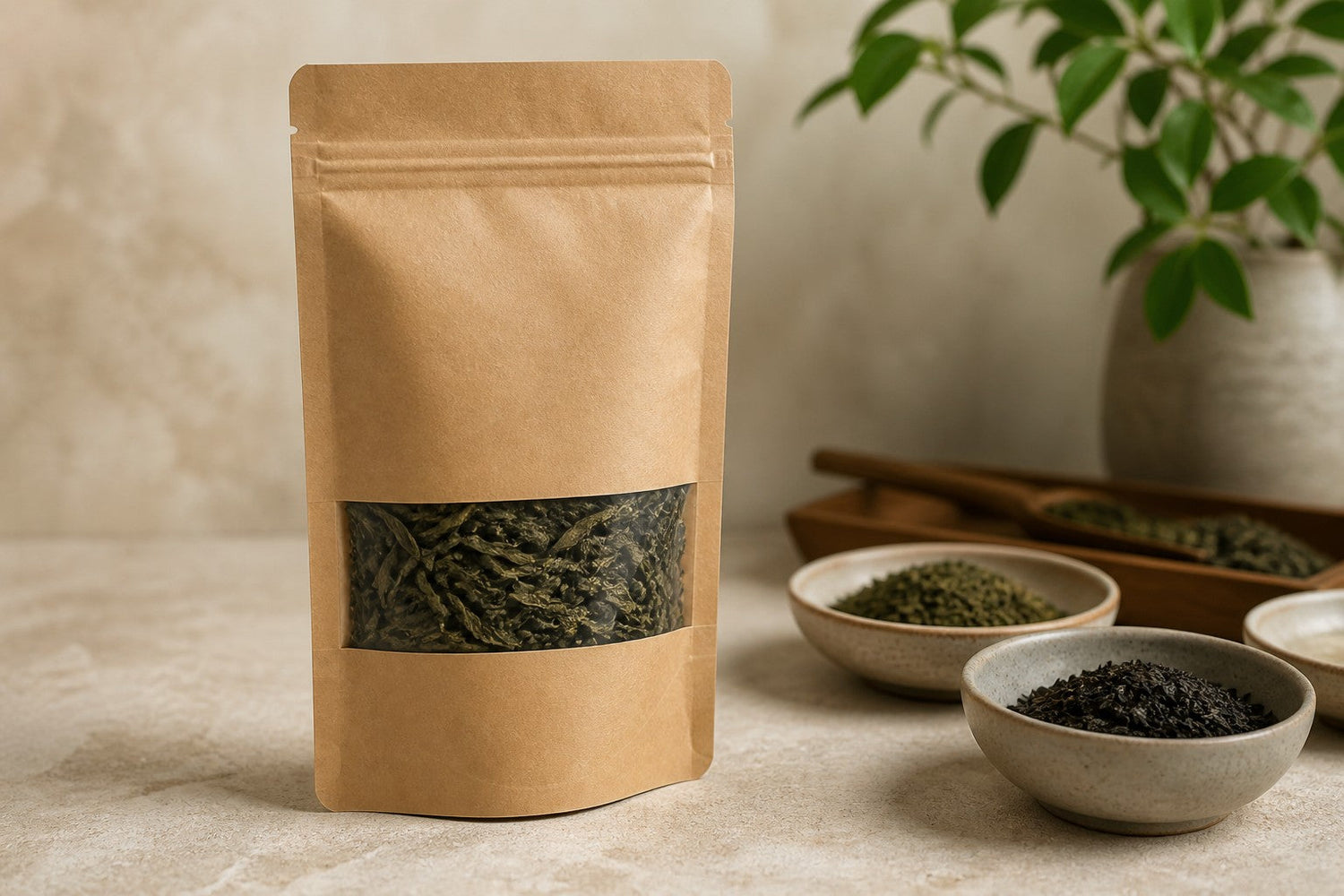
Kraft window tea pouch packaging can be attractive because it lets a customer see the product. That does not make visibility the whole packaging decision. The right starting format depends on the blend, fill volume, light exposure, aroma and moisture goals, reclosure behavior, and the way the pouch will be displayed or shipped.
This guide is for tea brands deciding whether a window stand-up pouch belongs in the brief, or whether an opaque or flat format should be tested first. It turns a visual preference into a supplier-ready decision.

1. Treat the window as one requirement, not the specification
A clear window answers one merchandising question: can the buyer see the product? It does not answer how much light the blend can tolerate, what moisture target the package must support, whether the pouch will be opened repeatedly, or whether the chosen format fits the filling process.
Current commercial tea-packaging pages from ePac show a range of tea formats and options, including resealable closures, windows, stand-up pouches, rollstock, and lay-flat formats. A current CarePac window stand-up pouch example also shows that a window can be part of a retail-ready pouch direction. Those pages confirm that the format exists; they do not decide whether it is right for your blend.
For general window-pouch display background, see Anacotte’s window pouch display guide. The narrower question here is tea-specific: what should change in your brief when the window is part of the product and material decision?
2. Compare the three starting directions
| Starting direction | Useful when | Questions to validate |
|---|---|---|
| Kraft-look stand-up with window | Retail display, product inspection, visual differentiation, and multi-use reclosure are important | Window area, light exposure, zipper use, fill density, seal, storage, and actual blend stability |
| Opaque stand-up pouch | Protection or controlled exposure is the leading concern while keeping a retail stand-up format | Barrier structure, artwork, reclosure, display expectation, and whether the customer needs to see the leaves |
| Flat pouch | Single-serve, sample, compact shipping, or a slim SKU is the leading use case | Fill volume, headspace, opening, seal, tear feature, and whether reclosure is needed |
The active Anacotte kraft clear-window stand-up reference is a useful geometry and procurement starting point. The active custom tea flat pouch is a comparison branch for samples and compact formats. Neither reference should be read as a universal material or freshness recommendation.

3. Ask whether the blend benefits from visible merchandising
A window earns its place when seeing the product helps the customer understand or choose the SKU. That might be useful for a visibly distinctive whole-leaf blend, a botanical mix with recognizable pieces, a premium retail shelf, or a brand whose product inspection is part of the buying experience.
But “looks natural” and “shows the leaves” are not complete packaging requirements. The brief should still define:
- Blend structure: whole leaves, broken leaf, flowers, fruit pieces, stems, or fine particles.
- Fill behavior: bulk density, target net weight, headspace, dust, settling, and how the blend presents after filling.
- Use pattern: single serve, occasional opening, or repeated scoop-and-reclose use.
- Display route: shelf, ecommerce parcel, subscription mailer, market stall, or another channel.
- Exposure concern: light, moisture, oxygen, aroma transfer, and the storage conditions the brand actually expects.
The pouch window should be designed around those answers. A large window may help display, while a smaller controlled window may preserve more opaque surface for artwork or reduce the exposed viewing area. That is a design and validation question, not a universal rule.
4. Use research to define tests, not to pick a universal winner
Tea-packaging research is useful because it makes material and light exposure questions visible. A PubMed-indexed study compared several packaging materials for tea-related phytochemical stability, and a more recent study of transparent tea packaging discusses the tension between product visibility and light-related considerations. These are research examples, not a ranking that can be applied to every blend, window, laminate, or storage route.
Use the evidence to ask better project questions:
- Does this blend have a light-sensitive quality or appearance target?
- What storage and display exposure should the sample represent?
- Is the window construction part of the barrier design, and is the actual laminate documented?
- Should the first comparison include a window stand-up pouch, an opaque stand-up pouch, and a flat opaque sample?
- What sensory, moisture, aroma, or visual checks will be recorded over the intended storage period?

5. Confirm the zipper and fill operation before you approve the look
A tea pouch is handled more than once. The zipper, opening, fill area, and top seal should be assessed with the actual blend, not an empty display sample.
- Opening: can the filling team load the blend without excessive dust or product in the seal zone?
- Closure: does the zipper align and close across the actual pouch width after filling?
- Reclosure: can the intended customer close the pouch without folding leaves into the track?
- Stand-up behavior: does the bottom gusset hold the pouch upright at the target fill and after partial use?
- Artwork area: is enough opaque surface left for the brand, product information, coding, and SKU differences?
- Shipping: does the format arrive without crushing the gusset, stressing the zipper, or obscuring the window?
Anacotte’s existing loose-leaf tea pouch test brief is a useful next read for fill-volume and reseal questions. This article adds the earlier buying decision: whether the window belongs in the first sample set at all.
6. Know when opaque or flat is the better starting hypothesis
Start with an opaque or flat comparison when protection, compactness, or a single-serve workflow matters more than product visibility. That does not mean opaque packaging is always better. It means the first test should reflect the risk you are trying to control.
- An opaque format may be the better comparison for a blend where light exposure is a serious project concern.
- A flat pouch may make more sense for samples, single servings, or compact ecommerce inserts.
- A stand-up window pouch may be the better comparison when shelf presentation and repeated opening are central to the SKU.
The right answer can also vary by SKU family. A tea brand may use a window stand-up pouch for a visible flagship blend and a compact opaque flat pouch for a sample or light-sensitive seasonal release. The decision should follow the product and channel, not a blanket material preference.

7. Send a tea-specific supplier brief
When requesting a sample or quote, include these fields:
- Blend description and a real sample of the leaves or inclusions.
- Target net weight, expected bulk density, and the desired fill tolerance.
- Window decision: required, optional, preferred area, or comparison test.
- Material and barrier questions: light, moisture, oxygen, aroma, and storage assumptions.
- Format: stand-up zipper pouch, flat pouch, or both for comparison.
- Fill method: hand fill, auger, volumetric, or co-packer equipment if known.
- Opening and closure requirements: zipper, tear feature, hang hole, or other use detail.
- Display route: retail shelf, ecommerce, subscription, wholesale, or mixed channel.
- Artwork: opaque print area, window position, coding zone, SKU count, and proof needs.
- Sample checks: fill appearance, zipper use, standing, seal inspection, parcel handling, and storage/light questions.
Do not ask a supplier to confirm “freshness” from a visual reference alone. Ask for the structure, the test plan, and the documentation needed to evaluate the actual blend.
Final takeaway
A kraft window tea pouch can be a strong retail direction when product visibility, stand-up display, and repeated opening are important. It should be tested against the tea blend’s fill behavior and storage needs, with an opaque or flat alternative included whenever light exposure, compactness, or single-serve use changes the decision.
When you are ready, request a project-specific tea packaging quote from Anacotte with the actual blend, target fill, window area, format alternatives, storage assumptions, closure requirements, artwork, and sample questions.
Sources and boundaries
- ePac Custom Tea Packaging
- CarePac Matte Black Stand Up Pouch With Window
- CarePac Zipper Pouch
- Packaging materials and tea phytochemical stability, PubMed
- Transparent Packaging for Tea, Foods
These sources provide current market examples and research context. They do not establish a universal freshness result, sustainability claim, compliance outcome, or material recommendation for every tea blend.

Dejar un comentario
Este sitio está protegido por hCaptcha y se aplican la Política de privacidad de hCaptcha y los Términos del servicio.