
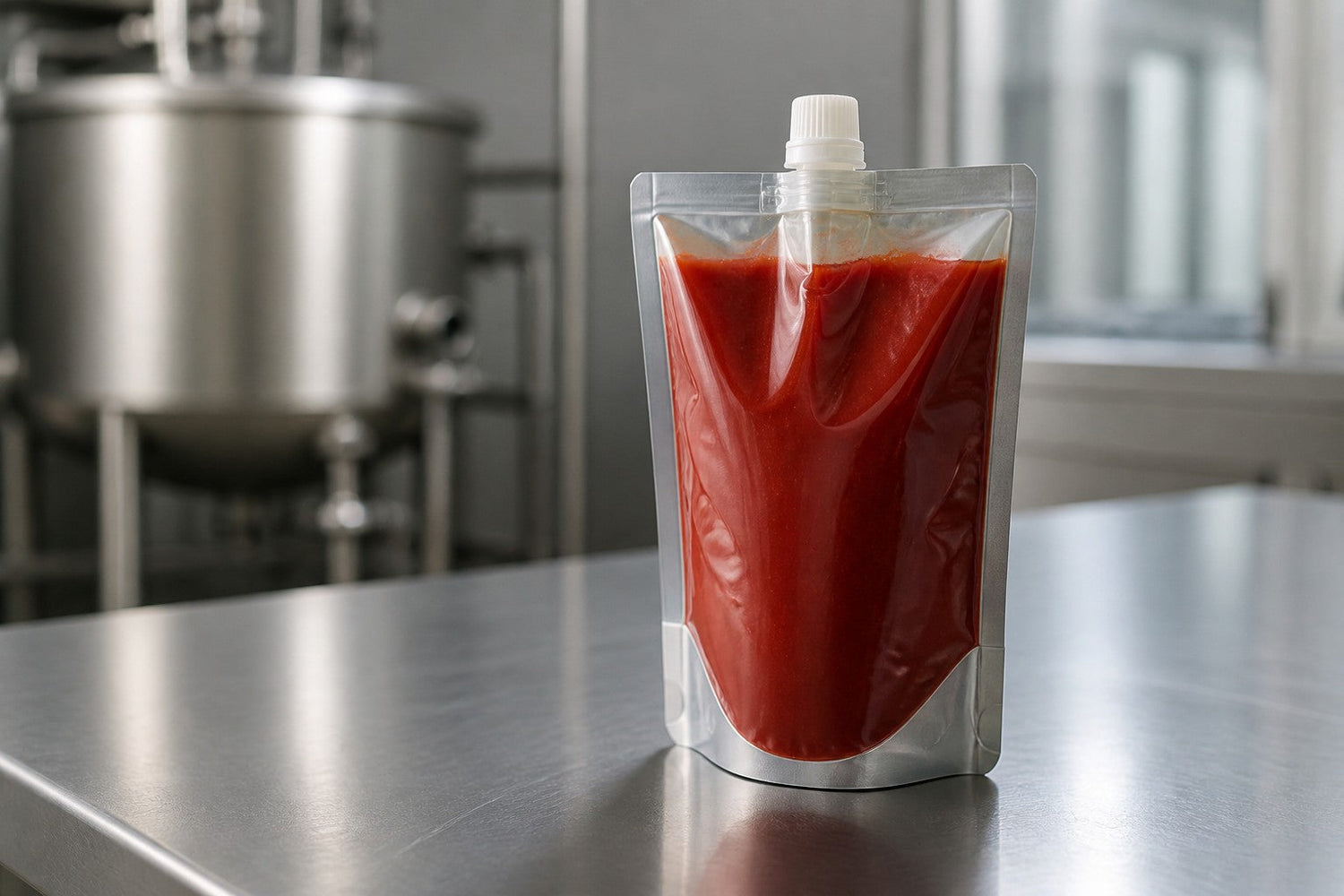
Hot-fill pouch packaging is not a pouch-size decision first. It is a process, product, fitment, and distribution decision that a supplier needs to understand before a useful quote can be prepared. If your brief only says “hot fill” and a target volume, you may still be leaving out the information that determines the pouch structure, spout, seals, fill method, and testing plan.
This guide is a pre-quote handoff for liquid-food brands and co-packers. It focuses on the questions to answer, the details to label as unknown, and the boundaries that should stay with your process authority or technical team.

1. Name the process route before you name the pouch
“Hot fill,” “hot fill and hold,” “retort,” “pasteurization,” and “refrigerated fill” are not interchangeable labels. They describe different process questions, and the pouch manufacturer needs the actual route rather than a general heat-resistance request.
The U.S. Food and Drug Administration’s acidified-food materials distinguish process and filing questions for commercial processors. The FDA process-filing form also uses a Hot Fill and Hold process mode for product that is thermally processed outside the container and then filled hot. That terminology is useful for a supplier handoff, but it is not a universal temperature specification or a substitute for a scheduled process.
If your product may be an acidified or low-acid shelf-stable food, confirm the applicable responsibilities with your process authority and regulatory team. A pouch shape alone does not establish shelf stability, safety, or approval.
If you need broad background, start with Anacotte’s retort pouch guide. This article covers the narrower next step: what to send before asking for a quote.
2. Put the product facts at the top of the brief
A supplier can make a better first recommendation when the pouch is matched to the product state and the way it will be filled. Send the information you know, and label the rest as pending rather than filling gaps with assumptions.
- Product state: sauce, broth, soup, puree, beverage base, concentrate, or another liquid or semi-liquid.
- Formula context: pH and water activity if available, suspended solids, viscosity, particulates, oil content, and any ingredients that may challenge seals or barrier layers.
- Target fill: a nominal volume and the actual fill tolerance. The Anacotte reference product is titled 300ml / 10 fl oz, but that is a reference format, not a recommendation for every recipe.
- Headspace and fill behavior: expected headspace, foaming, splashing, stringing, and whether the pouch is filled through the fitment or through an open top before sealing.
- Process information: process mode, actual fill-temperature range, hold time or thermal profile when known, and whether the pouch will be exposed to pressure or another post-fill step.
A useful rule is simple: if the co-packer or process authority has not confirmed a value, write “to be confirmed.” That is more helpful than turning a supplier’s general product description into an unsupported claim about your formula.

3. Match pouch geometry to how the customer will use it
For a liquid product that will be poured and closed again, a stand-up spout pouch is a logical format to evaluate. Anacotte’s retort and hot-fill spout pouch is the primary live reference for this article. Its geometry gives the discussion a starting point: a flexible stand-up body, a capped spout, and a bottom gusset.
That starting point still needs to be checked against the use pattern:
- Pour-and-reclose: ask whether a spout and cap support the intended pour rate, hand feel, cap handling, and number of openings.
- Single-serve: a flat sachet or another portion format may be a better branch than a multi-use spout pouch.
- Line filling: confirm whether the co-packer fills through the fitment, uses an open-mouth fill, or needs a different pouch opening and seal layout.
- Fitment: specify spout diameter, cap style, fitment material, cap torque, tamper-evidence direction, and compatibility with the filling and capping equipment.
- Seal zones: ask where product contamination is most likely and which top, side, bottom, and fitment seals must be inspected after filling and processing.
For a sauce or broth application, the retort spout pouch for sauces and broth is a useful adjacent product reference. Use it to discuss application questions, not to promise that a particular recipe, temperature, or shelf-life target is already validated.

4. Separate packaging requirements from process validation
A hot-fill quote should connect packaging requirements to the process without pretending the package can answer every food-safety question. The supplier can discuss film structures, fitment options, seals, and sample testing. Your process authority or technical team must confirm whether the complete product-and-process system meets the intended route.
| Quote input | What to provide | What remains project-specific |
|---|---|---|
| Thermal route | Hot fill and hold, retort, refrigerated fill, or another named route | Actual process authority, scheduled process, and validation |
| Product | State, target fill, pH/aw if available, solids, viscosity, and formula constraints | Final compatibility and shelf-life evidence |
| Fitment | Spout, cap, opening, cap handling, and filling-line interface | Torque, leak performance, and line approval |
| Distribution | Ambient or refrigerated route, shipping, storage, and expected handling | Final barrier, seal, and distribution test plan |
| Artwork | Label panel, print direction, coding area, and SKU count | Final regulatory and artwork approval |
This distinction matters because commercial supplier pages may show that hot-fill or retort formats exist, but they do not establish the correct structure for your formula. Current examples from TOPPAN and ProAmpac are useful market references. Treat them as examples of available application directions, not as a specification for your project.
5. Plan the sample around the failure modes you care about
Before a production order, define what a pilot sample must answer. A good sample is not just a smaller version of the final pouch; it is a way to expose the unknowns that could change the quote.
- Does the real product fill cleanly without contaminating the critical seal or fitment area?
- Does the filled pouch stand, pour, and reclose in the intended customer use pattern?
- Does the pouch remain visually and mechanically coherent after the planned process step?
- Can the co-packer run the pouch at the intended fill rate, equipment interface, and cap-handling sequence?
- What seal, leak, compression, transport, or storage checks are needed before a shelf-life or distribution decision?
Do not write “passed” until the relevant test has actually been run and recorded. The image below represents a neutral pilot-review workflow, not a test result.

6. Use this short handoff when requesting a quote
Copy the following fields into your supplier email or intake form:
- Product name and state: liquid, puree, sauce, broth, or other.
- Target fill and tolerance: nominal volume plus the actual fill range.
- Process route: named hot-fill, hot-fill-and-hold, retort, refrigerated, or another route.
- Formula information: pH, water activity, viscosity, solids, oil, particulates, and any known compatibility concerns.
- Fill method: co-packer, equipment type, fitment fill or open-mouth fill, and expected line speed if known.
- Format: stand-up spout pouch, portion pouch, or a format still under evaluation.
- Fitment: spout, cap, tamper-evidence direction, torque, and customer pour/reclose behavior.
- Distribution: ambient or refrigerated, ecommerce or retail, shipping route, and storage assumptions.
- Artwork: dimensions, coding area, label/print direction, SKU count, and proof requirements.
- Testing questions: fill trial, seal inspection, leak check, thermal exposure, compression, and transport checks.
Then separate the confirmed facts from the open questions. That makes the first quote more useful and gives the supplier a clear list of what must be resolved in sampling.
Final takeaway
The best hot-fill pouch brief starts with the product and process, then selects geometry and fitment around the real use pattern. A stand-up spout pouch may be a strong direction for a pour-and-reclose liquid product, but the final film, fitment, seals, thermal route, and distribution plan remain project-specific.
When you are ready, request a project-specific quote from Anacotte with the product state, target fill, process mode, fill method, fitment, distribution assumptions, artwork, and test questions. If some values are still unknown, list them as unknowns so the sample can answer the right questions.
Sources and boundaries
- FDA Acidified & Low-Acid Canned Foods Guidance Documents
- FDA Food Process Filing for Acidified Method
- TOPPAN Retort and Hot Fill Pouches
- ProAmpac Flexi-Free Cook/Chill Bags
These sources provide regulatory context and current market examples. They do not approve a formula, guarantee shelf life, or replace project-specific packaging and process validation.

Dejar un comentario
Este sitio está protegido por hCaptcha y se aplican la Política de privacidad de hCaptcha y los Términos del servicio.