
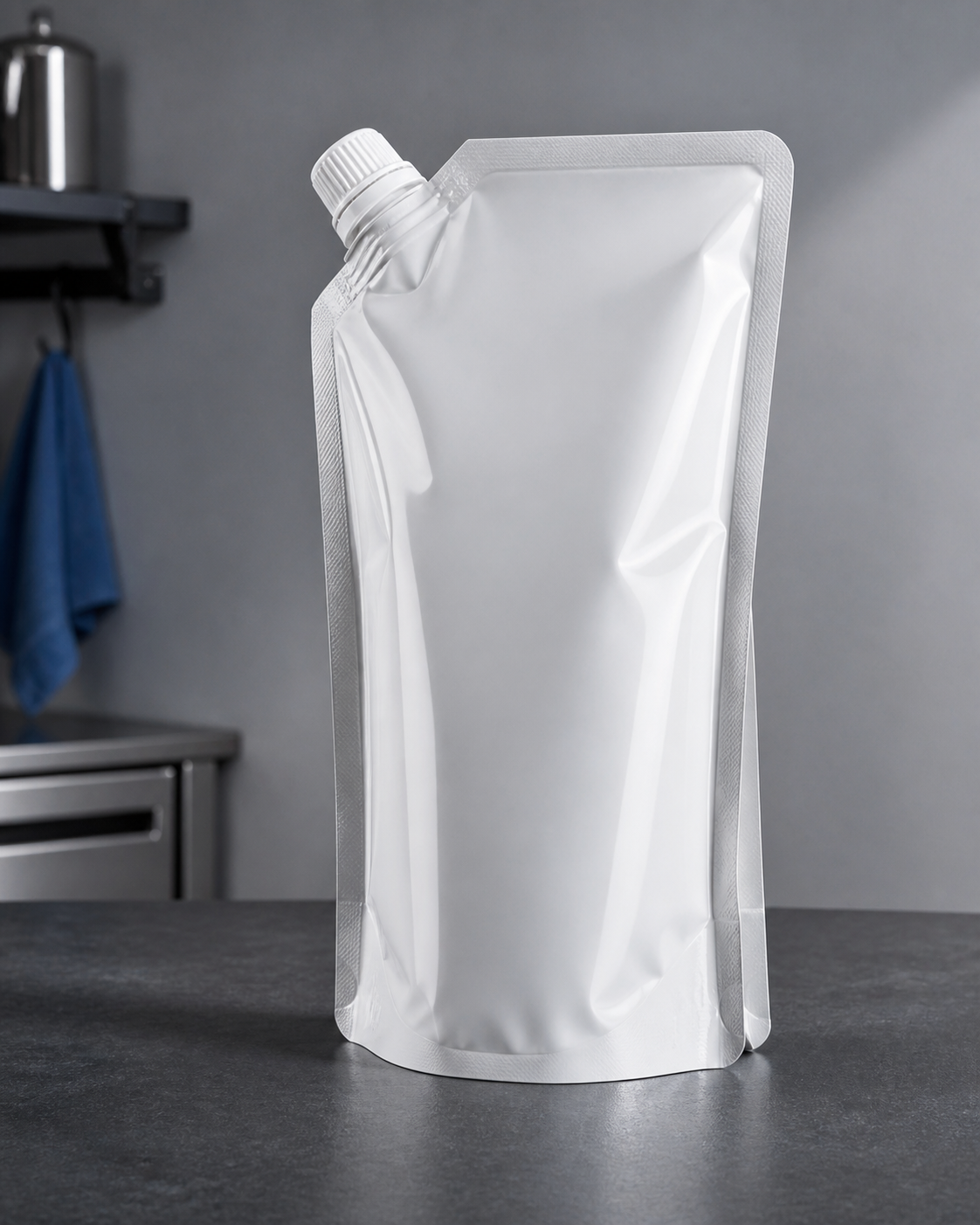
A cleaning-liquid pouch quote is only useful when every supplier is pricing the same job. “Three-liter detergent spout pouch” is a starting description, not a complete packaging brief. The formula, fill routine, fitment, material assumptions, artwork scope, sample plan, quantity, and delivery basis can all change the quote and the technical questions that sit behind it.
Quick answer: Before asking for a price, send the product and use conditions, target fill and headspace, pouch geometry, spout and cap requirements, proposed material questions, artwork and SKU scope, sample/test expectations, quantity per artwork, case-pack needs, and destination. Ask the supplier to state assumptions, exclusions, and evidence still required. A spout pouch may be a reasonable starting route for a controlled refill or pour, but the final structure must be confirmed with the real formula, filling method, and distribution plan.

| Quote field | What to provide | Why it changes the discussion |
|---|---|---|
| Product and use | Cleaner type, formula notes, intended user, refill or single-use routine | Frames compatibility, closure, labeling, and handling questions |
| Fill and geometry | Weight/volume, tolerance, headspace, target dimensions, gusset, spout, cap | Creates a comparable physical package scope |
| Material | Current structure, candidate alternatives, finish, barrier or seal questions | Prevents a material name from hiding a technical assumption |
| Artwork and quantity | Panels, codes, artwork count, print route, units per design, case pack | Separates print/setup and inventory exposure |
| Samples and route | Blank/printed/filled samples, tests, destination, storage and shipping assumptions | Defines what the supplier is actually being asked to prove |
1. Start with the cleaning product and its routine
Cleaning liquids are not one packaging category. Laundry detergent, dish soap, fabric softener, window cleaner, floor cleaner, and concentrated formulas can differ in viscosity, fragrance, solvent or surfactant profile, fill temperature, and expected storage. The buyer does not need every laboratory result before requesting a conversation, but the brief should distinguish what is known from what still needs review.
Record the product name or working description, whether it is a concentrate or ready-to-use liquid, the available pH or viscosity range, fragrance or solvent notes if relevant, fill temperature, target storage duration, and any known compatibility concern. If a value is not available, write not supplied rather than allowing a supplier to assume a standard formula.
Then describe the user routine. Is the pouch a single-use dose, a refill poured into another container, a retail pack used over several openings, or a larger back-of-house format? The routine affects reclosure, spout position, orifice size, grip, label space, and secondary containment. It also determines whether a flat sachet, a stand-up spout pouch, or a larger side-gusset route deserves a sample.
2. Make fill and headspace measurable
“One liter” or “three liters” does not define the finished package. Ask for target fill by weight or volume, tolerance, expected headspace, orientation during storage, and the desired filled dimensions. Include the shape of the fill when the product is viscous, foamy, or sensitive to air. The filler should confirm how the requested volume behaves on the intended equipment.
For a multi-use liquid refill, a stand-up pouch with a bottom gusset and a spout can be a useful candidate because it connects filled stance with a controlled opening. That is a format hypothesis, not a universal recommendation. A true single-use portion may need a flat three-side-seal sachet; a bulk or refill-station program may need a larger bag, stronger handling features, or a different dispensing route. For the broader product-form comparison, see Anacotte’s laundry detergent pouch format guide; this article narrows the question to what a supplier needs in the quote brief.

| Use pattern | Candidate route to discuss | Questions to carry into the sample |
|---|---|---|
| Single-use dose or trial | Flat sachet or small flat pouch | Tear direction, complete emptying, dose tolerance, and secondary pack |
| Retail refill used across several pours | Stand-up pouch with spout and reclosure | Pour angle, residue, cap handling, filled stance, and panel stress |
| Large household or back-of-house refill | Larger spout or side-gusset candidate | Grip, handle, case pack, lifting, dispensing, and parcel/secondary containment |
3. Turn “spout pouch” into a fitment request
A spout is not one specification. Put the intended spout location, orifice or fitment preference, cap or closure direction, tamper-evidence question, target bottle neck if the liquid is poured into another container, and any handle requirement in the brief. Ask the supplier to show a drawing or sample that identifies the fitment zone and the seal around it.
Ask how the proposed fitment will be evaluated with the actual product. A cap that is easy to open on a dry sample may behave differently with a wet hand, a viscous liquid, residue around the opening, or repeated use. Record the first-open, pour, recap, storage, and final-use sequence. Do not approve a fitment from a product name or an empty pouch photo.
For household chemicals, route any child-safety, warning, tamper-evidence, or market-specific labeling question to the responsible product and regulatory owners. A generic pouch or cap image does not establish a child-resistant result or legal compliance.

4. Ask the supplier to show material assumptions
Do not write only “strong material” or “chemical-resistant film.” Ask the supplier to identify the proposed structure, inner sealant, finish, barrier or opacity direction, and any conditions that could change the recommendation. The buyer should provide the product and exposure information; the supplier should state what the proposed structure is intended to address and what must be tested.
For a cleaner or detergent, useful questions can include: Does the proposal assume a particular pH, surfactant, fragrance, solvent, viscosity, fill temperature, storage period, or transport route? Which observations will be made on filled samples? What would trigger a different structure or fitment? Who owns the compatibility method, acceptance criteria, and record?
Current supplier pages show that the market offers multiple cleaning-liquid routes and asks buyers to discuss size, material, spout/cap, printing, quantity, samples, and destination. Baolai’s current detergent spout-pouch page and EHAI’s current detergent-pouch page are useful examples of supplier-facing fields, but their material, price, MOQ, certification, delivery, and performance statements remain supplier-specific. They are not Anacotte specifications and do not replace a project test.
5. Separate artwork, SKU, and quantity
Packaging quotes often become incomparable because artwork and quantity are compressed into one total. State the number of designs, the quantity per design, whether the same structure and dimensions apply to each SKU, the print route under consideration, front/back or multi-panel requirements, clear windows or special finishes, and the location of lot/date/barcode codes.
Ask for the quote to separate sample work, setup or plate/cylinder assumptions if relevant, printed units, packaging for shipment, and delivery basis. Do not copy a supplier’s listed MOQ or price into the article as a market rule. A supplier page can show that a quote field exists; it cannot establish what an Anacotte project will cost or what order size is appropriate.
If the artwork is still changing, say so. A low-quantity test can reduce printed-inventory exposure, but it does not make an untested formula, fitment, seal, or shipping route safe. Keep the artwork revision, owner, approved copy, and open technical questions in the same project record.
6. Define the sample and test scope before comparing price
Ask suppliers to identify whether they are offering blank samples, printed mockups, filled prototypes, or production-like samples. Each stage answers a different question:
- Blank sample: size, opening, gusset, fitment placement, and pack-out discussion.
- Printed mockup: artwork scale, panel hierarchy, code zones, and finish direction.
- Filled prototype: pouch shape, pour routine, residue, recap, seal appearance, and handling observations.
- Production-like trial: line, filling, sealing, inspection, and route-specific learning under defined conditions.
For the filled sample, define what will be observed and what will not be inferred. The plan may include seal contamination, fitment weld, cap handling, fill tolerance, panel change, odor or appearance change, storage orientation, parcel compression, and secondary containment. Compatibility, stability, child safety, regulatory status, and shelf life require the evidence and qualified review applicable to the product and market.
The existing laundry detergent refill pouch test plan is a useful next read when the quote has been narrowed and a filled-pack test needs to be designed. It covers a deeper testing question; it does not replace the pre-quote scope in this article.
7. Normalize the quote line by line
When responses arrive, put them into one comparison table. If a supplier leaves a field blank, mark it as unknown instead of assuming the cheapest or fastest interpretation.
| Comparison line | Supplier A | Supplier B | Buyer follow-up |
|---|---|---|---|
| Filled geometry and dimensions | State exact proposal | State exact proposal | Request drawing and filled sample |
| Spout, cap, and weld | Fitment, orifice, cap, assumptions | Fitment, orifice, cap, assumptions | Confirm with product and pour routine |
| Material structure | Candidate layers and unknowns | Candidate layers and unknowns | Ask for product-specific review and tests |
| Print and SKU scope | Artwork count, print/setup, units | Artwork count, print/setup, units | Normalize quantity per design |
| Samples and testing | Sample type, quantity, included work | Sample type, quantity, included work | Write pass criteria and owner |
| Delivery and exclusions | Destination, case pack, basis, exclusions | Destination, case pack, basis, exclusions | Compare like with like |
8. Send a controlled supplier handoff
A good first message can be short if it is structured. Include:
- Product and use: liquid type, concentrate/ready-to-use status, known formula notes, refill or single-use routine.
- Fill: target weight/volume, tolerance, headspace, fill temperature, and filled-pack dimensions if available.
- Package: pouch route, bottom/gusset preference, spout location, fitment/cap, reclosure, handle, and tamper-evidence questions.
- Material: current structure if any, proposed alternatives, finish, barrier, seal, and compatibility questions.
- Artwork and order: SKU count, print files, code zones, quantity per design, sample quantity, case pack, destination, and target date.
- Evidence request: sample type, included tests, assumptions, exclusions, open decisions, and the owner for final approval.
Anacotte’s current heavy-duty laundry-detergent spout pouch and laundry-detergent packaging collection can serve as application and geometry references. They do not decide the right formula, material, fitment, or test plan for a new project.

Frequently Asked Questions
What information does a detergent pouch supplier need for a quote?
Start with product and use, target fill and headspace, pouch geometry, spout/cap, material questions, artwork and SKU scope, sample/test expectations, quantity per design, case pack, destination, and target timing. Mark unknown fields explicitly so the supplier can state an assumption instead of silently filling the gap.
Is a spout pouch always the best cleaning-liquid format?
No. It is a candidate when the routine needs controlled pouring or refilling. A flat sachet, a larger side-gusset route, or another dispensing system may fit a different dose, channel, fill method, or handling requirement. Compare a filled sample against the real routine.
Can the supplier choose the material?
A supplier can propose a candidate structure, but the proposal needs the product and exposure conditions behind it. Ask what the proposal assumes, what documents are available, what samples will be tested, and what results would cause a different structure. Do not treat a material name as proof of chemical compatibility or shelf life.
Does a low-MOQ sample prove leak performance?
No. A small run can reduce printed-inventory exposure, but it does not replace formula compatibility, seal, fitment, stability, parcel, or safety work. Define the sample type, test conditions, acceptance criteria, and owner before using a result to approve the package.
How should cleaning-liquid pouch quotes be compared?
Normalize the filled geometry, spout and cap, material assumptions, artwork and SKU scope, sample/test scope, quantity, case pack, delivery basis, exclusions, and unresolved technical work. Only then compare the commercial number.
Next step
If the package is ready for a supplier conversation, request a project-specific quote with the formula/use description, target fill, pouch route, fitment, artwork, quantity, sample questions, and destination. Keep the final material, compatibility, performance, safety, and regulatory decisions with the responsible project owners and qualified reviewers.

Hinterlasse einen Kommentar
Diese Website ist durch hCaptcha geschützt und es gelten die allgemeinen Geschäftsbedingungen und Datenschutzbestimmungen von hCaptcha.