
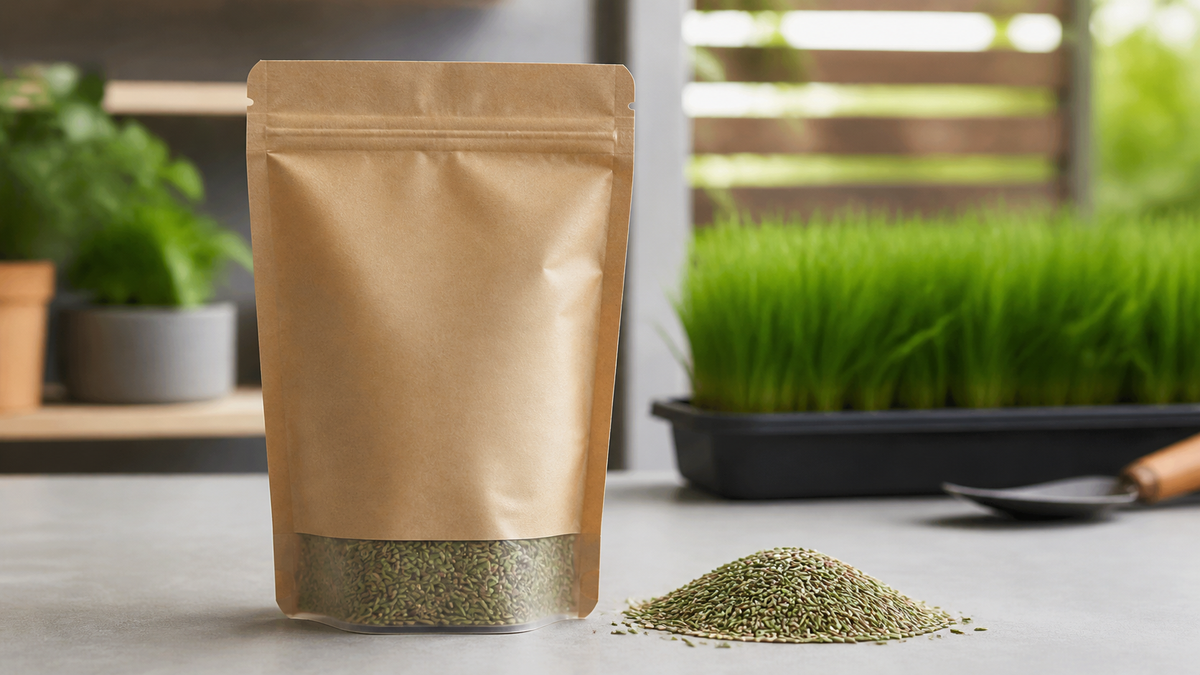
Grass seed bag packaging should be sized from the fill and handling route outward. A small retail bag, a resealable lawn-repair pouch, and a larger bulk pack may carry different weights, occupy different volumes, and move through different storage and case-pack routines. Choose the bag role first, then confirm dimensions, closure, label zones, and material through filled samples.

Separate the retail route from the bulk route
Retail and bulk are not just two artwork sizes. They can place different demands on the package. A retail pouch may need a shelf-facing panel, an easy opening, a resealable closure, and a manageable carry size. A larger-fill pack may need more stable bottom geometry, stronger handling assumptions, a different case pack, and a secondary route that keeps the bag from being dragged or crushed.
| Project input | Retail lawn-seed route | Bulk or larger-fill route |
|---|---|---|
| Fill decision | Set the target weight, settled volume, and shelf-facing dimensions from the real seed mix. | Set weight, density, headspace, lifting, and case or pallet assumptions together. |
| Opening routine | Tear-and-pour or zipper reclosure depending on whether the buyer applies the seed in stages. | Prioritize controlled handling, pour access, closure behavior, and a clear way to move the filled bag. |
| Panel need | Balance product identity, planting information, mix details, codes, and shelf hierarchy. | Reserve space for the same approved data while allowing for a larger or more irregular filled shape. |
| Secondary pack | Retail carton, case, display, or parcel protection may affect the final pouch size. | Case, pallet, warehouse, and transport handling should be included in the sample plan. |
Current supplier pages illustrate why the route matters. Smith Packaging shows lawn-grass-seed polyethylene bag examples at 1, 3, 5, and 10 lb, while Smith Seed Services shows separate poly and polywoven grass-seed routes for smaller and larger fills. These are supplier-specific market examples, not a universal size or material schedule.

Size the bag with the actual seed
Net weight alone does not tell you how a seed mix will sit in the bag. Record the species or mixture, density, coating or treatment status, particle shape, target weight, acceptable tolerance, settling, and headspace. Fill representative samples and inspect them in the intended standing, laying, and case-packed orientations.
For a resealable stand-up pouch, review how the bottom gusset opens, whether the filled bag stays stable, how close the product sits to the zipper, and how much panel area remains usable. For a larger-fill route, review lifting and stacking assumptions as well as the outer case or pallet. Do not carry a retail pouch drawing into a bulk brief without testing the filled geometry.

Choose closure and seal questions around the use routine
A lawn-seed buyer may open the package once, apply part of the blend, and store the remainder. Another buyer may pour the full contents during one project. Those routines lead to different conversations about a tear notch, zipper, opening width, dust control, and reclosure.
Keep the closure discussion separate from the material discussion. Ask the supplier and packer how the seed is kept away from the seal, what the filling and sealing sequence will be, how the zipper or tear is inspected, and which filled-pack observations matter. The word “resealable” describes a feature direction; it does not prove that every seed mix will pour cleanly, remain dry, or store successfully.
Build the label handoff before the artwork
For seed shipped in interstate commerce, USDA Agricultural Marketing Service guidance explains that the Federal Seed Act is a truth-in-labeling law and identifies primary information such as purity, germination, noxious weed seed, treatment where applicable, kind or variety, and interstate shipper details. Read the USDA AMS Federal Seed Act overview with the seed business’s regulatory owner; this article is not legal advice and does not replace state or product-specific review.
The packaging brief should therefore contain a panel map before the designer approves the final file. Reserve zones for:
- Product identity, seed kind, mixture or variety language, and approved claims.
- Purity, germination, lot identification, treatment or caution information where applicable.
- Planting instructions, net quantity, shipper or business information, codes, and barcode areas owned by the seed business.
- Artwork revision, SKU name, pack size, and a formed-sample approval owner.

Test the filled bag and the route that carries it
- Prepare representative fills. Record seed lot or blend reference, target weight, settled volume, headspace, and fill date.
- Review the formed pouch. Check stance, folds, zipper or tear direction, seal cleanliness, panel legibility, and code placement.
- Repeat the planned handling. Pour, partially empty, close, lift, stack, case-pack, and store samples according to the real routine.
- Inspect the secondary pack. Check movement, compression, scuffing, abrasion, and whether the pouch arrives in the orientation assumed by the brief.
- Record project evidence. Keep the structure, settings, sample count, seed identity, conditions, and acceptance criteria together. If the mix, fill weight, closure, or route changes, decide whether the result still applies.

When the Anacotte lawn-seed reference is useful
Anacotte’s custom lawn seed bag is a useful geometry and application reference for a project comparing a resealable stand-up route. The related bulk seed packaging bag can help frame a larger-fill conversation. Treat both pages as starting points, not proof that one structure covers every seed product or weight.
For adjacent context, review the existing seed-packet label and multi-SKU proof guide, the lawn-and-garden packaging overview, and the fertilizer state-to-format guide. This grass-seed article stays focused on fill weight, handling, label ownership, and the retail-to-bulk handoff.
What to send with a grass seed bag quote request
- Seed kind or mixture, density, coating or treatment status, target fill weights, and acceptable tolerances.
- Retail or bulk route, expected opening and reclosure routine, and how the customer will pour or carry the bag.
- Preferred pouch geometry, dimensions, gusset, closure, tear direction, finish, and case-pack assumptions.
- Approved label data, code and barcode zones, panel map, SKU list, artwork revision, and responsible approvers.
- Warehouse, pallet, parcel, and outdoor-exposure assumptions that the project team wants to screen.
- Requested filled-pack checks for settled volume, seal cleanliness, closure function, code readability, deformation, and secondary-pack fit.
FAQ: grass seed bag packaging
Can one grass seed bag size cover retail and bulk fills?
Do not assume it. Compare the actual fill weights, settled volumes, handling, closure, panel, and secondary pack. A retail sample can inform the direction, but a bulk route needs its own filled review.
Does a resealable pouch prove moisture protection?
No. Closure, film, seal, seed condition, storage, and handling all need project-specific review. “Resealable” is not a universal storage or performance claim.
Who owns the label requirements?
The seed business and its qualified regulatory owner must approve the exact copy for the intended market and shipment. The packaging team should preserve usable panel and code zones.
What should I do next?
Send your seed type, target fill weights, label data, SKU list, handling route, and artwork status to Anacotte Packaging to start a project-specific pouch conversation.

Deixar comentário
Este site é protegido por hCaptcha e a Política de privacidade e os Termos de serviço do hCaptcha se aplicam.