
Match the packaging format to product risk, filling method, and shelf channel.
Pouch packaging guide
How to Size a Flexible Pouch by Product Density and Filled Volume
How to Size a Flexible Pouch by Product Density and Filled Volume helps buyers compare packaging options, material trade-offs, MOQ paths, and quote inputs before choosing a pouch, film, or custom structure.
Need pricing for this exact packaging decision?
Share product type, fill weight, target quantity, material or barrier needs, artwork status, and launch timing. Anacotte can shortlist the practical structure before you over-spec the order.
Start an RFQCompare material, barrier, print, closure, and sustainability trade-offs before locking a spec.
Send product details, size target, quantity, and timing for a tighter quote.
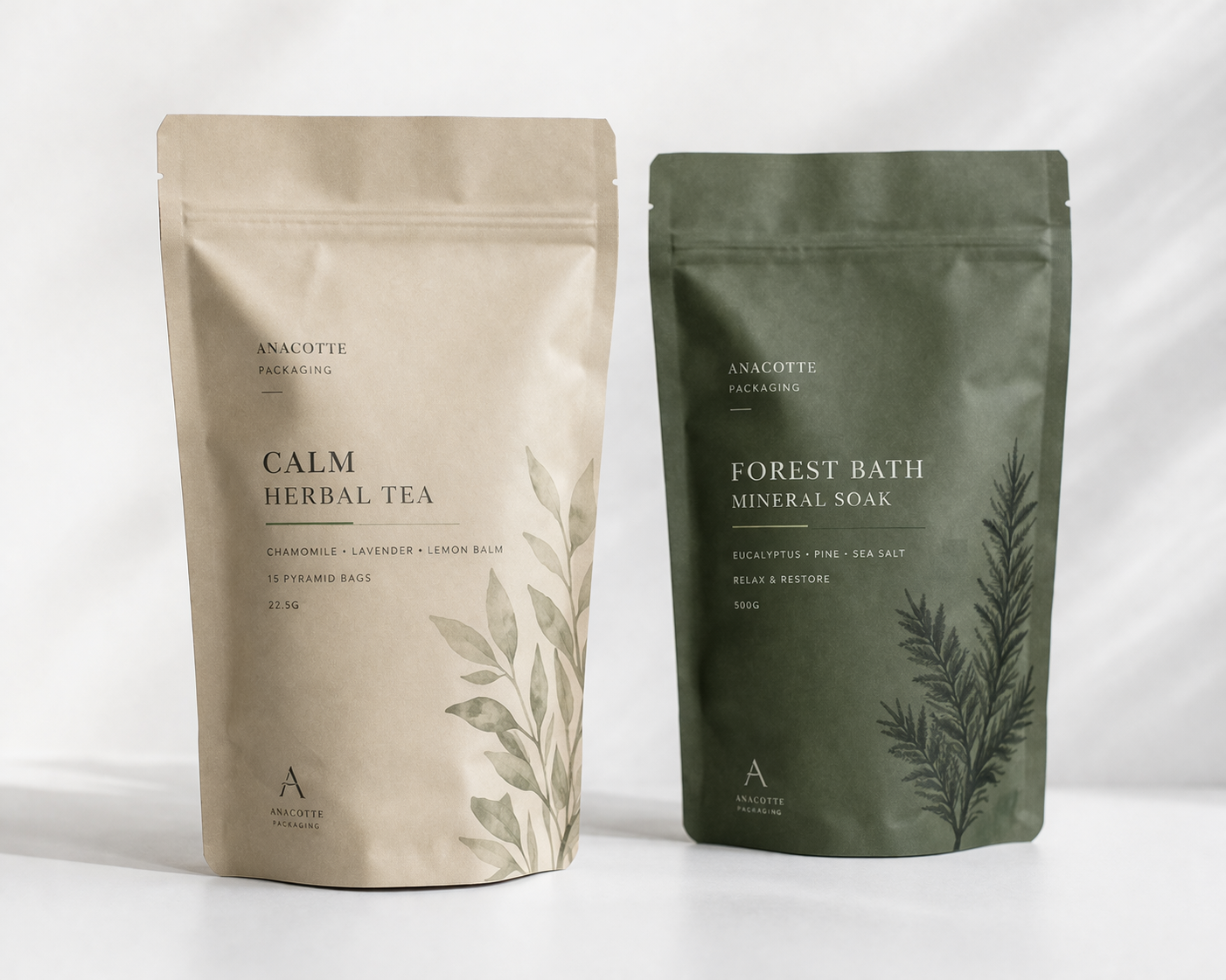
Direct answer: convert the target net weight into product volume using density, then choose a development pouch with enough usable internal volume for the product, headspace, sealing, fitment displacement, aeration, and handling. Do not select final pouch dimensions from a volume calculation alone. A filled mock-up and production-intent filling trial are required because pouch shape, gusset opening, film stiffness, and the filling process determine usable capacity.
The basic density calculation
For a product with a known density:
Product volume = target net mass ÷ product density
If mass is in grams and density is in grams per milliliter, the result is milliliters. For powders, use the bulk density that represents the product at the filling condition—not the density of the raw ingredient or a heavily compacted laboratory sample.
Worked powder example
A protein powder has a target net weight of 500 g and a measured loose bulk density of 0.62 g/mL.
- Product volume = 500 ÷ 0.62 = approximately 806 mL
- If the initial development assumption is an 85% fill ratio, internal development volume = 806 ÷ 0.85 = approximately 948 mL
The 948 mL figure is only a starting point for sample selection. Powder aeration, settling, scoop inclusion, zipper clearance, top-seal clearance, and the desired shelf shape can all require more space. The final sample should be filled by the intended process and checked after settling.
Worked liquid example
If the brief specifies 750 mL, the product volume is already known. If it specifies a net mass of 750 g and the liquid density is 1.08 g/mL, the product volume is approximately 694 mL. A spout pouch still needs additional usable volume for fill control, air management, fitment displacement, thermal expansion where relevant, and consumer handling.
Capacity factors that calculations miss
| Factor | Why it changes usable pouch capacity | What to verify |
|---|---|---|
| Gusset geometry | A gusset must open and form consistently to create the expected base volume | Filled stability, bottom shape, conveyor handling |
| Seal and zipper clearances | The nominal panel area is not fully fillable | Fill line, top seal, zipper function, tear notch access |
| Fitment displacement | Spout and flange occupy internal space and affect product flow | Fill level, headspace, evacuation, cap clearance |
| Powder aeration | Freshly dosed powder can occupy more volume than settled powder | Immediate fill height and post-settlement appearance |
| Fill temperature | Temperature can change density, viscosity, vapor, and package dimensions | Hot-fill limits, cooling behavior, vacuum or paneling |
| Film stiffness | Two pouches with the same flat dimensions can form differently | Shelf shape, flex cracking, machine opening |
How to measure density for packaging work
Use a representative production sample and record the method. For liquids, measure at the relevant filling temperature. For powders and granules, distinguish loose, tapped, and settled bulk density. The filler should identify which condition best matches the dosing process. If density varies by flavor, batch, moisture, or particle size, size the package around the realistic low-density case because that condition occupies more volume for the same net weight.
A safer pouch-sizing workflow
- Confirm whether the commercial target is net mass, net volume, or both.
- Measure density at the relevant production condition and document variability.
- Calculate product volume and add a clearly stated development allowance.
- Shortlist pouch dimensions and formats with the converter, including seal and closure clearances.
- Fill blank samples using the intended dosing method.
- Check sealability, appearance, stability, label or print area, case packing, and consumer access.
- Repeat with production-intent film, zipper or spout, and machine settings before approval.
Common project patterns
Protein powder pattern: low bulk density and aeration can make a pouch look undersized immediately after filling even if the product settles later. Pet-food topper pattern: particles and oil distribution can affect both density and flow toward the spout. Liquid refill pattern: a volume-only brief may miss headspace, cap clearance, and how the pouch is supported during filling.
These are anonymized patterns from recurring packaging briefs, not published customer performance claims.
Information to include in a pouch-size request
- Target net weight and/or net volume
- Density or bulk-density range, method, and temperature
- Powder aeration, settling behavior, particle size, or liquid viscosity
- Filling machine, dosing method, and expected fill speed
- Required zipper, spout, cap, scoop, or tear feature
- Desired shelf shape, case count, and shipping orientation
- Target quantity, artwork status, and launch timing
Use the spout-pouch size guide, protein powder packaging guide, pet-food packaging guide, or low-MOQ packaging guide for the next decision. You can also download the RFQ and validation checklist.
Request quote support
Send product specs for a packaging recommendation
Tell us your product, target pack size, barrier needs, quantity, artwork status, and timing. We will help you narrow the right packaging direction before you lock the spec.
Get direction on pouch type, film structure, closure, finish, and shelf-life risk before locking a specification.
Share your target run size so we can compare digital, custom, and bulk production trade-offs.
Include filling method, pack size, material preference, artwork status, and launch timing for a more precise reply.
Decision tools
Move from a guide to a documented sample brief.
Use measurable product, pouch, fitment, machine, and test inputs before approving the final specification.
Updated
Method: transparent screening inputs and decision limits
Final specification requires representative samples and documented testing
01Spout × viscosity matrixScreen a candidate bore from viscosity, particles, and the filling route.
02Filling-line checklistConnect the product, pouch, fitment, machine, and test protocol.
03Barrier material selectorTurn product, process, barrier, transparency, and recycling goals into a test brief.