
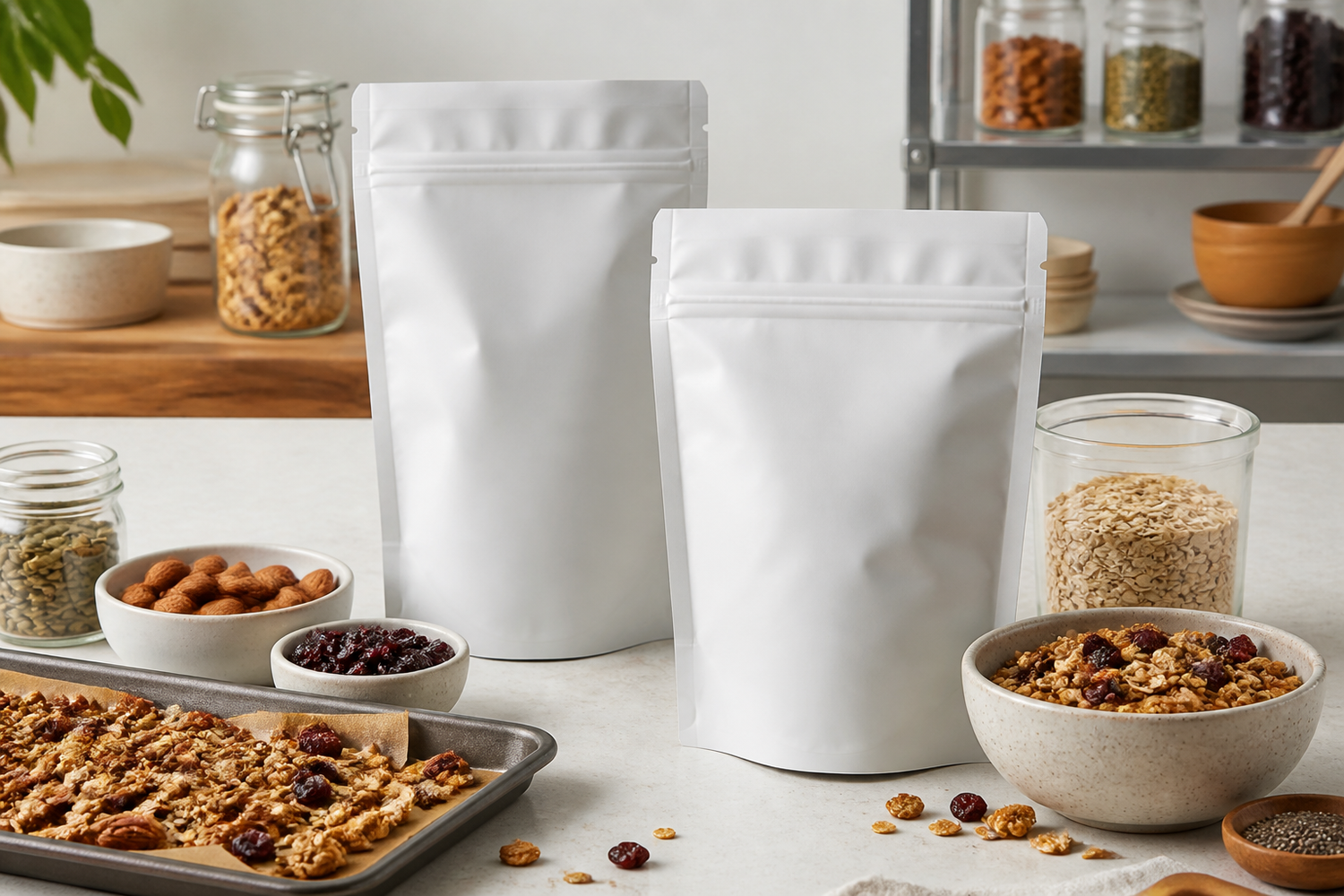
Granola pouch packaging should be specified around the granola you will actually sell—not a generic ounce chart. A dense, fine oat mix can occupy very different space from a recipe built around large clusters, dried fruit, chocolate pieces or whole nuts. The same nominal net weight can change the filled shape, headspace, zipper cleanliness and how much breakage occurs before the pouch reaches a customer.
This checklist is for U.S. granola founders, co-packers and operations teams preparing a custom pouch project. It is packaging-planning information, not food-safety, shelf-life, allergen, labeling or legal advice. Your food manufacturer, quality team, packaging supplier, test laboratory and qualified label reviewer should approve the actual formula, process, package and claims.

1. Build one controlled row for every recipe and pack size
Start with a matrix rather than a pouch catalog. Give each sellable SKU a formula revision, target net weight, expected serving pattern, fill method, channel and artwork owner. Record the largest representative clusters and inclusions because they influence opening width, fill behavior and puncture or scuff questions.
- Recipe revision and responsible food-safety/quality owner.
- Representative production lot, not only loose ingredients.
- Target net weight, fill tolerance and verification method.
- Largest clusters, nuts, fruit or chocolate pieces expected in normal production.
- Oil, dust and crumb behavior observed during filling and repeated use.
- Single-serve or multi-serve use, retail display and ecommerce case pack.
- Ingredient, allergen, nutrition, claim and variable-code approval status.
Keep unknowns explicit. The pouch supplier can propose candidate structures after receiving the intended use, but packaging should not be asked to establish the food's validated shelf life or regulatory status. Those decisions remain with the responsible product and quality teams.
2. Size the pouch with representative clusters

Fill several candidate sizes with production-representative granola using the intended method. Record weight, occupied volume, fill height, settling time and clearance below the zipper and final top seal. Do not compress the product simply to make a smaller catalog size work unless the product team has accepted the resulting breakage and consumer experience.
Evaluate at least four conditions:
- Freshly filled: can the top seal be made without crumbs or inclusions entering the seal zone?
- Settled: does the pouch slump, distort the artwork or become unstable after normal handling?
- Case packed: do neighboring pouches or case pressure visibly increase cluster breakage?
- Part used: can a customer pour a serving and reclose the package without product collecting in the zipper?
Use a documented observation method. A practical trial may sieve or photograph the product before and after a defined handling sequence, but the product owner must choose the sample size and acceptance limit. Avoid unsupported promises such as “crush-proof.” The purpose is to compare controlled prototypes and identify failure modes before a larger print run.
3. Test opening, pouring and reseal behavior
A zipper adds value only when it remains easy to find, align and close during real use. Granola crumbs, oat dust, sticky fruit pieces or chocolate can enter the track. A narrow opening may also force large clusters to scrape against the tear edge or spill outside the pouch.

Run repeated open-pour-reclose cycles with the filled pouch. Observe tear initiation, opening width, pour control, product in the zipper, closing feedback, top-edge curling and whether the pouch stands after product removal. Include users with realistic hand sizes and tasks; do not rely only on an empty sample.
When problems appear, change one variable at a time: opening width, zipper position, pouch depth, fill height, tear feature or portioning method. A larger pouch can improve access but may create an excessive visual gap above the fill. A clear window may help buyers see the product but must be reviewed against barrier, artwork and truthful-presentation requirements. Record the tradeoff instead of declaring one feature universally best.
4. Map FDA-regulated copy onto the formed pouch
The FDA's Food Labeling Guide summarizes statements that may be required on U.S. food labels and points users to updated topic-specific rules. The January 2025 Food Allergen Labeling Q&A explains FDA's current thinking on declaring major allergen food sources, including sesame.
Granola recipes frequently contain or share production environments with wheat, milk, tree nuts, peanuts, soy or sesame. Packaging artwork cannot substitute for formulation, supplier, sanitation and cross-contact controls. The responsible label reviewer should approve the ingredient list, allergen declaration, Nutrition Facts, net quantity, business information, claims and any required instructions for the actual SKU.
Print the artwork at actual size, form the pouch and fill it. Mark no-copy zones for the final seal, zipper, tear notch, bottom or side gussets, registration movement and variable lot/date coding. Check the principal display panel on the filled shape, not only on a flat PDF. Confirm that required copy remains legible when the pouch is full, partly used and standing on a shelf.
5. Control flavor families without mixing proofs

A granola family may share a pouch size while changing nuts, fruit, chocolate, sweeteners, nutrition, allergens and claims. Maintain a release matrix linking formula revision, label copy, barcode, net weight, pouch size, artwork file, colorway and approver. A visual color change is not proof that the ingredient or allergen panel was updated.
Use named approvals for formula/food safety, regulatory copy, brand artwork, packaging feasibility and final production release. For multi-SKU digital printing, ask how quantities, designs and revision files will be identified through proofing and production. Keep obsolete files out of the active handoff, but retain the approval history.
6. Validate the filled pouch in its distribution pack-out
Test the complete sale unit, not just an empty pouch. Observe seal contamination, pinholes, scuffing, window damage, zipper function, cluster breakage and product migration into the headspace. For ecommerce, include the actual carton, cushioning and number of pouches. For wholesale, include the case count, orientation and stacking configuration.
The FDA's food-contact packaging information emphasizes intended conditions of use. A supplier's generic food-contact statement does not by itself validate the complete pouch for every recipe, storage period or market. Ask for documentation relevant to the intended product and use, then have the responsible team review it.
7. Send a quote-ready granola pouch handoff
Include representative finished granola, recipe/SKU matrix, target net weights, occupied-volume observations, largest cluster/inclusion, fill method, opening and zipper needs, storage/channel details, case pack, artwork status, code zone, quantities and written test questions. Identify which values are targets and which are still to be verified.
Review Anacotte's granola packaging options and stand-up pouches, then request a project-specific quote with real recipes, fill and proof inputs. Samples should answer documented questions, not confirm assumptions made from a screen.
Frequently asked questions
Can pouch size be chosen from net weight alone?
No universal conversion is reliable. Fill representative product, record occupied volume and settling, and check zipper/seal clearance with the largest normal clusters.
Does a zipper guarantee that granola stays fresh?
No. Product formulation, initial seal, barrier, consumer use, storage and shelf-life validation interact. Treat the zipper as one feature in a finished-pack test plan.
Should a granola pouch have a clear window?
Only after the product, brand, barrier, light exposure, artwork and truthful-presentation tradeoffs are reviewed. Validate the proposed window in the complete structure.
What should be sent to the packaging supplier?
Send representative finished granola, target weights, cluster/inclusion profile, fill route, pouch/closure concept, SKU matrix, approved-copy status, quantities, distribution pack-out and sample-test questions.

댓글 남기기
이 사이트는 hCaptcha에 의해 보호되며, hCaptcha의 개인 정보 보호 정책 과 서비스 약관 이 적용됩니다.