
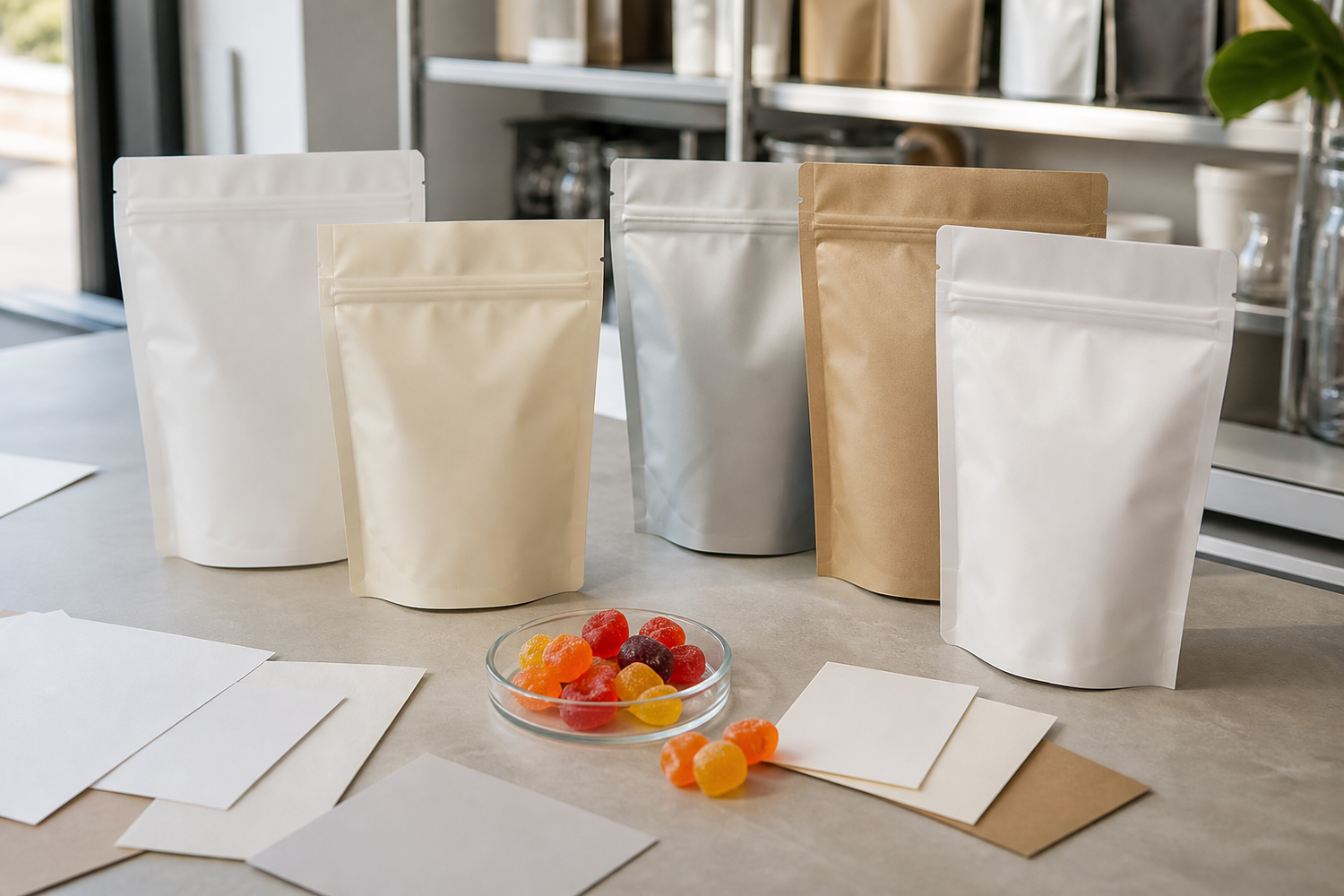
When a supplement brand searches for gummy supplement pouch packaging, the hard part is rarely choosing one attractive mockup. The harder decision is whether a pouch family will still work when several formulas, serving counts, flavors, colors, and label versions are filled, opened, reclosed, and shipped.
This checklist is for packaging development and supplier handoff. It does not establish supplement efficacy, shelf life, moisture performance, tamper evidence, child resistance, or regulatory compliance. Those questions need product-specific documentation, testing, and qualified review.

Start with the gummy family, not one hero SKU
A pouch that works for one flavor or serving count may not be the right size or artwork system for the rest of the line. Before you select a format, make a simple SKU matrix:
- Formula, flavor, gummy shape, average piece size, and expected fill weight.
- Serving count, directions for use, and whether the consumer will reach in repeatedly.
- Storage assumptions supplied by the product owner and any planned channel or case pack.
- Front-of-pack hierarchy, label version, color direction, lot/date area, and other artwork variables.
- Whether a market or product-specific child-resistant requirement needs to be evaluated separately.
Anacotte’s current resealable vitamin gummy pouch is positioned as a customizable route with a zipper and a low-MOQ starting point. Use that as a conversation starter, then confirm the actual gummy, fill, closure, artwork, and use case. Product-page positioning is not a guarantee for every formula or distribution route.
1. Size the pouch with real gummies
Do not approve a pouch from a flat artwork file or an empty sample alone. Fill representative gummies into the candidate format and record how the pieces sit, how much headspace remains, and how the package behaves when it is held or placed in a case.
Your fill-proof sheet should capture:
- Piece count, fill weight, gummy dimensions, and any variation between batches.
- Usable volume and headspace at the intended fill, not only the nominal pouch size.
- Whether the pouch stands, slumps, or folds in the intended shelf and shipping position.
- How easily the consumer can reach the gummies after the first few uses.
- Case-pack, shipper, and display assumptions that affect the formed package.

2. Make reclosure an observed use case
“Resealable” describes a feature; it does not describe what happens after repeated use. Observe the zipper with the real fill. Look at how the gummy pieces, sugar coating, oils, or crumbs interact with the closure area, and record whether the user can find and engage the zipper without a complicated hand movement.
For a practical reclosure trial, record:
- Opening and closing motion at the intended fill level.
- Whether pieces or residue reach the zipper track.
- Alignment and handling after the pouch has been opened several times.
- What the package looks like after it is placed in a bag, drawer, or case.
- Any storage instruction or consumer-use note that still needs responsible review.
The purpose is to identify questions and improvements early. A reclosure observation is not a shelf-life test and should not be written up as proof of moisture protection.

3. Specify tamper direction before artwork
A tear notch, zipper, first-open cue, or other feature can be part of a tamper-evidence direction, but the presence of one feature does not automatically make a pouch tamper-evident. Define what the consumer should see on first opening, how the feature will be represented in the artwork, and what technical or market-specific validation is required.
Ask the supplier and responsible quality/compliance team:
- What first-open feature is being requested, and what user action should reveal it?
- Which part is a functional feature versus an artwork cue?
- How will the feature be checked on the formed, filled pouch?
- Does the intended channel or market have a specific requirement for tamper evidence or child resistance?
- Which claims are allowed on the package, and who approves the final wording?
If the product or market requires child-resistant packaging, specify that requirement separately and validate it. Do not treat a standard zipper or a particular pouch shape as universally child-resistant.

4. Build a formed-label and Supplement Facts matrix
Artwork approval should happen on the formed pouch. The front panel can change when the package is filled, the bottom is set, or the pouch is held. Build a matrix for every SKU so that a color change does not accidentally change required copy, code placement, or panel hierarchy.
The FDA’s Dietary Supplement Labeling Guide describes label elements such as statement of identity, net quantity, Supplement Facts, ingredients, and name/place information. The FDA’s Nutrition Labeling chapter adds detail on Supplement Facts formatting. Use those pages as starting references, then have the responsible team review the actual formula and market.
A formed-label matrix can include:
- SKU name, flavor/color, formula version, and artwork revision.
- Statement of identity, net quantity, Supplement Facts, ingredients, and required statement/warning review fields.
- Lot/date/traceability zones and the method by which they will be applied.
- Front and back panel dimensions after filling, plus safe areas around the zipper, notch, seals, and curves.
- Approval owner, approval date, and the sample ID used for the review.
Also request the relevant food-contact documentation for the intended use. A high-barrier description or a clean product photograph is not a substitute for the documentation and testing appropriate to the actual product.
5. Approve the family, not only the sample
Use one repeatable release loop for every SKU:
- Send representative gummies, serving count, fill weight, formula/storage assumptions, and the intended channel.
- Review the candidate format with empty and filled samples.
- Run the reclosure and handling observations with the real gummy pieces.
- Review the formed front/back label and Supplement Facts/artwork matrix.
- Record open questions, owners, changes, and the exact sample approved for the next step.
This prevents a family of SKUs from being approved by one hero mockup. It also gives the supplier a better brief for discussing pouch size, zipper direction, finish, artwork, and production route.
What to send with a gummy pouch quote request
For a productive packaging conversation, send:
- Representative gummies, average piece size, serving count, fill weight, and formula/storage assumptions.
- SKU list with flavor/color, artwork revision, label copy status, and any lot/date plan.
- Preferred pouch format, zipper/reclosure direction, tear-notch or first-open direction, and case pack.
- Intended sales channel and any market-specific child-resistant or tamper-related requirement.
- Timing, pilot quantity, and which questions need a physical proof before approval.
Start with Anacotte’s gummies packaging collection to compare relevant routes, then use the quote request page with the real-product inputs above. If you are comparing formats, the flat-bottom pouch collection is a useful next step.
FAQ
Is a resealable pouch enough to prove gummy shelf life?
No. Reclosure is one feature of the package. Barrier performance, product stability, shelf life, and storage instructions require product-specific documentation and testing.
Does a tear notch automatically make a pouch tamper-evident?
No. Define the intended first-open feature, user cue, inspection method, and market requirement. A tear notch can be a design direction without being a validated tamper-evident claim.
Can one pouch size cover every gummy SKU?
Do not assume it. Test actual piece size, count, fill weight, headspace, repeated access, formed label space, and case pack across the family.
Does every gummy pouch need to be child-resistant?
Requirements depend on the product, market, and responsible compliance review. If child resistance is needed, specify and validate that requirement separately rather than relying on a standard pouch feature.
What is the fastest next step?
Send representative gummies, serving count, fill weight, formula/storage assumptions, closure and tamper direction, SKU/artwork matrix, intended channel, and case-pack details. That gives a supplier enough context to discuss a meaningful proof.
This article is general packaging information, not legal, regulatory, food-safety, or medical advice. Confirm the final package, artwork, labeling, food-contact documentation, and process with the responsible professionals before production.

댓글 남기기
이 사이트는 hCaptcha에 의해 보호되며, hCaptcha의 개인 정보 보호 정책 과 서비스 약관 이 적용됩니다.