Granola Packaging for Clusters, Blends and Single Serves
Granola is not one packaging problem. Large clusters can break at narrow openings, loose blends can settle differently, inclusions can change filled shape, and single servings need portion and opening discipline. A brand also has to balance retail shelf presence, ecommerce pack-out, subscription rotation, café or hotel use, artwork versions and reorder risk.
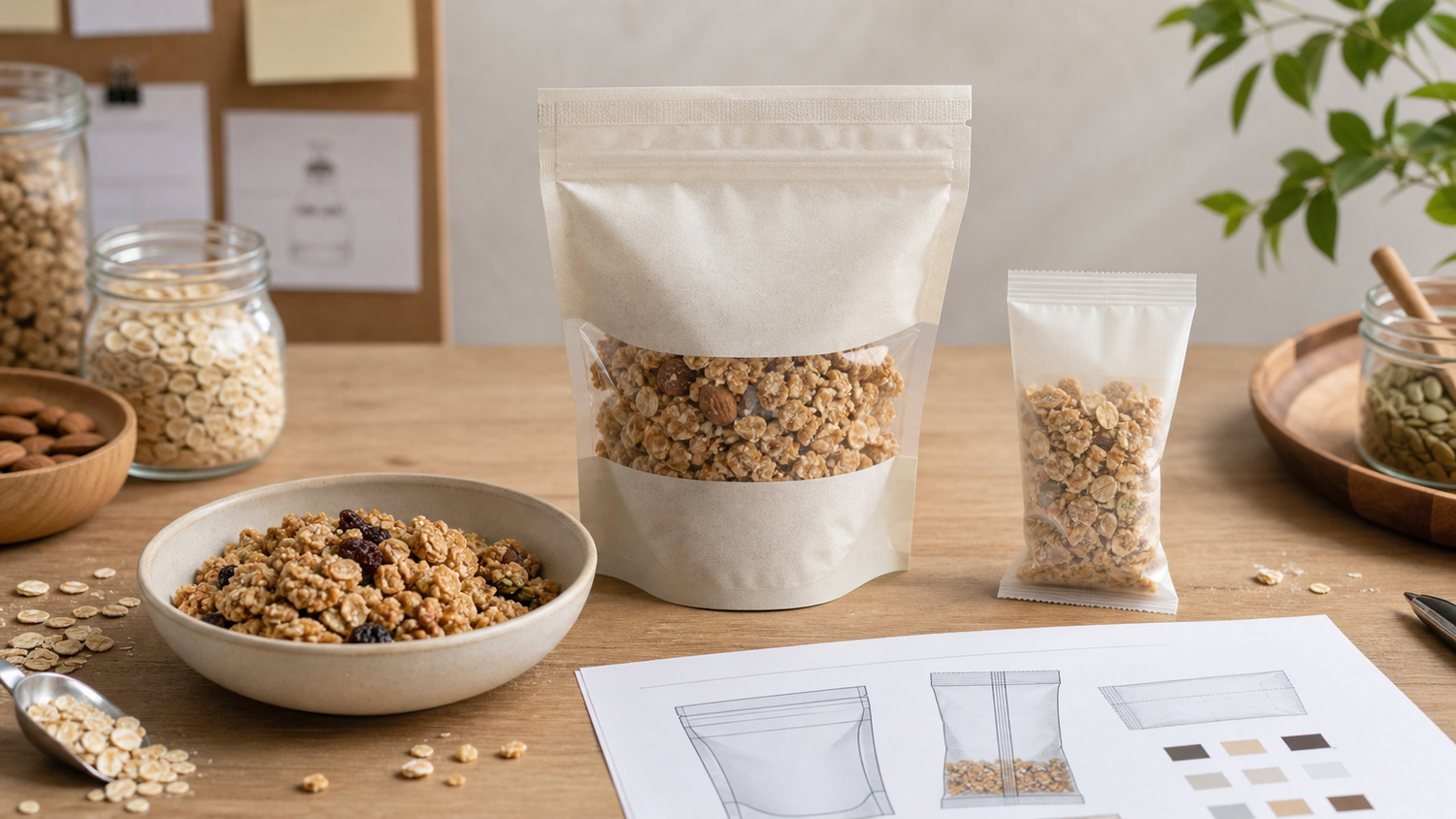
Quick Answer: Choose the package around product geometry, target fill, opening routine and channel. A resealable stand-up pouch is a flexible starting point for many consumer packs; a flat-bottom pouch can improve structure and printable area; a flat sachet can suit controlled single servings; and a side-gusset bag can suit larger fills. Compare representative filled samples, record quantity per artwork and avoid using a generic capacity chart as a production guarantee.
Granola Format Decision Matrix
| Use Case | Recommended Starting Point | What to Verify |
|---|---|---|
| Chunky clusters | Wide-opening stand-up or flat-bottom pouch | Check breakage, zipper access and filled shape |
| Loose blends | Stand-up pouch or flat-bottom pouch | Check settling, scoop access and headspace |
| Single serving | Flat sachet or small pouch | Check portion, tear and eating routine |
| Subscription flavors | Coordinated resealable pouches | Control artwork and quantity per SKU |
| Bulk retail refill | Side-gusset or larger flat-bottom bag | Check filled weight, handling and case pack |
1. Define Product Geometry
Cluster size, loose flakes, nuts, fruit and powdery fines change opening and filled-shape needs. For granola packaging format selection, this choice affects filling, use, artwork, buyer confidence, inventory exposure and the evidence needed before production.
Recommended control: Record particle range, fragile inclusions, representative density and target fill. Mark each field as confirmed, preferred, unknown or not applicable, with a source, owner and date.
What to verify: Fill physical samples and inspect breakage, settling and access. Use representative product, a physical package, realistic operations, written pass criteria, consistent photos and controlled sample IDs.
2. Choose the Consumer Routine
Pouring, scooping and eating from the pouch require different openings and closures. For granola packaging format selection, this choice affects filling, use, artwork, buyer confidence, inventory exposure and the evidence needed before production.
Recommended control: Map first opening, repeated use, storage and final product removal. Mark each field as confirmed, preferred, unknown or not applicable, with a source, owner and date.
What to verify: Observe users without coaching and record spills or trapped product. Use representative product, a physical package, realistic operations, written pass criteria, consistent photos and controlled sample IDs.
3. Compare Stand-Up and Flat-Bottom Pouches
The two formats differ in stance, panels, geometry and cost. For granola packaging format selection, this choice affects filling, use, artwork, buyer confidence, inventory exposure and the evidence needed before production.
Recommended control: Compare equal fills and artwork needs rather than judging empty samples. Mark each field as confirmed, preferred, unknown or not applicable, with a source, owner and date.
What to verify: Review filled stability, case packing and shelf presentation. Use representative product, a physical package, realistic operations, written pass criteria, consistent photos and controlled sample IDs.
| Sample Stage | Useful For | Not Proof Of |
|---|---|---|
| Blank physical sample | Size, opening, fit and pack-out | Final print, compatibility or shelf life |
| Printed mockup | Artwork scale and SKU differentiation | Production performance |
| Representative filled prototype | Use, residue, closure and handling observations | Every distribution route |
| Production-like trial | Process and inspection learning | Unchanged future performance |
4. Plan Single-Serve Sachets
A sachet can support sampling and hospitality but adds portion and tear decisions. For granola packaging format selection, this choice affects filling, use, artwork, buyer confidence, inventory exposure and the evidence needed before production.
Recommended control: Define dose, dimensions, tear direction, coding and kit assembly. Mark each field as confirmed, preferred, unknown or not applicable, with a source, owner and date.
What to verify: Test opening, product flow and use with the intended meal. Use representative product, a physical package, realistic operations, written pass criteria, consistent photos and controlled sample IDs.
5. Screen Barrier Questions
Moisture, oxygen, aroma and fat risks depend on the recipe and shelf-life target. For granola packaging format selection, this choice affects filling, use, artwork, buyer confidence, inventory exposure and the evidence needed before production.
Recommended control: Share product facts, storage and target shelf life with qualified suppliers. Mark each field as confirmed, preferred, unknown or not applicable, with a source, owner and date.
What to verify: Use project-specific shelf-life and package evidence. Use representative product, a physical package, realistic operations, written pass criteria, consistent photos and controlled sample IDs.
6. Build the SKU and Artwork Map
Granola launches often include flavors, sizes and channels. For granola packaging format selection, this choice affects filling, use, artwork, buyer confidence, inventory exposure and the evidence needed before production.
Recommended control: Keep one row per artwork with quantity, revision and proof owner. Mark each field as confirmed, preferred, unknown or not applicable, with a source, owner and date.
What to verify: Review all variants together before release. Use representative product, a physical package, realistic operations, written pass criteria, consistent photos and controlled sample IDs.
7. Test Ecommerce and Retail Handling
Parcel compression and shelf display create different risks. For granola packaging format selection, this choice affects filling, use, artwork, buyer confidence, inventory exposure and the evidence needed before production.
Recommended control: Build the real case or parcel around representative fills. Mark each field as confirmed, preferred, unknown or not applicable, with a source, owner and date.
What to verify: Inspect seals, closure, breakage and presentation after handling. Use representative product, a physical package, realistic operations, written pass criteria, consistent photos and controlled sample IDs.
8. Define Reorder Rules
A low-MOQ run should produce evidence for the second order. For granola packaging format selection, this choice affects filling, use, artwork, buyer confidence, inventory exposure and the evidence needed before production.
Recommended control: Track sell-through, complaints, damage and repeat purchase by SKU. Mark each field as confirmed, preferred, unknown or not applicable, with a source, owner and date.
What to verify: Reorder from controlled results and current artwork. Use representative product, a physical package, realistic operations, written pass criteria, consistent photos and controlled sample IDs.
Common Mistakes and Better Controls
Expensive errors often begin as uncontrolled assumptions that pass from a brief into artwork, samples and production without an owner.
| Mistake | Why It Fails | Better Control |
|---|---|---|
| Choose from a rendering | Physical filling, use and distribution remain unknown | Use representative filled samples |
| Change several variables at once | The cause of a result becomes unclear | Use controlled sample IDs |
| Hide quantities inside one total | SKU inventory exposure is invisible | Plan quantity per artwork |
| Approve copy without an owner | Conflicting versions can enter production | Keep one approval record |
| Treat one sample as universal proof | A limited observation is overextended | State test limits clearly |
Quote-Ready Brief Checklist
A useful request lets suppliers compare the same scope and identify unknowns without inventing answers.
| Brief Field | What to Provide | Why It Matters |
|---|---|---|
| Product | Form, behavior, representative lot and target fill | Frames size and test questions |
| Package | Preferred format, features, reference and unknowns | Creates comparable feedback |
| SKU map | Artwork count, quantity, revision and owner | Controls version and inventory risk |
| Operations | Filling, sealing, coding, storage and route | Connects design to handling |
| Decision plan | Sample goal, pass criteria and reorder trigger | Turns testing into action |
Attach reference-pack photos with a ruler, available dielines, one row per SKU, fill-process notes and a list of decisions that remain open. Ask every supplier to state assumptions, exclusions, sample scope, delivery basis and the evidence required before production. Keep quoted capability separate from the specification actually approved for the project. When feedback conflicts, assign an owner and resolution date instead of silently choosing the fastest answer. The final record should let a teammate reconstruct why the format, dimensions, closure, artwork revision, quantity and test plan were selected.
Relevant Anacotte Packaging resources include granola packaging, snack packaging, stand-up pouches, flat-bottom pouches, sample packs, request a quote. For U.S. market context, review the FDA food-contact substances resources, the FDA food-labeling resources, and GS1 US for item identification and barcode planning. These public resources do not approve a product, package, label or market plan.
Frequently Asked Questions
Can a low MOQ run replace packaging tests?
No. It can reduce printed-inventory exposure, but it does not replace project-specific samples, approvals, compatibility, stability, distribution or regulatory work. Keep unresolved questions visible for supplier, filler, laboratory, retailer, legal, regulatory or engineering review as appropriate.
What should I send before requesting a quote?
Send product form, target fill, package preference, SKU count, quantity per artwork, features, artwork status, filling method, storage, route, destination and target date. Keep unresolved questions visible for supplier, filler, laboratory, retailer, legal, regulatory or engineering review as appropriate.
Can one pouch work for every formula or recipe?
Only after materially different products, fills, closures, use routines and process conditions are compared with representative evidence. Keep unresolved questions visible for supplier, filler, laboratory, retailer, legal, regulatory or engineering review as appropriate.
Does a digital proof approve physical performance?
No. A digital proof supports artwork review; physical and production-like samples answer different questions. Keep unresolved questions visible for supplier, filler, laboratory, retailer, legal, regulatory or engineering review as appropriate.
How should a startup compare supplier quotes?
Normalize dimensions, format, features, quantity per artwork, print method, sample scope, delivery basis, destination, exclusions and unresolved decisions. Keep unresolved questions visible for supplier, filler, laboratory, retailer, legal, regulatory or engineering review as appropriate.
When should the package be re-tested?
Re-test when a material, supplier, product, fill, closure, process, secondary pack, route or claim changes materially. Keep unresolved questions visible for supplier, filler, laboratory, retailer, legal, regulatory or engineering review as appropriate.
Next step
If the package is ready for production planning, request a custom packaging quote with product, fill, format, SKU, artwork, testing and delivery inputs. If the product concept, SKU system or visual direction is still changing, use Anacotte Brand Launch Studio first, then hand the controlled brief to Anacotte Packaging.


コメントを書く
このサイトはhCaptchaによって保護されており、hCaptchaプライバシーポリシーおよび利用規約が適用されます。