
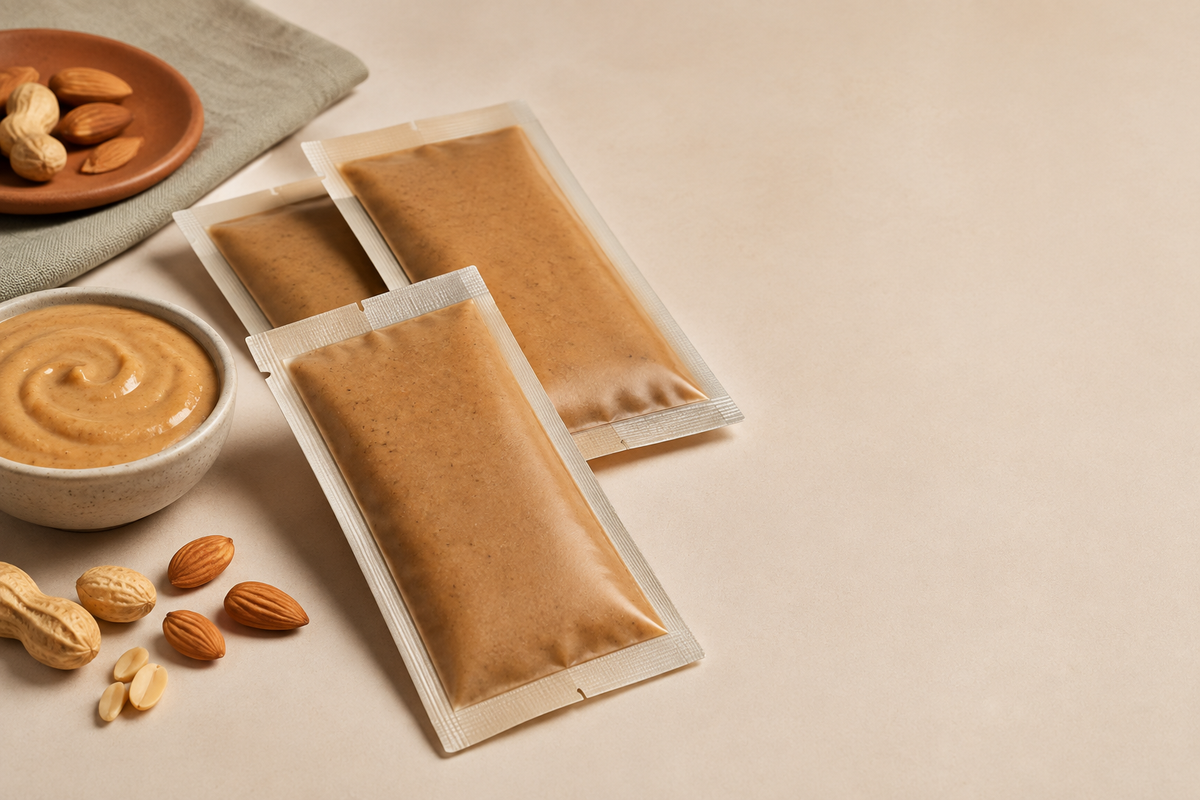
Nut butter packaging has to satisfy two different routines: a portable single serving and a multi-use pack that is opened, squeezed, closed, and stored again. Both may be called a “pouch,” but the fill behavior, opening, seal, and consumer expectations are different. Start with the routine, then select the geometry.
Important: This guide is a planning framework, not a guarantee of squeeze evacuation, grease resistance, food-contact authorization, shelf life, barrier, price, MOQ, lead time, or a universal best format. Final structure and tests should be confirmed with the packaging supplier and the responsible compliance or food-safety owner.

Decide whether the pack is single-use or repeat-use
A flat three-side-seal sachet can be a practical starting point for a defined portion. It stores compactly, does not need a zipper or fitment, and can be designed around a tear-open routine. A spout pouch may make more sense when a consumer needs repeated dispensing. A jar or other rigid format may still win when a wide opening, utensil access, or a familiar pantry routine matters most.
The live Anacotte custom flat pouch for nut butter is a relevant product reference, including a 1 oz / 30 g product-page title. Treat that as a reference point, not a universal portion recommendation. Other current market examples show why the routine matters: OMW Foods presents peanut butter in a 3 oz pouch, while Vör Manufacturing describes routes from small squeeze pouches to jars or bulk. The pack should be selected around the real use case, not around a single category label.
Describe the formula before specifying the film
Nut butter may be smooth, particulate, oily, dense, or temperature-sensitive. Oil separation and changes in temperature can alter how the paste moves through a small opening. Capture:
- Flow and texture: smooth or crunchy, stringy or cohesive, and whether particles change the opening requirement;
- Oil and fat behavior: separation, surface oil, grease interaction, and any formula change after storage;
- Temperature: fill and consumer-use range, including chilled or warm conditions if relevant;
- Target portion: net weight, volume, headspace, and tolerance for under- or over-fill; and
- Channel: sampling, foodservice, e-commerce, retail shelf, travel, or another distribution route.
This information helps the supplier discuss the sealant, barrier, opening, and fill process as a connected system. It also keeps the conversation honest: a pouch that works for one nut butter formula may not work for another.
Compare the pouch paths
| Format path | May fit when | Questions to resolve |
|---|---|---|
| Flat three-side-seal sachet | The pack is a defined portion and the consumer will open it once. | Tear direction, opening size, squeeze access, residue, seal contamination, and filled-pack burst or transport performance. |
| Small spout pouch | The product is used more than once and controlled dispensing or reclosure matters. | Spout bore, cap, tamper feature, cleaning, residual product, fitment weld, and reclosure after a filled dispense. |
| Stand-up or gusseted pouch | Display stability and a larger retail footprint justify the extra geometry. | Filled stability, bottom construction, opening or zipper, headspace, seal area, and transport orientation. |
| Jar or rigid pack | The use routine needs a wide opening, spoon, or long pantry life. | Weight, breakage, closure, headspace, and why flexible packaging is still the better route. |
For the primary flat-sachet concept, do not add a zipper, spout, valve, or bottom gusset by default. Those features can be evaluated as alternatives when the consumer routine requires them.

Connect portion, fill, and seal design
Portion size affects more than the amount of product inside. It influences pouch width, paste travel, headspace, tear-zone placement, seal width, and the distance a consumer must squeeze. The filling route also matters: a product that wets the seal area can create a very different risk from a clean dry fill.
A quote-ready specification should ask about:
- target net content, fill tolerance, headspace, and the dimension of the product bed;
- top-fill, piston, pump, co-packer, or other equipment route;
- tear-notch position, opening width, seal band, and whether the user needs a spoon or direct squeeze;
- artwork, code zone, SKU count, finish, and any label or compliance panel;
- case pack, pallet or parcel route, and the orientation likely to occur in transit; and
- material, barrier, food-contact, and storage questions for the supplier and compliance owner.
Test squeeze evacuation on filled samples
“Easy to squeeze” is subjective until the project defines the user motion and what counts as acceptable access. Test the real formula, or clearly label a substitute as an early geometry check. Useful observations include:
- Open cleanly: Check whether the tear starts where intended and leaves a usable opening without sharp or ragged edges.
- Dispense with a practical motion: Record the hand position, angle, squeeze path, and whether the paste exits as a controllable ribbon.
- Observe residue: Note product left in corners, along seals, or near the tear zone after the normal consumer motion.
- Review seal contamination: Inspect filled seals and any weak or distorted areas after the actual fill process.
- Handle and transport: Run drop, compression, and distribution checks that match the intended route, then repeat opening and squeeze observations.
- Review storage: Compare the relevant temperature and dwell conditions, watching for oil separation, seepage, or changes in handling.

Keep food-contact and barrier claims conditional
The FDA food-types and conditions-of-use page treats oil/fat foods and use conditions as distinct inputs. The formula, temperature, storage, and process therefore belong in the material discussion. A supplier’s page may present a structure or commercial capability, but that does not automatically establish the right food-contact basis, grease behavior, oxygen or moisture barrier, or shelf life for your product.
Do not use a generic “food grade” phrase as the whole specification. Ask what information the supplier needs to assess the intended use, and route the final decision to the responsible compliance owner. The goal is a documented match between formula, film, seal, process, storage, and distribution.
Build a quote-ready nut butter brief
Sparal’s current nut-butter quote page is a useful reminder that suppliers may ask for product, fill weight or volume, pouch format, SKU count, material or barrier goal, features, artwork status, target date, and ship-to. Treat its MOQ, price, and lead-time language as supplier-specific. For your own request, add:
- formula and practical squeeze/flow description;
- portion, headspace, storage, fill temperature, and equipment;
- single-use or repeat-use routine, opening style, and reclosure need;
- seal, tear, fitment, barrier, and food-contact questions;
- artwork, code area, SKU count, case pack, and distribution route; and
- sample count, acceptance criteria, and who signs off after filled-pack review.

FAQ
Is a flat pouch the right choice for every nut butter?
No. It can be a strong starting point for a defined single-use portion, while repeat use may favor a spout pouch or jar. Formula behavior and the consumer routine decide the format.
What portion size should I choose?
Start with the use occasion and the product-page or channel requirement, then confirm net content, headspace, fill tolerance, and the resulting pouch dimensions. A 1 oz / 30 g reference is not a universal recommendation.
Can I use a dry snack pouch specification for nut butter?
Not safely by default. Oil, paste, temperature, seal contamination, opening, squeeze, and food-contact questions may require a different structure or test plan.
What should I send Anacotte?
Share the formula behavior, target portion, fill route, opening routine, storage, distribution, artwork status, and test criteria through the quote path. Use the custom flat nut-butter pouch page as a starting product reference, then compare the broader context in High-Barrier Bags for Protein Powder and Custom Stand-Up Pouch Packaging.
Next step: Decide whether the pack is single-use or repeat-use, record the filled-pack behavior you need, and request samples that can answer the opening, squeeze, seal, storage, and transport questions before final artwork or production approval.

コメントを書く
このサイトはhCaptchaによって保護されており、hCaptchaプライバシーポリシーおよび利用規約が適用されます。