Flexible Packaging

Frozen Seafood Portion Pouches: A Supplier Handoff Checklist Before Sampling

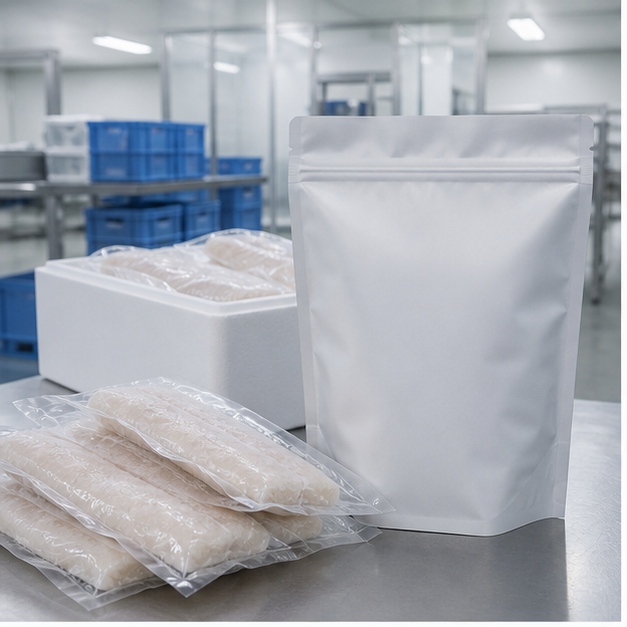
Blank frozen seafood portion pouch in a clean cold-chain packing setting

A frozen seafood pouch is not selected by appearance alone. Before samples can be useful, the supplier needs to understand the food, the portion, how it is packed, where it travels, and what the brand needs to inspect after a filled trial.

This guide is for brands preparing individually portioned fish or seafood products for a packaging conversation. It is not food-safety, shelf-life, cold-chain, regulatory or material-selection advice. The final package and its documentation must be reviewed for the actual food, process, intended use and market.

1. Define the sale unit before choosing the pouch

Blank frozen seafood portion pouch in a clean cold-chain packing setting

Start with what the customer buys and handles. Is each pouch a single fillet, a fixed multi-piece portion, or a meal component? Note target net weight, count tolerance, the product’s shape, whether pieces are rigid when frozen, and whether the pouch is sold alone or inside a carton or bundle.

Those details help prevent a vague request such as “we need frozen seafood packaging.” They also make it easier to compare sample sizes and pouch directions with a supplier.

2. Map the packing and cold-chain route

Describe the route from the packing line to the customer. Include whether the product is packed frozen, whether it passes through a blast-freezing or other process step, how it is case packed, and whether it moves through wholesale, retail, ecommerce or more than one channel.

For a sample discussion, list the handling moments that could matter: loading into a case, warehouse storage, picking, parcel delivery, freezer placement and customer opening. Do not assume a pouch that looks suitable on a table will represent the finished route.

3. Give your supplier an intended-use question set

Gloved hands inspecting the top seal edge of a blank frozen seafood pouch

For U.S. food-contact uses, the FDA explains that food-contact substances have a regulatory basis. Ask a supplier what information and documentation is needed for the actual use; do not treat a generic “food grade” phrase as a complete answer.

Your brief should include the product description, target market, fat or moisture characteristics relevant to technical review, packing process, storage conditions, expected distribution route and any special handling. Seafood processors also need product- and process-specific controls; packaging does not replace that work. The FDA’s fish and fishery products guidance is a useful prompt for involving the right processing and regulatory reviewers.

4. Plan information zones before artwork is final

Frozen products still need a practical panel map. Before artwork approval, reserve space for the product identity, net quantity, required information, lot or date code, barcode, handling instructions approved by the brand, seal margins and any areas used by the packing operation. Keep critical copy away from seals, corners and zones likely to distort during filling or handling.

A packaging supplier can help identify mechanical constraints, but the brand remains responsible for approved label content and market-specific review.

5. Test a filled sample in the planned pack-out

Blank frozen seafood pouch packed inside a simple ecommerce shipping box

Empty samples can help with size and appearance. A filled trial should add the conditions that resemble the project: product loading, sealing, freezing, case packing, storage and the relevant handling route. Agree in advance on what to record, such as pouch revision, fill condition, seal settings, sample count, pack-out, observations and any failure.

If the food, portion geometry, packing process, shipping setup or pouch construction changes, treat it as a new question for the test plan rather than assuming an earlier result transfers unchanged.

6. Send a quote-ready handoff

Blank frozen seafood pouch beside portion samples, ruler and empty packaging checklist

A useful request for quote includes:

  • Seafood type and product description, target market and intended use.
  • Portion count, net weight, approximate product dimensions and fill method.
  • Packing, freezing, storage and distribution details.
  • Expected pouch quantity, SKU count, carton or parcel pack-out and delivery destination.
  • Artwork status, label and code-zone requirements, and launch timing.
  • The sample questions the team wants to answer before production.

With that handoff, the supplier conversation can focus on feasible samples rather than generic claims. Explore Anacotte’s frozen seafood flat-pouch direction, then request a project-specific quote with the details above.

Frequently asked questions

Is one pouch structure right for every frozen seafood product?

No. Product shape, process, intended use, storage, pack-out and route should be reviewed for the specific project.

Can an empty pouch sample prove that the project is ready?

No. Empty samples are useful for early evaluation, but a filled test plan should reflect the product and handling conditions the brand expects.

What should we send before asking for a packaging quote?

Send the product and portion details, packing route, storage and distribution conditions, artwork status, quantity and sample questions. That gives the supplier a usable starting point.

前後の記事を読む

Blank coffee pouch with a degassing valve beside roasted coffee beans

コメントを書く

このサイトはhCaptchaによって保護されており、hCaptchaプライバシーポリシーおよび利用規約が適用されます。

Contact Us

Do you have any question?