
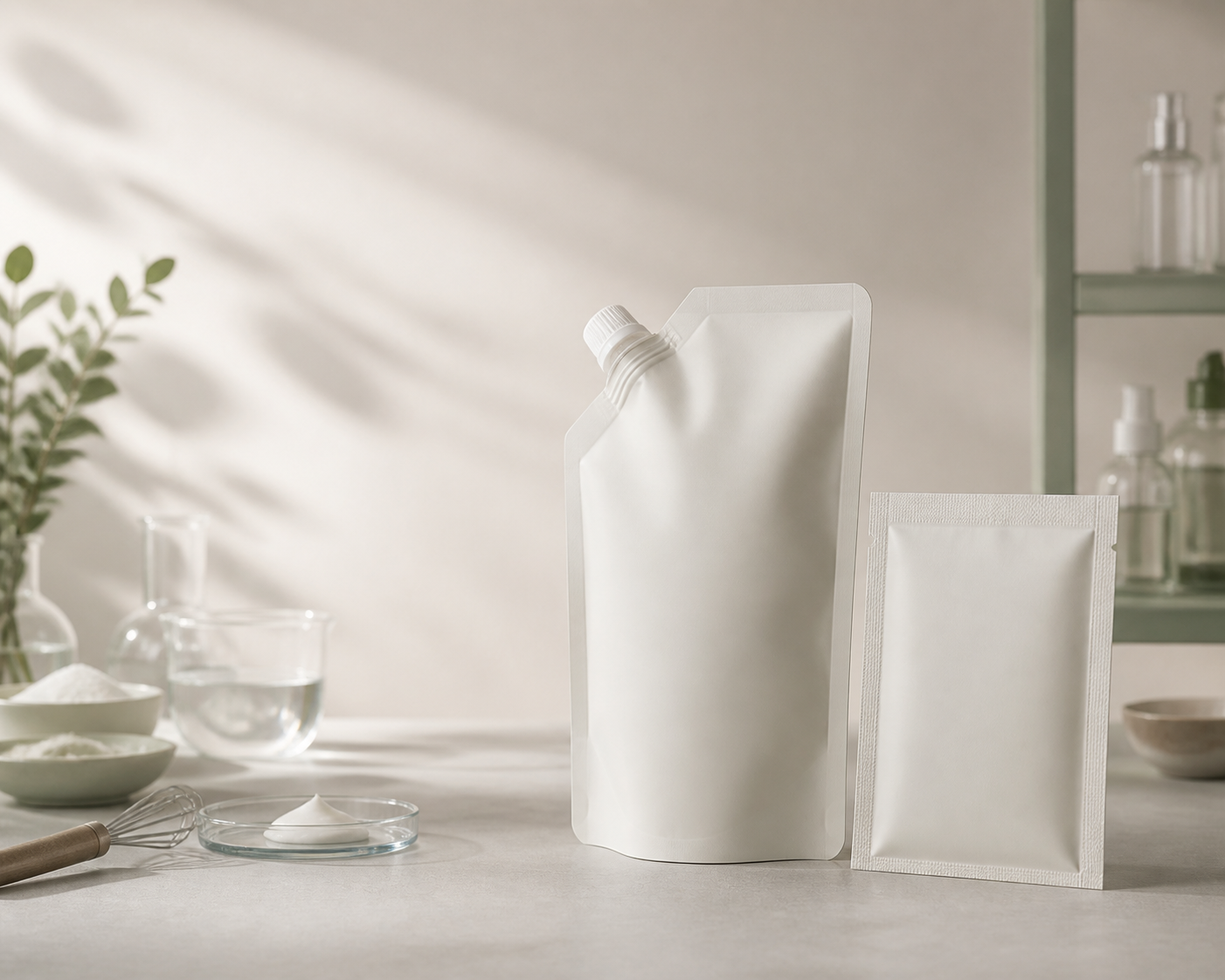
Choosing a hair mask pouch starts with the formula and the way a customer will use it, not with the package silhouette. A thick cream used repeatedly in a shower or salon setting may call for a different starting hypothesis than a single-use travel sachet. The right choice still needs a filled sample, a closure review, and a proof of the actual artwork and code zones.

Start with formula state and use pattern
Before asking for a price, write down five inputs: whether the formula is liquid, cream, or unusually thick; the target fill; whether the customer uses one dose or returns to the pack; where the package will be opened; and how the filled unit will be tested or shipped. These inputs do not approve a format, but they prevent a pouch from being selected only because its nominal volume looks right.
Keep the decision conditional. A supplier may describe a package as suitable for a thick formula, but your formula, fill temperature, headspace, and dispensing behavior still need to be tested together. Treat the product page and supplier examples as starting references, not a performance guarantee.
When a spout pouch is a useful starting hypothesis
A spout pouch is worth sampling when the user will dispense a thick or cream-like formula more than once and the fitment, cap, and squeeze behavior are part of the experience. It can also make sense when the package will live in a shower, backbar, or travel kit and the buyer wants a defined opening rather than tearing the entire top.
Anacotte currently lists a 250ml / 8.5 fl oz Premium Hair Mask Spout Pouch positioned for thick-viscosity liquid hair care. That is a relevant geometry reference for a quote conversation, not proof that 250ml, a particular fitment, or a soft-touch finish is right for every mask.
Current supplier examples show the same general market direction: Grace Beauty Pack presents personal-care spout pouches with squeeze use, a closure, and customizable options, while QIYU lists shampoo, conditioner, lotions, creams, and sunscreen among spout-pouch application examples. Those are supplier-specific examples. They support a sampling path, not a universal rule that every hair mask needs a spout.

When a flat sachet is a useful starting hypothesis
A flat sachet is a better starting hypothesis when the unit is intended for one application, a travel kit, a trial, or a controlled sample. It removes the need to design a repeat-use closure, and the sealed perimeter gives the artwork and fill team a simple packet to proof. That does not mean a flat sachet is automatically easier: the tear edge, seal width, fill tolerance, and amount of formula left in the packet still matter.
Use the flat route when the usage pattern is single-dose or when you want to learn from a small sample before committing to a repeated-use format. If the customer is expected to return to the package, test the opening and remaining product instead of assuming a sachet will behave like a pouch with a cap.
For broader shape context, see Anacotte's stand-up versus flat pouch comparison. For a wider fitment discussion, the spout-pouch options guide is a useful adjacent resource; this article keeps the decision specific to hair-mask formula and use pattern.
Compare the proof questions before artwork
Bring the same questions to both format options. The table below is a sampling brief, not a specification approval.
| Question | Spout pouch focus | Flat sachet focus |
|---|---|---|
| Formula and fill | Can the actual formula move through the selected fitment under realistic squeeze pressure? | Does the target fill spread across the packet without entering the seal zone? |
| Opening and use | Can the user remove, retain, and replace the cap without contaminating the opening? | Can the user open the tear edge cleanly and use the intended dose? |
| Seals and code | Are the fitment seal, body seals, and lot/date-code area separated from the fill path? | Does the perimeter seal remain clear of product and leave room for the code? |
| Label and print | Is the front panel usable when the pouch is squeezed or laid down? | Does the flat packet leave enough usable area after seals and tear notches are reserved? |
| Use and shipping | What happens after repeated opening, bathroom storage, or parcel handling? | What happens when a single packet is bent, squeezed, or opened away from home? |

A simple formula-to-format decision matrix
| If the project looks like this | Start by sampling | Ask for proof of |
|---|---|---|
| Thick formula, repeated use, controlled dispensing | Spout pouch | Fitment size, cap behavior, squeeze force, fill temperature, and clean seal zones |
| One treatment, travel, or trial sample | Flat sachet | Fill distribution, tear edge, seal width, code area, and residual product |
| Unclear use pattern or changing formula | Sample both formats | Real user test, filled dimensions, artwork zones, and the next-order decision |
| Multiple sizes or hair-care SKUs | One common geometry only if the fill test supports it | SKU artwork matrix, fitment consistency, and proof sign-off per version |
The important output is not a universal winner. It is a documented starting hypothesis and a short list of tests that can change the decision.

Build a quote-ready request
Send the converter or packaging team enough information to compare the two routes:
- Formula state and a plain-language viscosity description, plus any temperature or filling constraints.
- Target fill by weight or volume, intended dose, and whether the customer will use the package once or repeatedly.
- Preferred dimensions, fitment or tear-edge direction, cap/closure preference, and any standing or display requirement.
- Quantity, number of SKUs, artwork status, lot/date-code method, and desired ship date.
- The test conditions that matter: squeeze, dispensing, seal inspection, storage, parcel handling, or a shower/backbar simulation.
For a first conversation, Anacotte's quote path can be paired with a clear request for spout and flat samples. Ask the team to identify which inputs are assumptions and which can be confirmed only after a filled proof.
FAQ
Does a thicker hair mask always need a spout?
No. Thickness is one input, not a universal threshold. The actual formula, fitment, fill method, and dispensing test should determine whether a spout is workable.
Is a flat sachet only for samples?
No. A flat sachet can suit a single-use or travel unit. The decision depends on dose, opening behavior, label space, and how the package will be filled and handled.
Can I choose the format from capacity alone?
Capacity is not enough. The same nominal fill can have very different dispensing, seal, headspace, and artwork requirements depending on the formula and use pattern.
What should I send with a sample request?
Send formula state, target fill, intended use, dimensions, closure direction, quantity, SKU count, artwork status, code requirements, and ship date. That gives the supplier a testable brief instead of a shape-only request.
Bottom line: Treat the spout pouch and flat sachet as two testable hypotheses. Choose the route that matches the use pattern after the filled sample, seal, fitment, code, and artwork checks—not the route that only looks right in a catalog.

Commenta
Questo sito è protetto da hCaptcha e applica le Norme sulla privacy e i Termini di servizio di hCaptcha.