
Choosing stock or custom stand-up pouches is not only a packaging-format decision. It is a decision about how much artwork, inventory, and production commitment your brand is ready to make on the first run. A pouch that is easy to sample today may not be the most economical route once the design, SKU count, and repeat demand are stable.
This guide gives you a conditional way to compare the options. It does not promise a universal minimum order, price, lead time, barrier result, or food-contact suitability. Those details depend on the actual product, pouch structure, quantity, artwork, and production plan.

The decision is about commitment, not just pouch shape
A stand-up pouch can look similar across suppliers while the buying decision changes substantially underneath. Ask four questions before comparing quotes:
- Are you still learning the right fill weight, size, closure, or shelf presentation?
- Is your artwork final, or are names, flavors, claims, and SKU panels still changing?
- Do you need one design, or several designs that must launch together?
- Are you validating demand, or replenishing a package that already has repeat volume?
If the answers point to learning and change, a stock route can reduce the initial commitment. If the answers point to fixed artwork, repeat demand, and a consistent retail program, custom printing may deserve a closer quote comparison. Neither path is automatically cheaper or better.
Compare four first-run packaging paths
| Route | Usually fits when | What to verify |
|---|---|---|
| Stock pouch | You need a fast physical sample or a small initial quantity. | Available sizes, colors, closure, material documentation, label area, and actual filled-package performance. |
| Stock pouch plus label | The pouch geometry works but the printed artwork is still evolving. | Label adhesion, panel coverage, handling, code placement, and whether the label process adds a new production step. |
| Digitally printed custom pouch | Artwork is developed but you still have several SKUs or a shorter run. | Digital-print capabilities, color expectations, material options, proof approval, quantity, and unit economics. |
| Higher-volume custom print | One or more designs are stable and repeat demand can support a larger commitment. | Setup, print method, plates or cylinders where relevant, inventory plan, re-order timing, and total landed cost. |
Current suppliers describe stock, digital, and higher-volume printed stand-up pouches as different routes. Their minimums and lead times are supplier-specific, so use those pages to understand the questions—not to copy a benchmark into your own quote. If you are comparing pouch shapes rather than purchase routes, see the stand-up versus flat pouch comparison.
When a stock stand-up pouch is a sensible starting point
Stock packaging is often useful when the first run is primarily a learning exercise. You may be testing an actual fill, collecting customer feedback, checking how a zipper behaves in use, or deciding whether a size works across several product variations. A stock pouch can also give a team a way to move forward while the final artwork system is being built.
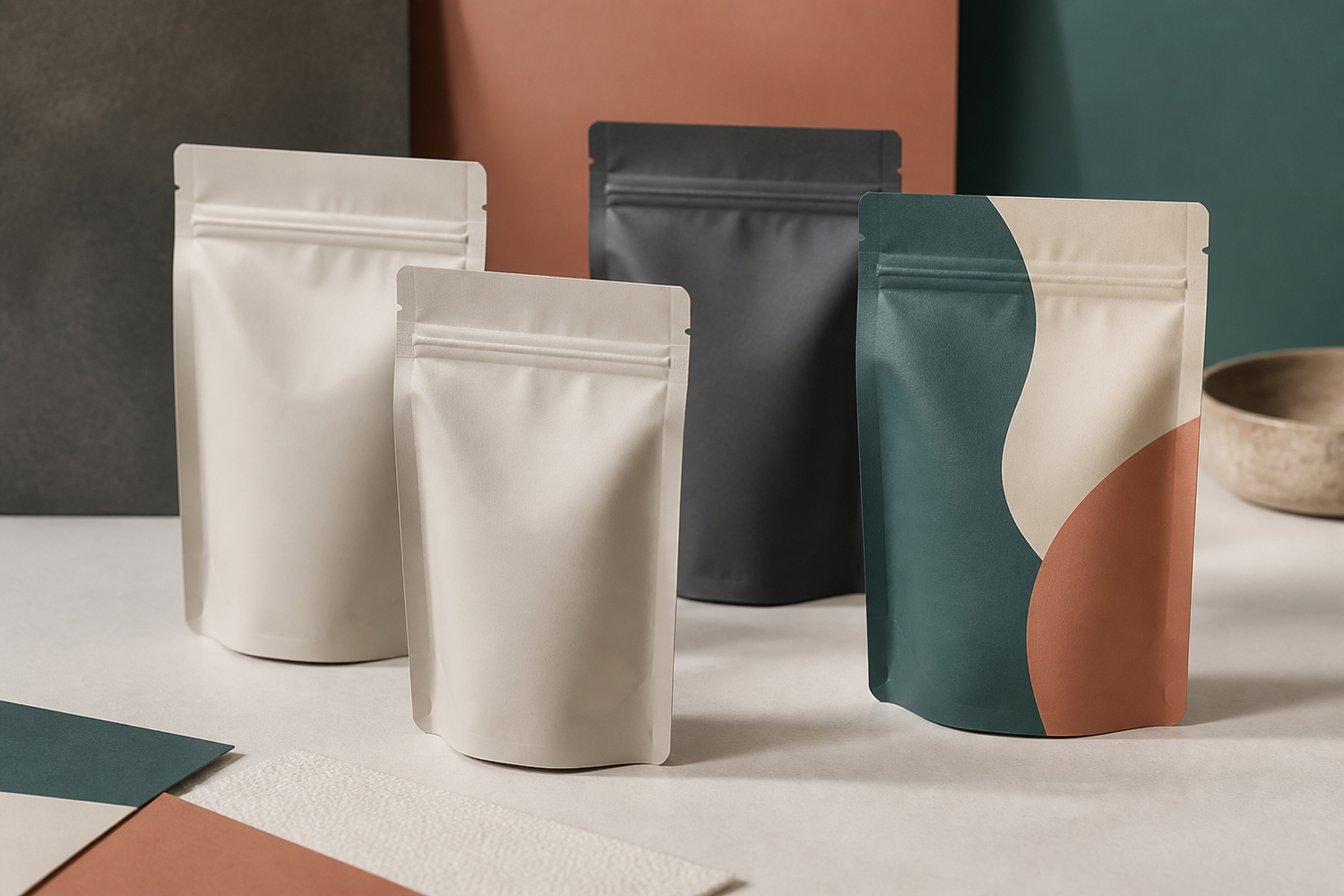
Anacotte’s current 100 pcs Matte Foil Stand-Up Pouches product is presented as a stock option for samples, small launches, and early SKU tests. The page lists multiple sizes, a matte flexible body, a resealable zipper, a heat-sealable top, and an optional label or custom-branding route. Treat those as page-level product information, not as a universal specification for every pouch or every product.
Before using a stock pouch, confirm the product state, target fill, closure, material and barrier needs, direct-contact documentation where applicable, and the distribution environment. A photo of an empty bag cannot prove shelf life, seal performance, or suitability for your product.

When stock plus a label may be the middle path
A blank pouch with a label can bridge product learning and brand presentation. It may be useful when the package geometry is known but the printed design is not. It can also help a team test a new flavor or seasonal SKU without committing every design to a longer custom-print cycle.
The trade-off is that a label becomes part of the package system. Check whether it stays attached through filling, handling, condensation, abrasion, parcel movement, and storage. Reserve enough space for required product information, a lot or date code if your process uses one, and any instructions the customer needs. Confirm the label stock and adhesive for the actual surface; do not assume that a label on one matte or foil pouch will behave the same way on another.
When custom printing earns a closer comparison
Custom printing becomes more compelling when the brand has stable artwork, a repeatable fill, a clear SKU architecture, and a quantity that can support the chosen production route. The value may be less about a single bag and more about consistent panels, repeatable brand color, a defined label-free workflow, or a pouch size and feature combination that stock options cannot provide.
Ask the supplier to separate the quote into the costs and assumptions that actually change the decision: artwork and proofing, setup, print method, material structure, pouch dimensions, closure, quantity by SKU, freight, and re-order timing. For a deeper process comparison, use the digital versus gravure printing guide, then return to the first-run question: which option fits the amount of uncertainty you still have?

Use this comparison before you order
- Write the product brief. Record whether the contents are dry, oily, dusty, granular, fragile, or otherwise sensitive. Add the target fill weight and how the pouch will be filled.
- Define the package geometry. Confirm width, height, gusset, zipper, tear notch, window, and any heat-seal area. Do not choose a feature just because it appears in a product photo.
- Set the learning goal. Decide whether the first order is for fit, customer feedback, a parcel trial, artwork approval, or a repeatable retail launch.
- Map the SKU risk. List designs, flavors, sizes, and quantities separately. Several small SKUs can change the best print route even when the total unit count looks attractive.
- Request a physical proof loop. Ask how the real product, fill, closure, artwork, and ship assumptions will be checked before production. A sample is evidence for a project, not a universal certification.

What to send with a first packaging inquiry
A useful inquiry is easier to answer when it includes the actual product state, target fill, finished pouch dimensions, preferred closure, expected quantity by SKU, artwork status, intended market, storage and distribution assumptions, and desired ship date. If you are unsure about the material or barrier, say what the product contains and how it will be stored instead of selecting a structure from a generic chart.
Use the current Anacotte quote path after you have assembled those inputs. The goal is not to force a stock or custom answer before the product is understood. The goal is to make the next sample, proof, and quote conversation specific enough to reduce rework.
Frequently asked questions
Are stock stand-up pouches always cheaper?
No. Stock can reduce the initial commitment, while custom printing may improve the economics of a stable, higher-volume design. Compare total setup, quantity, freight, labels, labor, and re-order needs for the actual project.
Can I add a label to a stock pouch?
Some stock routes support a label or custom-branding approach, and Anacotte’s current stock page describes that as an option. Confirm the surface, adhesive, label area, code plan, and handling environment before treating it as approved.
When should I move from stock to custom?
Consider the move when the artwork, SKU family, fill, package dimensions, and repeat demand are stable enough that direct printing and a larger production commitment can be evaluated with a real quote. The timing is a business and packaging decision, not a fixed unit threshold.
Packaging structures, food-contact status, barrier performance, artwork requirements, and production economics must be confirmed for the actual product and market. This article is a planning guide, not a quote or regulatory approval.
Next step: send the product state, target fill, dimensions, closure, quantity by SKU, artwork status, storage/distribution assumptions, and ship date so a stock sample or custom proof route can be evaluated on the same brief.

Laisser un commentaire
Ce site est protégé par hCaptcha, et la Politique de confidentialité et les Conditions de service de hCaptcha s’appliquent.