
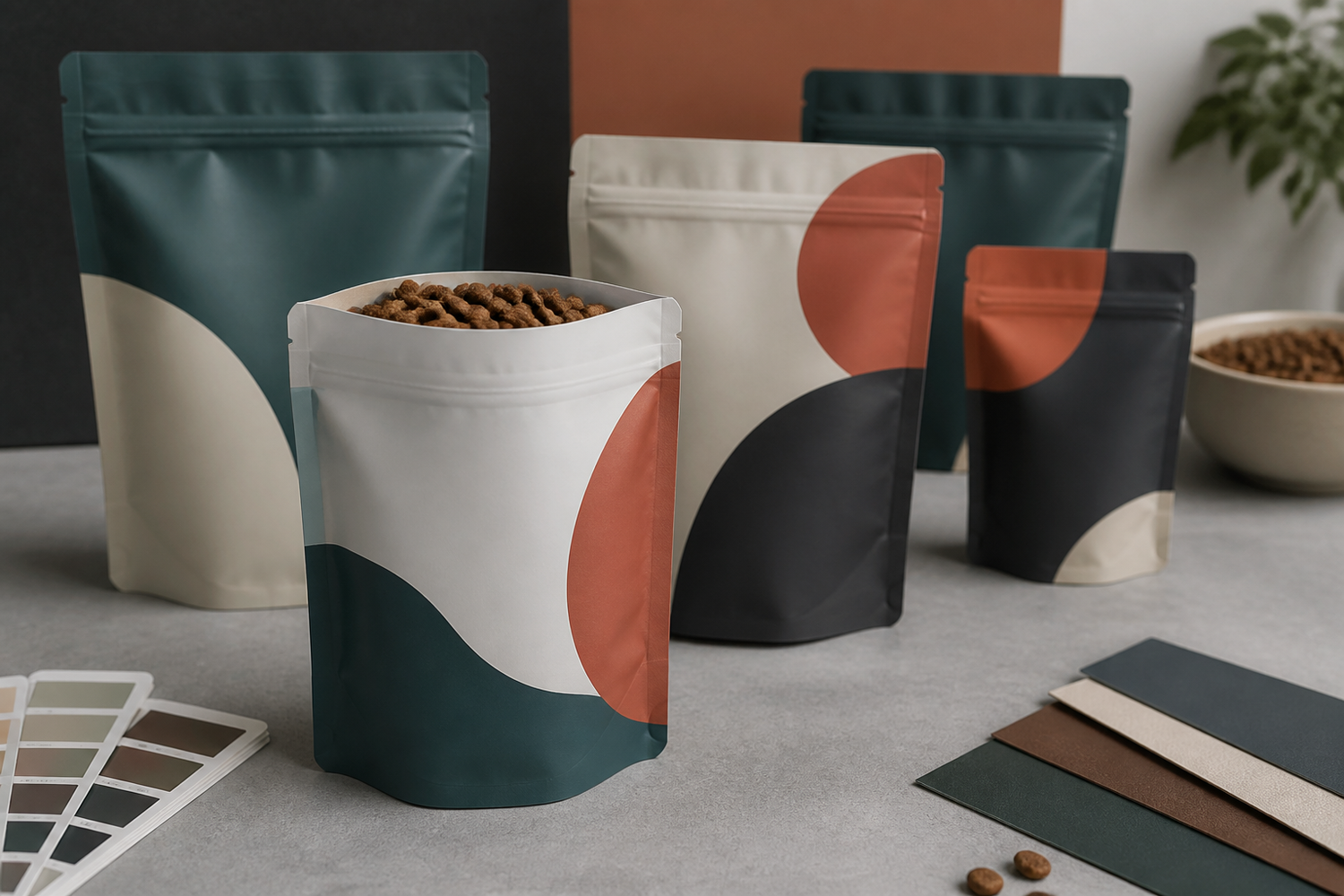
Pet food pouch packaging is not finished when the front artwork looks right. The package also has to remain identifiable and usable after it is opened, scooped, closed, stored, and—if a problem occurs—reported. That is why lot-code visibility and opened-pack handling belong in the packaging brief before a design is printed.
This article focuses on dry kibble, treats, and selected freeze-dried formats. It is an operational planning guide, not a complete pet-food regulatory opinion, a shelf-life study, or a claim that any pouch prevents contamination or preserves freshness for a defined period.

An opened bag is the real use case
A pet-food package may look perfect in a sealed product photo and still create practical questions after the first opening. Can the customer find the lot number and best-by information? Does the zipper align after representative scoops? Is the code still visible when the top is folded or the pouch is moved into a secondary container? Can the brand connect a complaint photo to a specific product and production record?
These questions do not require a universal package answer. They require a defined use loop with the real product, fill, closure, storage, and distribution assumptions.
Separate three kinds of information
Lot number. The FDA’s consumer guidance explains that a lot number can identify a specific batch of pet food or treats during a product problem or recall. It may be printed in different places on a bag or pouch, often near a best-by date or on the bottom, side, or upper area. The practical lesson is to choose and test a code zone that the responsible team can find and retain; do not assume one location is required for every product.
Best-by or date information. A date is not the same thing as a lot number. The FDA notes that companies may use date information as part of a batch-identification approach, but the package team should document how the product, date, plant, and lot information relate in the actual release process.
Traceability records. The FDA’s Traceability Lot Code page describes the connection between a traceability lot code, its source, and the records used to link supply-chain events. It also states that the final rule does not require the traceability lot code to be printed on food labeling or packaging. Do not turn that statement into a universal rule for every pet-food product or market. Instead, separate the regulatory/quality decision from the artwork decision and confirm the applicable requirements.
For a practical starting point, keep the original package or preserve the code information when product is transferred to another container. The package itself may be one of the easiest places for a customer or support team to find the information later.
Choose the pouch around the product state and use loop
For dry kibble or treats, a resealable stand-up pouch with a bottom gusset can support an upright display and repeated scoop-and-close handling. The current Anacotte dry-kibble zipper pouch is a relevant geometry reference for that conversation. The product page is not a universal proof of barrier, freshness, shelf life, or seal performance; those claims require project-specific documentation and testing.
Freeze-dried foods may lead to a different size, base, barrier, and handling discussion. Anacotte also has a flat-bottom freeze-dried dog-food reference; treat it as an alternate geometry, not an automatic replacement for a stand-up zipper pouch.
Wet pet food and retort products belong in a separate process review. Current supplier examples distinguish wet-food retort pouches from dry-food pouches, with different processing, material, and equipment questions. Do not use a dry-kibble opened-pack test as a retort approval.

Run a four-part opened-pack proof loop
| Moment | Record | Question to answer |
|---|---|---|
| Before opening | Fill weight, pouch size, lot/date zone, barcode, artwork version, and package photos. | Can the release team identify the product and code without guessing? |
| First opening | Tear-notch or opening method, top clearance, zipper alignment, and any visible seal or print damage. | Does the intended opening method match the actual filled package? |
| Repeated use | Representative scoop cycles, reclosure actions, powder or kibble in the zipper area, and code visibility after handling. | Can the package be used and closed as the brief expects? |
| Storage and complaint record | Storage assumptions, parcel conditions, original-package retention, code photo, and issue description. | Can a later complaint be connected to the right product and production record? |
This is a project test plan, not a shelf-life protocol. If the product needs a defined shelf life, oxygen or moisture barrier target, drop performance, or other technical result, add the relevant test method, acceptance criteria, and responsible reviewer to the brief.
Build the artwork and release matrix before printing
Do not leave the code zone as an afterthought. Add it to the same release matrix as the product name, variant, net quantity, barcode, ingredient or feeding information, best-by/date logic, and any market-specific label review. The matrix should identify which information is preprinted, which is added during production, and which is recorded in the supply-chain or complaint system.
The Pet Food Institute’s process overview describes packaging-stage controls such as checking the correct barcodes and date codes, reviewing container and packaging integrity, and confirming shipping conditions. Those points are useful prompts for a release record. They do not replace the brand’s quality system or applicable official requirements.

What to ask about structure and closure
- Product: What are the fill weight, particle size, oil or fat content, dust level, and intended serving or scoop?
- Geometry: Is the pouch stand-up, flat-bottom, side-gusseted, or another form, and how will it be filled and stored?
- Closure: Is the zipper used after every opening? Is a tear notch or heat seal part of the first-opening experience? Is tamper evidence a separate requirement?
- Code: How will lot, date, barcode, and plant or batch information be printed, verified, photographed, and retained?
- Distribution: What parcel, warehouse, temperature, humidity, and secondary-container assumptions should the proof reflect?
Current commercial suppliers show that pet-food pouches can use different formats, reclosure features, fitments, and material paths. A supplier case study may show a specific drop, barrier, or zipper result, but that result belongs to that project. Ask for evidence tied to your product and process instead of importing a claim from another package.
Send a supplier-ready pet-food brief
A useful inquiry includes the actual pet food or a representative sample, target fill, pouch dimensions or desired capacity, closure preference, code/artwork matrix, quantity by SKU, storage and parcel assumptions, and the date by which the package must be ready. Add photographs of the filled package after opening if the project has already started.
Use the Anacotte pet-food packaging collection to orient the format conversation, then use the quote path with the actual brief. The goal is to choose a pouch that can be evaluated in the same way it will be used—not to infer performance from an empty-bag image.

Frequently asked questions
Does every pet-food pouch need a lot code printed on the package?
Do not generalize. FDA guidance explains the usefulness and common locations of pet-food lot numbers, while the Traceability Lot Code page distinguishes recordkeeping from a universal printed-package requirement. Confirm the applicable product, market, and quality process before artwork approval.
Where should the lot code go?
Choose a zone that the filling or coding process can print reliably and that the customer or support team can find after opening. Test it on the real filled pouch, then document the location and retention process. The correct zone is project-specific.
Is a resealable zipper enough to prove opened-pack performance?
No. A zipper is a feature, not a test result. Run representative opening, scooping, contamination-of-the-closure-area observation, reclosure, storage, and code-visibility checks with the actual product and package.
Can I use the same proof for wet pet food and dry kibble?
No. Wet or retort products can require different processing, materials, equipment, and acceptance criteria. Treat them as a separate packaging brief.
Pet-food labeling, traceability, packaging structure, barrier performance, and market obligations must be reviewed for the actual product and jurisdiction. This article is an operational planning guide, not regulatory or food-safety advice.
Next step: send the actual product, fill, pouch geometry, closure, code/artwork matrix, storage, parcel, and complaint-record assumptions so a physical proof plan can be discussed.

Laisser un commentaire
Ce site est protégé par hCaptcha, et la Politique de confidentialité et les Conditions de service de hCaptcha s’appliquent.