

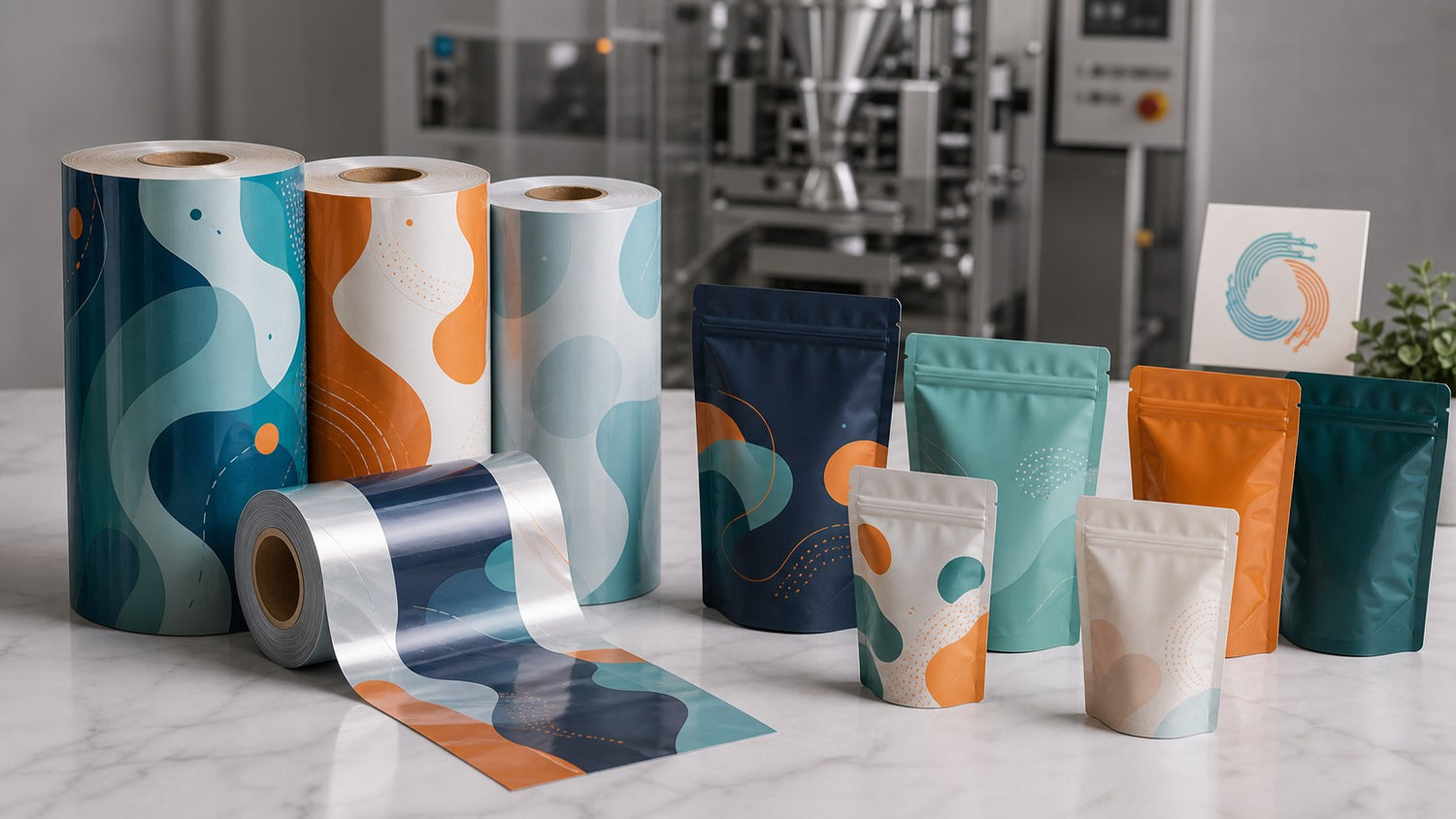
Rollstock vs premade pouches is a practical decision about equipment, MOQ, speed, flexibility, and long-term unit cost. Rollstock is printed flexible film supplied on rolls, then formed, filled, and sealed on packaging equipment. Premade pouches are already converted into bags before filling, so brands or co-packers fill and seal the finished pouch. The short answer: choose rollstock when you have compatible equipment, higher volume, and stable SKUs; choose premade pouches when you need lower setup friction, low MOQ testing, digital printing for multi-SKU launches, or a simpler co-packing path.
Both paths can use structures such as PET/PE, PET/VMPET/PE, PET/AL/PE, or recyclable mono-material options where suitable. The correct structure depends on product sensitivity, filling process, target shelf life, seal requirements, and target market. For food products sold in the United States, Canada, or EU, buyers should confirm food-contact suitability and labeling rules before production. FDA information on food contact substances, Health Canada guidance on food packaging materials, and the European Commission page on food contact materials are useful planning references.
What rollstock is best for
Rollstock is usually the stronger option when production volume is high and the brand or co-packer has form-fill-seal equipment. It can support pillow bags, sachets, stick packs, flow wrap, lidding film, and automated pouch formats depending on the machine. The advantage is efficiency: film can run at speed, storage can be compact before filling, and unit economics can improve when the SKU and equipment setup are stable.

The challenge is that rollstock requires more technical coordination. Buyers need machine width, roll width, core size, unwind direction, registration marks, seal temperature, line speed, film stiffness, and cutting tolerance. A beautiful rollstock design can still fail if the film does not track, seal, or cut properly. For this reason, rollstock buyers should involve the equipment operator or co-packer before artwork is finalized. Anacotte buyers can compare high barrier packaging options when product protection is the main driver.
What premade pouches are best for
Premade pouches are often better when brands want a more flexible launch path. They can be used for stand up pouches, flat bottom pouches, flat pouches, zipper pouches, spout pouches, sample pouches, or specialty formats. They are especially useful for startups, seasonal launches, flavor testing, retail pilots, and ecommerce programs where the brand does not yet want to commit to a high-volume automated line.

Premade pouches can support low MOQ, digital printing for multi-SKU launches, and faster SKU changes when artwork or flavors are still evolving. They may also offer more structure, closures, fitments, and shelf-ready formats than basic rollstock paths. Buyers can compare stand up pouches, flat bottom pouches, and low MOQ packaging when planning pilot runs.
Cost, MOQ, lead time, and equipment comparison
Rollstock can reduce unit cost at scale, but it can also increase pre-production work. Premade pouches may cost more per unit in some cases, but they can reduce equipment dependency and simplify early-stage launches. A custom quote should be based on size, material, artwork, print method, number of SKUs, and quantity. Lead time depends on artwork readiness, proofing, material availability, sample approval, and shipping method.
| Decision Factor | Rollstock | Premade Pouches |
|---|---|---|
| Best fit | High-volume automated filling lines | Low MOQ, pilot runs, ecommerce, retail-ready pouch formats |
| SKU flexibility | Best when SKUs are stable | Strong for multi-SKU launches and digital printing |
| Equipment dependency | High; machine specs must be confirmed | Lower; filling and sealing path is often simpler |
| Common risk | Film does not run, seal, or register correctly | Pouch size, zipper feel, or fill opening does not match product |

Material structures and sustainability claim planning

Both rollstock and premade pouches can use PET/PE for general dry products, PET/VMPET/PE for stronger light and aroma protection, and PET/AL/PE when a higher barrier foil structure is needed. Recyclable mono-material options may be suitable for selected products, but buyers should test barrier, sealing, machine performance, and shelf life before making claims. The FTC Green Guides summary explains why environmental claims should be qualified. Avoid broad claims such as eco-friendly, fully sustainable, or 100% recyclable unless supported by final structure and local recycling access.
Common buyer questions and complaints
Common questions include: “Do I need rollstock if I use a co-packer?”, “Can I start with premade pouches and switch later?”, “Which path is cheaper?”, and “Can the same artwork be reused?” Common complaints include rollstock that does not run on the machine, pouches that look underfilled, weak seals, zipper problems, and artwork placed too close to seal areas. The safest path is to confirm equipment, sample with actual product, and choose the format that matches current volume rather than a future volume target.
Another common mistake is comparing only the printed package price while ignoring operational cost. Rollstock may need machine setup, film waste during tuning, operator training, and tighter technical documentation. Premade pouches may have a higher unit price but can reduce early complexity, especially when a brand is testing several flavors, weights, or sales channels. Buyers should compare total launch cost, not only the quoted packaging unit cost.

Get a quote for rollstock or premade pouches
To quote accurately, send product type, fill weight or volume, target market, preferred format, machine specs if rollstock is needed, pouch size, material preference, barrier needs, artwork status, number of SKUs, sample needs, and quantity.

Ready to compare rollstock and premade pouches? Request a custom quote based on size, material, artwork, and quantity, or start with low MOQ digital printing if your SKU plan is still evolving.
Frequently Asked Questions
Is rollstock cheaper than premade pouches?
At higher volumes, rollstock may reduce unit cost, but it depends on equipment, film structure, speed, waste, artwork, and quantity. Premade pouches can be better for smaller or flexible launches.
Can I switch from premade pouches to rollstock later?
Yes, many brands start with premade pouches and move to rollstock after SKU, demand, and equipment requirements become more stable.
Which format is better for multi-SKU launches?
Premade pouches with digital printing are often easier for multi-SKU testing, while rollstock is stronger when volume and machine setup are stable.


Laisser un commentaire
Ce site est protégé par hCaptcha, et la Politique de confidentialité et les Conditions de service de hCaptcha s’appliquent.