
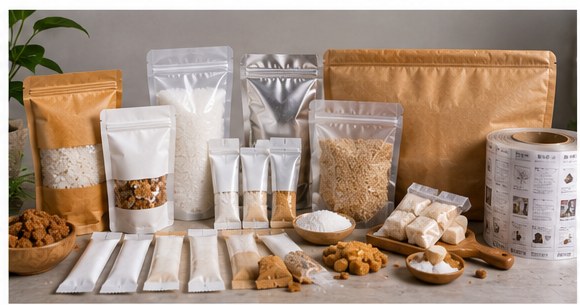
Sugar packaging needs to protect granulated sugar, brown sugar, powdered sugar, icing sugar, raw sugar, coconut sugar, sugar cubes, and sweetener blends from moisture, leakage, clumping, and poor dispensing. For retail brands, packaging should look clean and shelf-ready. For refill and bulk buyers, strength, fill volume, and carton efficiency matter more. Anacotte Packaging supports low MOQ custom options for powder sachet packaging, rollstock film, refill pouches, and custom sugar pouches.
What does sugar packaging need to protect?
Sugar is sensitive to moisture and storage conditions. Utah State University Extension recommends storing sugar in a cool, dry location and notes that moisture can make granulated sugar hard and lumpy. For packaging buyers, this means the pouch structure, seal quality, zipper design, and storage environment all affect product performance.

For food products, buyers should confirm food-contact material suitability and local labeling requirements before production. The FDA provides resources for food contact substances, and sugar brands should also review added sugars on the Nutrition Facts label when selling in the U.S. market.
For sample packs or small retail sugar formats, Anacotte’s 30 g flat pouch for tea, snacks and sample packs is a useful reference when testing compact dry-product packaging.
Retail, bulk, and single-serve sugar packaging
Retail sugar packaging usually needs a strong shelf presentation, clear product information, and enough protection for home pantry storage. Common retail sizes include 250 g, 500 g, 1 kg, and 2 kg, depending on product density and market positioning. Stand up pouches and flat bottom pouches work well for branded retail sugar because they display upright and provide printable front panels.
Bulk and refill sugar packaging usually focuses on strength, pouring convenience, and storage efficiency. Common refill or bulk sizes include 1 kg, 2 kg, 5 kg, and 10 kg. For pantry refills, café supplies, zero-waste style stores, or brands replacing rigid jars and tubs, custom refill pouches can support easier handling and lower storage volume.
Single-serve sugar packaging is usually driven by portion control, hygiene, speed, and easy dispensing. Coffee, tea, hotel, restaurant, catering, airline, and meal-kit buyers often use 2 g, 3 g, 5 g, 7 g, or 10 g sachets. Final pouch dimensions can be customized based on sugar type, filling weight, packaging equipment, and sealing method.

Materials, seals, and packaging line performance
Common sugar packaging materials include PET/PE for standard dry goods, PET/VMPET/PE or PET/AL/PE for higher moisture protection, Kraft/PE for a natural retail look, recyclable PE-based options when suitable, and rollstock film for automated filling. The Flexible Packaging Association highlights flexible packaging for product protection, convenience, and efficient distribution, but the correct structure still depends on sugar type, pack size, and filling process.

For high-speed sugar packing lines, rollstock packaging film should be reviewed for seal consistency, film friction, slip level, heat-seal window, film tension, and machine compatibility. Fine sugar and powdered sugar can create dust around seal areas, so buyers should test the film on their own VFFS or HFFS equipment before approving bulk production.
Common packaging complaints include sugar clumping after storage, powdered sugar leaking from weak seals, sachet tear notches being hard to open, sugar dust contaminating the heat-seal area, zipper tracks clogging with fine sugar, refill pouches being difficult to pour into jars, and rollstock film not running smoothly on packing machines.

Should sugar packaging use a clear window?
A clear window can be useful when the sugar has visual appeal. Granulated sugar, brown sugar, raw sugar, coconut sugar, and sugar cubes can benefit from partial visibility because customers can see color, texture, and crystal size. However, powdered sugar, moisture-sensitive sugar, or products intended for longer storage may be better in reduced-window or high-barrier structures.
For retail and sample-size dry goods, 150 g flat pouches for powders and snacks can help brands compare lightweight pouch formats, material structures, and window or print options before scaling. For heavier refill packs, a 1 kg bulk food stand up pouch is a better reference for larger dry-product capacity.

Low MOQ custom sugar packaging
Low MOQ sugar packaging is useful for private-label food brands, specialty sugar products, café supply lines, ecommerce sellers, refill programs, and seasonal sweetener blends. Brands can test pouch size, sachet tear performance, zipper behavior, clear window placement, rollstock compatibility, and artwork readability before committing to larger orders.

Sustainability claims should be made carefully. EPA recycling resources note the importance of improving communication across recycling systems, while How2Recycle provides standardized disposal instructions for packaging components in the U.S. and Canada. Recyclability depends on the final material structure, local collection systems, and package components.

Get a quote for sugar packaging
To quote sugar packaging accurately, send your sugar type, target fill weight, retail or bulk use, single-serve requirements, packaging line details, material preference, window preference, quantity, and artwork status. Anacotte Packaging can help compare sachets, rollstock film, refill pouches, and low MOQ custom retail pouches based on your product and filling process.
Ready to create custom sugar packaging? Request a quote for retail sugar pouches, single-serve sachets, rollstock film, refill packs, or bulk flexible packaging.
Frequently Asked Questions
What is the best packaging for sugar?
Retail sugar often works well in stand up pouches or flat bottom pouches, while single-serve sugar is usually packed in sachets or stick packs. Refill and bulk sugar products may need larger pouches with stronger seals and better pouring control.
Can sugar packaging prevent clumping?
Packaging can help reduce moisture exposure, but it cannot guarantee that sugar will never clump or harden. Storage humidity, sugar type, seal quality, and handling conditions also matter.
Can sugar be packed in rollstock film?
Yes, rollstock film is often used for automated sugar packing lines. Buyers should confirm film width, seal temperature range, friction, tension, and compatibility with their VFFS or HFFS equipment.
Can I order low MOQ custom sugar packaging?
Yes, low MOQ options are suitable for retail launches, private-label tests, seasonal blends, sample sachets, and refill programs. Final MOQ depends on pouch format, material, printing method, size, and production requirements.


Dejar un comentario
Este sitio está protegido por hCaptcha y se aplican la Política de privacidad de hCaptcha y los Términos del servicio.