
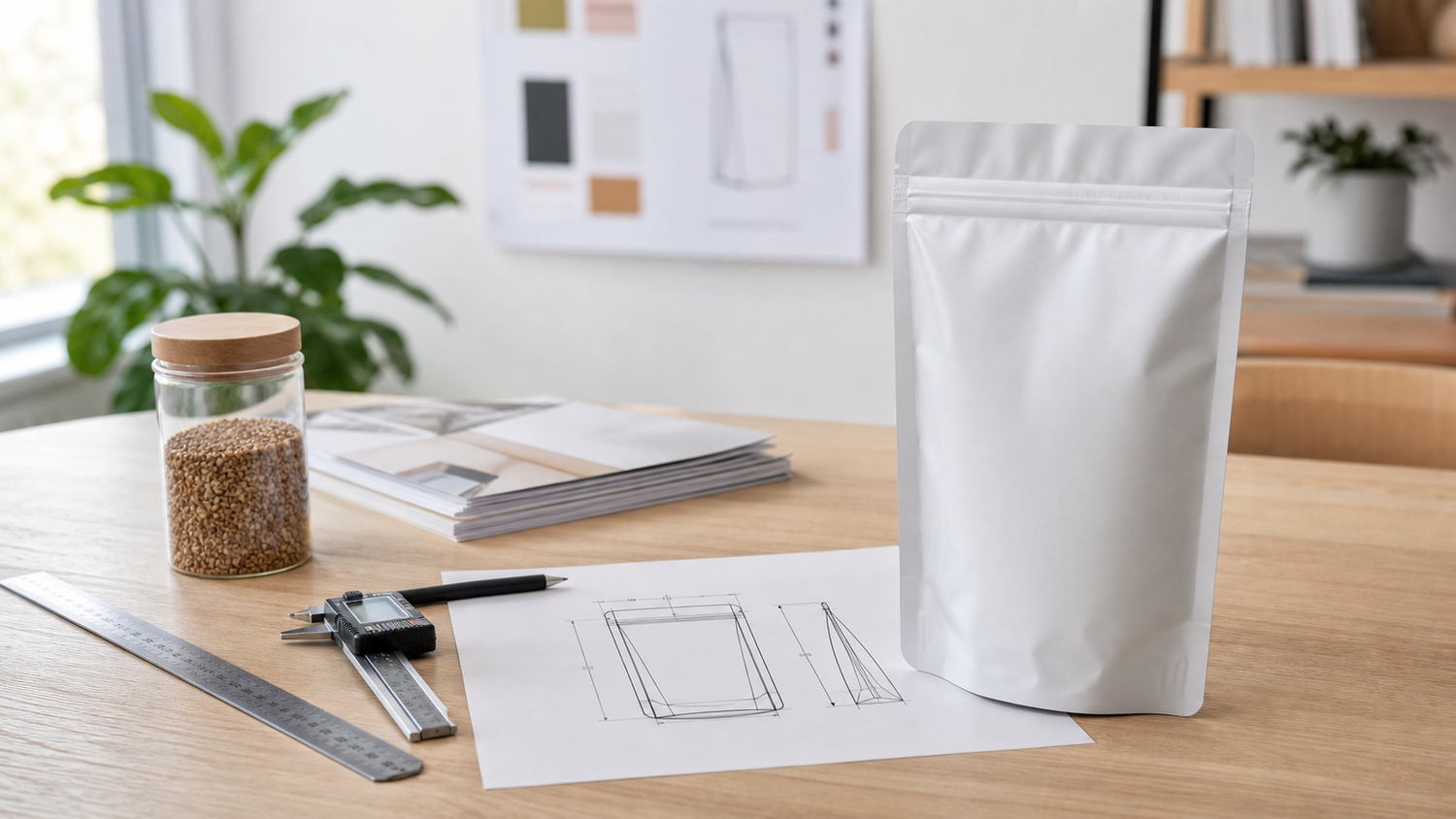
Choosing a custom pouch size is one of the earliest packaging decisions a small food, coffee, pet, supplement, beauty, or refill brand must make. It is also one of the easiest decisions to oversimplify. A label may say four ounces, eight ounces, or 250 grams, but that number alone does not describe how much physical space the product occupies. Coffee beans, fine powder, irregular pet treats, gummies, granules, liquid, and puree can have the same net weight while requiring very different usable volume, headspace, gusset depth, and seal area.
This guide gives founders and packaging buyers a supplier-ready method for choosing dimensions without publishing an unreliable universal ounce-to-size chart. Anacotte Packaging supports low-MOQ custom pouches, multi-SKU artwork, samples, and production review, but the final dimensions still need to be confirmed with the actual product, intended fill process, closure, storage condition, and physical test-fit. The goal is to reduce back-and-forth, not to replace engineering or filling trials.
Quick Answer: Start with product form and target fill weight or volume, then measure bulk density or viscosity, reserve headspace and closure space, choose a pouch format, confirm the filling method and shelf constraints, compare a reference package, and complete a physical test-fit. Do not choose a final pouch only from ounces because products with the same labeled weight can fill very differently.
Custom Pouch Size Brief: The Minimum Inputs
A packaging supplier can respond more accurately when the request separates known facts from preferences. Use the following table as the first page of the brief.
| Input | What to Provide | Why It Changes Size |
|---|---|---|
| Product form | Powder, granule, bean, irregular solid, liquid, puree, or frozen item | Shape, density, flow, and void space affect usable volume |
| Target fill | Net weight, fill volume, or unit count | Defines the required product space before headspace |
| Pouch format | Stand up, flat, flat bottom, side gusset, or spout | Each format uses width, height, and gusset differently |
| Closure and seal | Zipper, spout, tear notch, heat-seal band | Hardware and seal zones reduce usable interior height |
| Filling method | Hand fill, funnel, auger, premade pouch machine, or liquid filler | Equipment needs access, grip, and seal clearance |
| Reference pack | Photos and measured width, height, gusset, and seal area | Creates a concrete baseline for adjustment |
1. Start With Product Form, Not the Label Ounces
A net-weight statement is a commercial and labeling number, not a three-dimensional packaging specification. Fine protein powder can settle densely, coffee beans create large air gaps, jerky strips bridge across a narrow pouch, and puree moves according to viscosity. When those products are treated as interchangeable, a buyer may receive a bag that technically holds the product but fills poorly, looks underfilled, or leaves too little room for sealing.
Classify the product as powder, granule, regular solid, irregular solid, liquid, puree, or a temperature-controlled item. Then note whether it compacts, breaks, releases oil, traps air, foams, or changes volume after transport. These observations help a supplier identify which dimensional assumptions are safe to discuss and which require physical samples.
Describe how the product behaves
Send a small product sample or record the volume occupied by a known weight in a straight-sided container. Add photos showing particle shape, product length, and how the product settles after tapping.
Decision boundary: A general product category cannot establish final dimensions. Two granolas or two pet treats can have different bulk density and breakage behavior.
2. Separate Net Content, Target Fill, and Usable Capacity
Buyers often use net content, target machine fill, and nominal pouch capacity as if they are the same value. Net content is what the brand intends to sell. Target fill is the operational amount placed in the pack. Usable capacity is the space available after accounting for seals, zipper, spout, gusset behavior, product flow, and acceptable headspace. Confusing these terms creates avoidable quoting and sampling errors.
Record the commercial net weight or volume, the acceptable filling tolerance, and any count-based requirement. For liquids, provide both volume and approximate viscosity. For pieces, provide maximum length and typical count. For powders and granules, give bulk density if available or a measured volume for a known weight.
Write three different numbers in the brief
Create a one-line fill statement such as: 250 g whole coffee beans, hand filled, moderate headspace desired, resealable zipper, one-way valve, retail shelf use. This is far more actionable than asking for a 250 g bag.
Decision boundary: Nominal capacity tables are only references. They are not guarantees for an untested product.
3. Reserve Headspace for Filling, Settling, and Customer Use
Headspace is not automatically wasted material. It can provide room for a funnel, allow powder to settle below a zipper, keep crumbs away from a seal, make a spout pouch easier to fill, and improve the first-opening experience. Too much headspace can make a pouch look underfilled, while too little can contaminate the seal or create a strained package.
Define headspace according to the fill method and customer experience. A hand-filled startup pouch may need more working room than a tuned automated line. A resealable bag needs product below the zipper after transport. A premium flat-bottom bag should look intentionally filled without forcing the panels outward.
Decide what good headspace looks like
During test-fit, photograph the pouch immediately after filling, after settling, after sealing, and after a simulated shipment. Measure the distance from product level to zipper and top seal.
Decision boundary: A visual mockup cannot confirm working headspace because it does not reproduce product flow, settling, or sealing.
| Pouch Format | Useful Starting Use Case | Sizing Caution |
|---|---|---|
| Stand-up pouch | Snacks, treats, powders, gummies, refills | Bottom gusset opens differently by product and fill method |
| Flat pouch or sachet | Samples, single use, lightweight fills | Top and side seals consume a larger share of small packs |
| Flat-bottom pouch | Coffee, pet food, premium snacks | Panel width and box bottom must fit both product and shelf |
| Spout pouch | Liquids, gels, purees, concentrates | Spout location, viscosity, cap, fill temperature, and equipment matter |
| Side-gusset bag | Dense beans, larger dry goods, bulk packs | Case packing and vertical seal structure can limit dimensions |
4. Account for Zippers, Heat-Seal Bands, and Spouts
The printed height of a pouch is not the same as its usable fill height. The top heat-seal band, tear notch, zipper profile, hang hole, valve, or spout each occupies a functional zone. Artwork and product must stay clear of those zones. On small sachets, a few millimeters can materially change capacity and opening performance.
Ask the supplier for a dieline or annotated drawing that identifies the top seal, zipper centerline, tear notch, gusset fold, spout weld, and recommended artwork safe area. Use that drawing in both packaging design and fill trials.
Protect the functional zones
Mark the intended fill line on a blank sample. Confirm that product does not enter the zipper track or spout weld area and that the heat sealer can close the top without wrinkles or contamination.
Decision boundary: Moving a closure after artwork approval can require a new dieline and should not be treated as a cosmetic adjustment.
5. Choose a Format That Matches Product and Shelf
A stand-up pouch is versatile, but it is not automatically best for every product. Flat pouches can reduce material for samples. Flat-bottom bags can create stronger premium presentation. Side-gusset bags can suit dense coffee and larger dry fills. Spout pouches can support controlled dispensing for liquids and purees. The structure affects both capacity and the way shoppers perceive the fill.
Compare product behavior, fill weight, shelf footprint, display method, case packing, and expected price point. A small premium coffee launch may justify a flat bottom, while an influencer sachet may need a compact flat pouch. Keep one format across multiple SKUs only when the products actually fill similarly.
Use structure before decoration
Request blank samples in two likely formats and test them side by side with the real product. Record fill time, seal cleanliness, shelf stability, and case count.
Decision boundary: A premium-looking structure is not useful if it complicates filling or causes excessive unused capacity.
6. Match Dimensions to the Filling Method
The same pouch can behave differently on a tabletop hand-fill process and an automated line. Equipment may require a specific top opening, grip area, zipper position, spout orientation, or pouch stiffness. Powder can dust the seal; liquids can splash; long treats can bridge at a funnel. These process details can change the required width and headspace.
State the filler model or describe the manual process. Provide jaw width, nozzle or funnel size, pouch holder limits, seal-bar width, and desired throughput when known. If a co-packer will fill the product, include that partner before the dieline is locked.
Check hand fill and equipment constraints
Run a short filling trial using blank pouches and the intended sealer or machine. Time the process and inspect failed seals rather than relying only on whether the product fits.
Decision boundary: A pouch that passes a desk test may still fail equipment handling or production-speed requirements.
Common Mistakes and Better Decisions
Most pouch sizing mistakes come from missing inputs rather than a lack of available sizes. The correction is to make the brief explicit and test the assumptions.
| Mistake | Why It Fails | Better Decision |
|---|---|---|
| Choosing only by ounces | Weight does not describe density or shape | Provide product form, measured volume, and test sample |
| Using outside dimensions as capacity | Seals, zipper, and gusset reduce usable space | Review an annotated finished drawing |
| Ignoring the filler | Opening and seal clearance may not fit the process | Test on the actual manual or machine setup |
| Sharing one size across unlike SKUs | Fill appearance and headspace become inconsistent | Group SKUs by physical behavior |
| Approving only a digital proof | Artwork proof does not confirm capacity | Complete and document a physical test-fit |
What to Prepare Before Requesting a Quote
A concise size brief helps Anacotte Packaging and any filling partner respond with fewer assumptions.
- Product name and physical form
- Target net weight, volume, or unit count
- Measured occupied volume or bulk density when available
- Preferred pouch format and closure
- Storage condition and desired shelf-life target
- Hand-fill or equipment information
- Reference package photos and full measurements
- SKU count, quantity per SKU, artwork status, and launch date
Mark every item as confirmed, preferred, or unknown. Unknown is acceptable when it is visible; hidden assumptions are the greater risk.
Authoritative Checks and Internal Next Steps
For food and ingestible applications, use FDA food-contact substances resources as a starting point for regulatory context and keep material decisions with qualified suppliers and advisors. Use GS1 US when retail identification and barcode planning enter the project. These sources do not select a pouch size, but they help keep the broader packaging brief complete.
Continue with the relevant Anacotte Packaging resources: stand-up pouches, flat pouches, flat-bottom pouches, low-MOQ packaging, custom quote form. These links help buyers move from education to a format comparison, sample request, or production quote without treating a general guide as a finished technical specification.
Frequently Asked Questions
Can a supplier recommend pouch size from ounces alone?
Usually not with enough confidence for production. Ounces describe weight, while physical space depends on density, particle shape, trapped air, viscosity, headspace, closure, seals, and filling method. Ounces can start the conversation, but the buyer should provide product form, a measured sample, and ideally a physical test-fit.
How do I measure an existing pouch?
Measure the finished width and height, then record the bottom or side gusset, top seal, zipper position, tear notch, valve, spout, and any other functional zone. Photograph the front, side, bottom, and top with a ruler. Note whether the package was measured empty or filled.
Can several SKUs use one pouch size?
Yes when the products have similar fill volume, shape, headspace, closure, and filling needs. Create a SKU map and test the most demanding compatible product. If one SKU is much bulkier, more fragile, or uses different equipment, a separate size can be the better decision.
What is the difference between pouch dimensions and usable capacity?
Pouch dimensions describe the finished exterior. Usable capacity is the practical interior space left after side seals, top seal, zipper, spout, gusset behavior, product flow, and required headspace. The two are related but not interchangeable.
When is a physical test-fit essential?
Use a test-fit before printed production whenever the product is new, density is uncertain, pieces are irregular, the pouch includes a zipper or spout, equipment is involved, or multiple SKUs may share one size. It is also important after any change to fill, structure, or closure.
Does a digital proof confirm pouch size?
No. A digital proof confirms artwork placement and selected dimensions on a drawing. It does not reproduce product volume, settling, filling, seal contamination, zipper use, or shipment. Pair proof approval with a documented physical test-fit.
Next Step: Turn the Decision Into a Supplier-Ready Brief
If you know your dimensions, send them with the product, format, artwork, and quantity. If you only know fill weight or volume, send a product sample or reference package and request size-review samples before production. Start with the Anacotte Packaging quote form and state clearly that final dimensions require test-fit approval.

Dejar un comentario
Este sitio está protegido por hCaptcha y se aplican la Política de privacidad de hCaptcha y los Términos del servicio.