
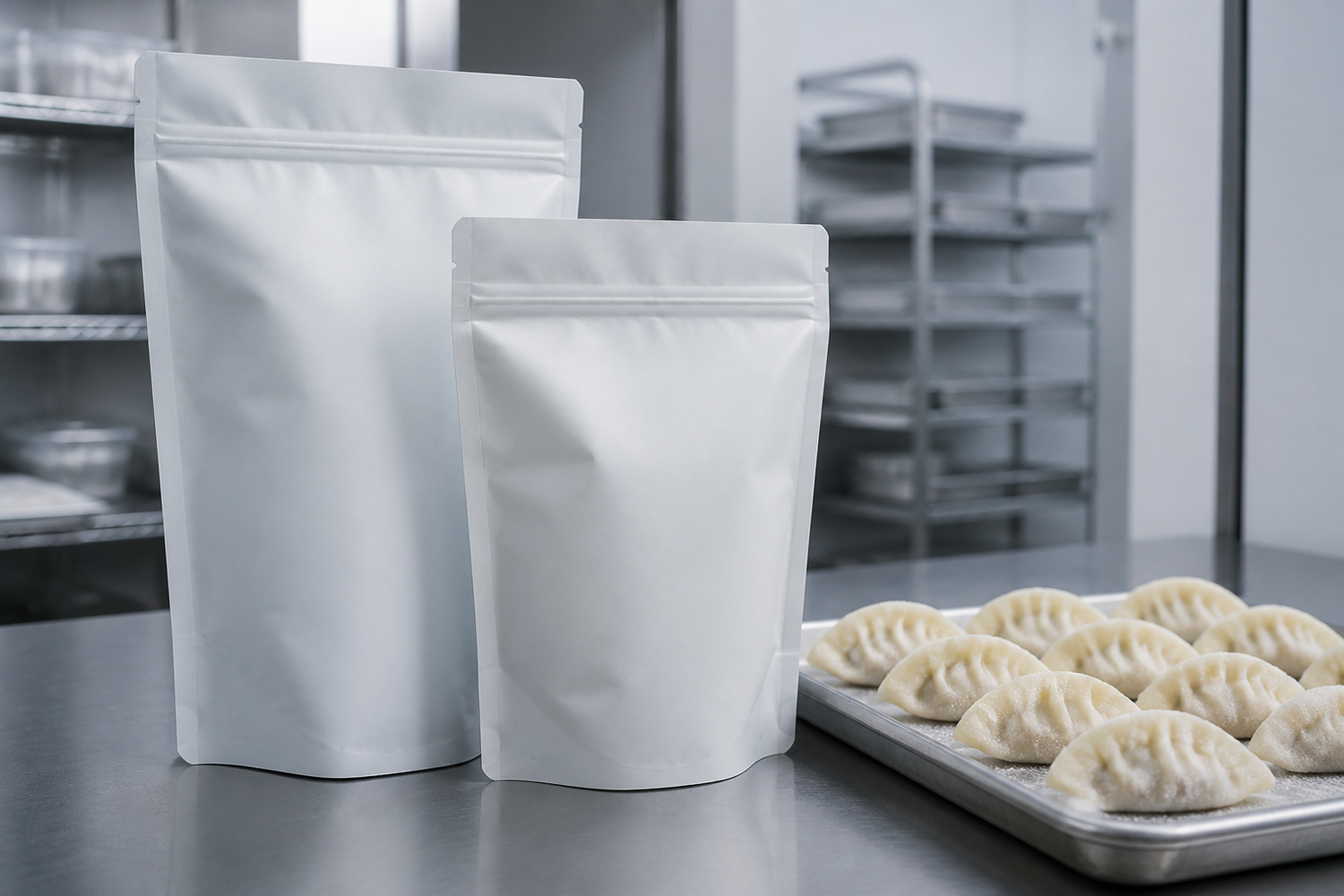
Frozen dumpling pouch packaging has to do more than hold a target net weight. The bag must accommodate dumpling count and shape, tolerate frost and frozen handling, keep seals and corners intact, provide usable cooking and handling information, and—when it is a multi-serve pack—let customers remove a portion without fighting a brittle zipper or tearing the panel.
This guide is for U.S. frozen-food founders, co-packers and operations teams preparing retail dumpling bags. It is packaging-planning information, not food-safety, process, cold-chain, labeling, transport-testing or legal advice. The responsible manufacturer, quality team, packaging supplier, test lab and regulatory reviewer should approve the food, process, package and instructions.

1. Define the dumpling and the route to the freezer
Create one controlled line for every sellable SKU. Record whether the dumplings contain raw, partially cooked or fully cooked meat, poultry, seafood or plant-based filling; classification and regulatory ownership affect label review and safe-handling instructions. Also capture the freezing process, product temperature at packing, fill equipment, storage range and intended distribution route.
- Dumpling type, formula revision and responsible food-safety owner.
- Piece dimensions, shape, edge profile and expected variation.
- Target count and net weight, plus fill tolerance and verification method.
- Individual quick freezing, tray freezing or other documented process.
- Frost, surface moisture and product hardness at the moment of filling.
- Retail or foodservice channel, case pack, storage and distribution temperatures.
- Cooking, safe-handling, allergen and variable-code copy status.
Do not use a generic “freezer-safe” description as the full specification. The supplier needs actual intended conditions; the quality team needs a validation plan; and the label reviewer needs the real formula and process.
2. Size with piece geometry, count and frost

Dumplings do not behave like a uniform powder. Pleated edges, pointed corners and irregular orientations can create local pressure against a film or seal. Fill multiple prototypes with production-representative frozen pieces. Record count, weight, occupied volume, headspace and how the pieces settle after normal case handling.
Check the following:
- Fill opening: pieces should enter without striking the zipper or contaminating the final seal area.
- Panel and corner loading: identify contact points where hard frozen edges press into the pouch.
- Seal clearance: normal count and orientation variation should stay below closure and seal zones.
- Display shape: confirm that the filled bag stands or lies as intended without hiding required copy.
- Portion removal: customers should be able to remove several pieces without dumping the entire pack.
A slightly larger bag may reduce top-seal risk and improve portion access, but excess headspace can affect shelf presentation and case efficiency. Compare filled samples instead of assuming that one catalog dimension is best.
3. Inspect seals, corners and the zipper while frozen
Materials and closures that feel flexible at room temperature can behave differently after freezing. Condition filled samples using the documented temperature/time profile chosen by the quality team. Then inspect them while still cold, after controlled handling and—if relevant—after approved temperature transitions.

Observe corner whitening or cracks, panel pinholes, delamination, seal channels, zipper brittleness, tear behavior and frost trapped in the closure. Cycle the zipper with product in the pack, not only on an empty sample. If the product is intended for multiple servings, repeat open-remove-reclose steps from the frozen condition and note whether ice or crumbs prevent closure.
USDA FSIS explains that proper packaging helps maintain frozen-food quality and prevent freezer burn. That consumer guidance supports the need for an intact package, but it does not prescribe a laminate or guarantee a shelf life. Define project-specific tests and acceptance criteria with qualified parties.
4. Separate frozen-food quality from safety claims
USDA's Freezing and Food Safety guidance distinguishes food safety from quality and directs consumers to follow product labels. Avoid implying that a pouch by itself makes a product safe, prevents all freezer burn or proves a cold chain.
The validated package plan should identify who owns freezing controls, seal verification, foreign-material controls, temperature monitoring, shelf-life study, complaint review and release. Packaging observations can reveal cracks or leaks, but they do not replace the food-safety plan.
5. Proof cooking, handling and allergen panels on the formed bag
Dumpling labels may need dense information: product identity, net quantity, ingredients, allergen declarations, Nutrition Facts, business details, storage statement, cooking instructions, lot/date code and possibly safe-handling text. Jurisdiction and formula ownership matter, especially for meat and poultry products.
USDA publishes Safe Handling Label Text for applicable raw or partially cooked meat and poultry products. FDA's 2025 allergen-labeling guidance covers FDA-regulated foods and major allergen food-source declarations. A qualified reviewer must determine which rules and statements apply to the actual dumpling SKU.
Print artwork at full size, form and fill the bag, then check:
- Principal display and net-quantity areas on the frozen filled shape.
- Ingredient, allergen, nutrition and business-information readability.
- Storage and cooking directions, including preparation methods actually validated by the food team.
- No-copy areas at the final seal, zipper, tear feature, gussets and registration tolerance.
- Lot/date code contrast and adhesion after cold conditioning and handling.
6. Test the complete frozen case pack

Place filled pouches in the intended case count and orientation. Condition them as the project requires, then apply a documented handling sequence. Inspect seals, corners, gussets, closures, scuffing, code readability and product damage. Note whether hard frozen pieces create repeated contact points or whether a pouch shifts and folds inside the case.
For direct-to-consumer shipments, validate the whole insulated parcel system separately, including coolant, time/temperature profile and delivery variables. The flexible pouch is only one part of that system. Do not claim that a passing pouch observation validates the shipper or food safety.
7. Send a quote-ready dumpling pouch brief
Provide product classification and responsible regulatory owner; representative frozen dumplings; piece dimensions and edge profile; target count/weight; freezing and filling route; temperature conditions; pouch format and closure concept; final sealing method; cooking/handling artwork status; case pack; quantities; and written sample-test questions.
Review Anacotte's frozen dumpling stand-up pouch and frozen-food packaging options, then request a project-specific quote. Treat supplier suggestions as candidates to validate with the real product and process.
Frequently asked questions
Can a pouch be chosen from dumpling weight alone?
No. Piece count, shape, frost, orientation, fill method, headspace and frozen handling all affect the working package. Test representative frozen pieces.
Does a zipper prevent freezer burn?
Do not make that guarantee. Package integrity, initial seal, barrier, reclosure use, storage and shelf-life validation interact. Test the complete filled pack.
Should zipper tests be performed at room temperature?
Room-temperature checks are useful but incomplete. Include product-filled samples conditioned to the approved frozen profile and inspect/cycle them as specified by the quality team.
What should be included in the supplier handoff?
Send formula/regulatory ownership, representative frozen pieces, dimensions, count/weight, freezing/filling route, temperature profile, closure/seal concept, label status, case pack, quantities and sample-test questions.

Dejar un comentario
Este sitio está protegido por hCaptcha y se aplican la Política de privacidad de hCaptcha y los Términos del servicio.