
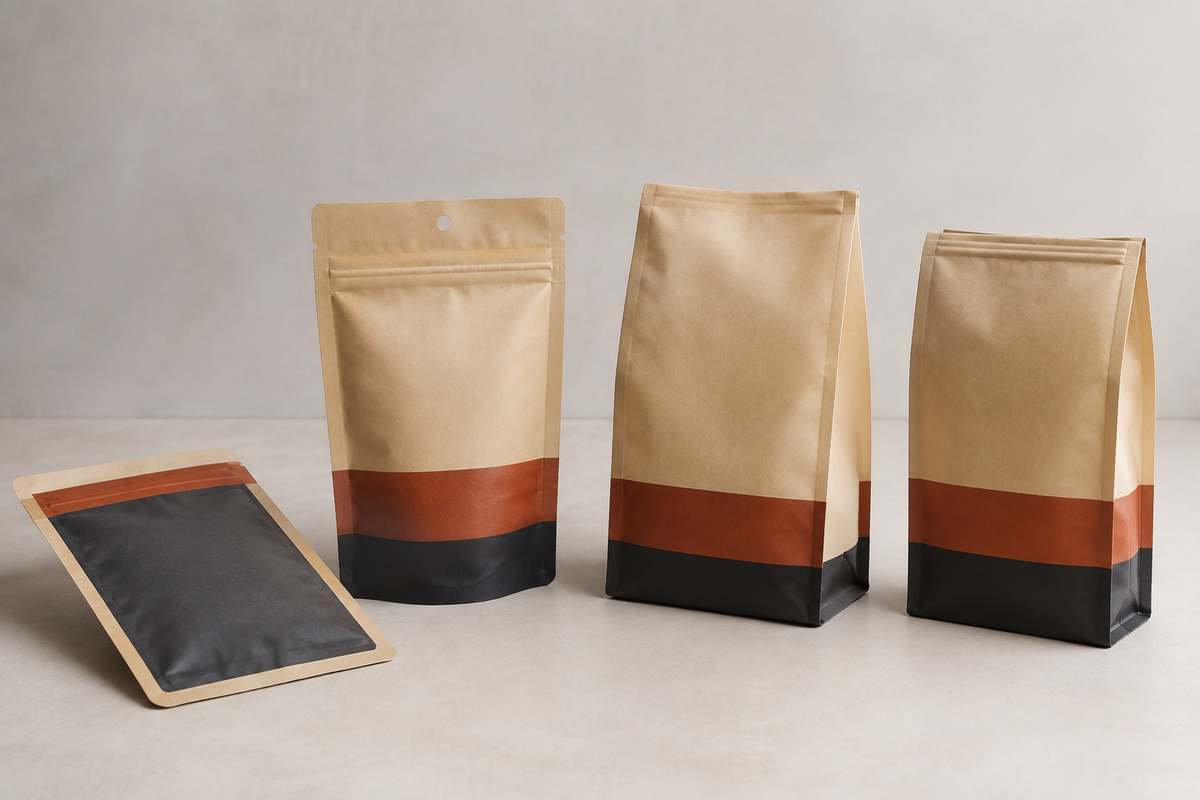
Beef jerky pouches should be specified around the product and the route to market, not around an empty-bag photo. A long strip, a narrow meat stick, a mixed-piece snack, and a crumb-prone fill can create different requirements for pouch width, mouth opening, headspace, seal protection, and reclosure.
This guide is for U.S. jerky brands, meat-snack founders, co-packers, and packaging buyers preparing a pouch brief. It is packaging-planning information, not food-safety, shelf-life, nutrition, label, or regulatory advice. The responsible food-safety, quality, and label owners must approve the actual process, storage route, copy, and finished pack.

Start with the jerky shape and sellable unit
The first question is not “Which pouch looks premium?” It is “What is going inside, how much goes in each unit, and how will the customer use it?” Capture the product form before asking a supplier to recommend a structure.
| Product situation | First packaging question | What to check with a sample |
|---|---|---|
| Long or wide strips | Does the pouch give the product enough width and a clean path from fill to opening? | Strip alignment, product movement, opening force, and whether edges reach the seal. |
| Individual meat sticks | Is a narrow single-serve pouch more useful than a larger resealable pack? | Stick insertion, tear direction, corner clearance, and how the product exits. |
| Small pieces, mixed cuts, or crumbs | How much mouth area and seal protection are needed for the actual fill? | Fines in the seal area, closure contamination, fill consistency, and handling. |
| Multi-portion retail pack | Will the consumer open and close the bag more than once? | Filled stance, zipper access, reseal behavior, and product residue near the track. |
These are starting hypotheses, not universal format rules. The representative product, target fill weight, tolerance, headspace, and case pack should travel with the request for quote. If a co-packer fills the bags, include its equipment and line-clearance requirements at the beginning.
Treat barrier as a requirement to qualify
Jerky suppliers commonly discuss oxygen, moisture, aroma, grease, and puncture protection because the package has to preserve the intended product experience after filling, sealing, shipping, and opening. ePac’s current jerky packaging overview shows high-barrier and metallized options alongside stand-up, lay-flat, and roll-stock routes. TricorBraun Flex likewise describes high-barrier film lamination as a typical jerky-packaging consideration in its current supplier example.
That evidence supports a better brief, not a universal laminate choice. “High barrier” is not a complete specification by itself. Ask the supplier which performance questions matter for the actual product, how the proposed structure will be converted and sealed, and what testing is needed. Keep the product, process, storage, and target shelf-life decision with the responsible technical owner.
The USDA FSIS jerky and food-safety reference is useful for keeping process and storage questions in the right lane. A pouch does not make an unqualified process safe, and a packaging page is not approval for a specific recipe or shelf-life claim.

Choose the pouch format by route, not by label alone
Flat three-side-seal pouches
A flat pouch can be a sensible starting hypothesis for single-serve strips, meat sticks, samples, or a route where compact storage matters more than a standing display. It can also reduce unnecessary features for a one-time opening. Confirm the filled width, tear path, seal margin, and whether the product can be removed without catching on a corner.
Stand-up pouches with a zipper
A stand-up pouch may fit a retail pack that needs shelf presentation and repeat opening. A zipper is not automatically the right answer: crumbs, oil, distorted fill, and an overfilled pouch can make reclosure less useful. Test the zipper with the real product, after transport and after several opening cycles.
Flat-bottom and quad-seal pouches
These structures can be considered when a brand wants a more structured retail footprint or a different panel arrangement. Review the filled width, depth, height, seam placement, and how much product settles at the bottom. Anacotte’s current 4 oz / 113g flat-bottom jerky pouch and 3 oz / 85g quad-seal jerky pouch are useful route references to discuss with a packaging specialist; their existence does not approve a particular size or structure for your product.
For an individual meat-stick route, compare the requirements with Anacotte’s 1 oz / 30g custom flat pouch reference. A product page can help start the conversation, but the representative stick and the actual fill routine still control the final drawing and sample.
Make opening and reclosure part of the job
Decide whether the customer should tear once, peel open, or reopen the pack over several servings. Then connect that decision to the product:
- A tear notch should lead to a controlled opening without cutting through the usable panel or creating a sharp, awkward edge.
- A zipper should remain outside the seal-contamination risk created by the actual fill. Reclosure must be checked after opening, product removal, and handling.
- A window can help product visibility, but it changes the artwork and material conversation. Treat it as an option to evaluate, not a universal freshness or shelf-appeal promise.
- A hang hole, rounded corner, or special finish can affect the filled pack, the display route, and the safe area for copy and codes.
Current supplier examples show how different these options can be. ePac lists resealability, windows, tear notches, peelable films, and top-fill or bottom-fill routes as configurable features. The Pouch House’s jerky pouch page similarly presents high-barrier printed pouches with optional windows and zippers and asks brands to coordinate with the co-packer. These are market examples, not a reason to copy a feature list without testing.

Send a co-packer-ready brief
A quote becomes easier to compare when every supplier receives the same inputs. Include:
- Product form, representative samples, target fill weight, tolerance, headspace, and whether the pack is single-use or multi-portion.
- Strip, stick, piece, crumb, fat, moisture, aroma, and puncture observations that the technical owner wants the package to address.
- Manual, top-fill, bottom-fill, or co-packer line information; equipment constraints; and the expected seal and line-clearance routine.
- Candidate format, filled dimensions, closure, tear notch, window, hang hole, finish, and front/back panel map.
- Approved label copy owner, nutrition/allergen review, barcode, lot/date-code method, artwork status, and SKU or flavor matrix.
- Distribution route, case pack, storage assumptions, sample count, and the questions the filled-pack test must answer.
Ask for the supplier’s assumptions in writing. If one quote says “stand-up jerky pouch” and another says “flat-bottom bag,” compare the drawings, dimensions, fill direction, materials, closures, and test plan rather than comparing the names.
Use a four-step validation loop before the first run
- Confirm the empty geometry. Check the dieline, panel map, seal areas, closure, tear feature, and filled dimensions.
- Fill with representative product. Use the actual strip, stick, piece, or mixed fill at the intended target and tolerance.
- Inspect the opened pack. Record seal contamination, opening force, tear path, product removal, zipper reclosure, edge lift, and panel readability.
- Run the route you will sell. Include case packing, shipping or handling, storage assumptions, and the responsible food-safety and quality review.
For a broader seal question, see Anacotte’s pouch seal-strength testing guide. For the first-run decision between stock and custom formats, use the stock-versus-custom stand-up pouch guide as adjacent planning context.

What to send when you request a jerky-pouch quote
Share the product form, target fill, representative sample, fill direction, desired opening and reclosure routine, storage and distribution assumptions, label status, SKU count, and the filled-pack tests you need. Then contact Anacotte for a project-specific conversation about format, material questions, print, sampling, and quote inputs. The best starting pouch is the one that can be tested against the product and the route—not the one with the most features.

Dejar un comentario
Este sitio está protegido por hCaptcha y se aplican la Política de privacidad de hCaptcha y los Términos del servicio.