

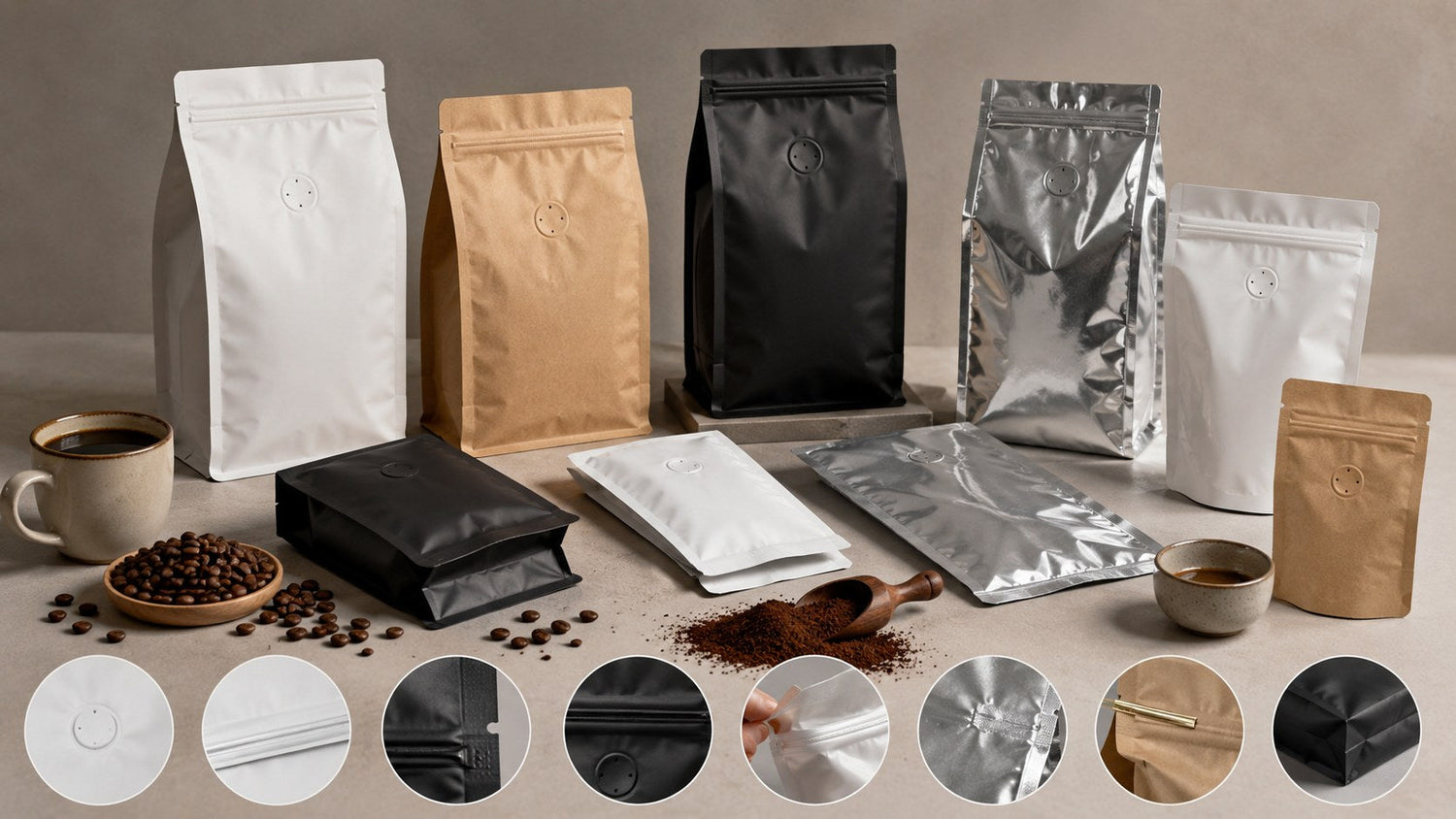
Coffee bags with valve are designed for freshly roasted coffee brands that need aroma protection, pressure release, retail presentation, and reliable shipping performance. They are commonly used for whole bean coffee, ground coffee, specialty coffee, coffee samples, retail coffee bags, wholesale coffee bags, and roast-to-order coffee packaging.
A one-way degassing valve helps release CO2 from freshly roasted coffee and reduce bag swelling, but it does not replace high-barrier film or guarantee freshness by itself. A good coffee packaging system should combine the right valve, barrier film, seal strength, zipper or tin tie, filling process, roast timing, storage condition, and shipping method.
Anacotte Packaging supports low MOQ custom coffee bags with valve for specialty roasters, private label coffee brands, ecommerce sellers, and wholesale coffee suppliers. Buyers can compare custom coffee bags with valve, valve packaging, coffee and tea packaging, and coffee bags with valve vs flat pouches before choosing the final format.
Why freshly roasted coffee needs valve planning
Freshly roasted coffee can continue releasing carbon dioxide after roasting. The fresher the roast is when packed, the more important valve planning becomes. Coffee packed the same day, within 24 hours, or 1–3 days after roasting may create more internal pressure than coffee packed after degassing or resting.

The Specialty Coffee Association discusses coffee freshness as a race against oxygen, moisture, temperature, and time. For coffee packaging, this means the valve should be treated as only one part of the freshness system. Oxygen barrier, moisture barrier, light protection, aroma retention, and seal quality are still essential.
Whole bean coffee usually needs more degassing consideration than many ground coffee projects, especially when packed soon after roasting. Ground coffee has different aroma loss and oxidation concerns, so film barrier and filling conditions are just as important as valve selection.
How a one-way degassing valve works
A one-way valve is designed to release internal gas while helping limit oxygen entry compared with simply opening the package. This can help reduce swelling and bursting risk in freshly roasted coffee bags. However, the valve does not make the coffee automatically fresh, airtight forever, or shelf-stable under all conditions.

Coffee storage guidance from the National Coffee Association emphasizes protecting coffee from air, moisture, heat, and light. That is why coffee brands should evaluate valve performance together with high-barrier film, heat seal strength, zipper reclosure, storage conditions, and transit time.
Valve position also matters. A front valve, back valve, or upper front valve should avoid the seal area, zipper, artwork, label space, and filling equipment contact points. Poor valve placement may cause artwork conflicts, weak presentation, blocked airflow, or inconsistent pressure release.
Coffee bag formats: side gusset, flat bottom, stand up, and flat pouch
Coffee brands often compare side gusset coffee bags, flat bottom coffee bags, stand up coffee pouches, flat pouches with valve, kraft coffee bags, and high-barrier foil coffee bags. Each format has a different balance of shelf presence, filling efficiency, print area, MOQ, and shipping performance.

| Bag Format | Best For | Buyer Notes |
|---|---|---|
| Side gusset coffee bag | Wholesale and classic retail coffee | Efficient for filling and traditional coffee shelf presentation. |
| Flat bottom coffee bag | Premium specialty coffee | Strong shelf stability and five printable panels for branding. |
| Stand up coffee pouch | Small-batch retail coffee | Flexible format with strong shelf presence and low MOQ options. |
| Flat pouch with valve | Samples, trial packs, ecommerce mailers | Compact and mailer-friendly, but with less shelf stability. |
| Kraft coffee bag with valve | Natural coffee branding | Barrier depends on the inner laminate, not the kraft look alone. |
| High-barrier foil coffee bag | Export, longer transit, aroma-sensitive coffee | Stronger oxygen and light protection for demanding channels. |
For a deeper format comparison, buyers can review Anacotte’s side gusset vs flat bottom coffee bags guide. For premium retail presentation, custom flat bottom coffee bags with valve are useful when brands want stability, valve support, and larger print areas.
Coffee bag sizes and common capacities
Common coffee sample packs include 30g, 50g, 60g, and 100g. Retail coffee bags often use 100g, 200g, 250g, 340g / 12oz, and 500g formats. Wholesale coffee bags may use 1kg, 2lb, or 5lb sizes. Final pouch dimensions can be customized based on fill weight, coffee density, roast level, valve position, zipper need, shelf display, and filling equipment.

Freshly roasted whole bean coffee may need extra headspace and valve planning because gas release can continue after packing. Ground coffee, coffee samples, and short-cycle ecommerce packs may use different formats depending on how long the coffee rests before packing and how quickly it reaches the customer.
Material structures for coffee bags with valve
Coffee is aroma-sensitive and oxygen-sensitive, so material structure should be selected carefully. PET/PE can work for some basic projects, while PET/VMPET/PE is common for stronger retail coffee barrier needs. PET/AL/PE, foil laminate, metallized film, and high-barrier film are often considered for export, longer shelf life, or aroma-sensitive coffee.

Kraft/PE and Kraft/VMPET/PE support a natural coffee brand look, but the barrier depends on the inner laminate. Matte white film, matte black film, soft-touch finishes, and custom print effects can support specialty coffee branding. Recyclable PE-based options may be available depending on barrier needs, valve type, zipper, and final structure.
For coffee products, buyers should confirm food-contact material suitability and local labeling requirements before production. The FDA explains that food contact substances can include food packaging and its components, such as adhesives, coatings, and colorants.
Zipper, tear notch, tin tie, and reclosure choices
The valve and zipper solve different problems. The valve is for degassing before opening, while the zipper helps consumers reclose the bag after opening. Retail coffee bags often use a resealable zipper and easy-open tear notch. Some traditional coffee formats may use a tin tie option, while some wholesale coffee bags may use no zipper if the product is transferred into bins or used quickly.

For ecommerce and retail, zipper feel matters because customers may open and close the coffee bag many times. A poor zipper can affect perceived quality, even if the valve and film barrier are suitable. Brands should test zipper smoothness, seal strength, and whether ground coffee dust interferes with reclosure.
Valve decision checklist

| Question | Why It Matters |
|---|---|
| How many days after roasting will you pack? | Fresher roasts release more CO2 and may need better valve planning. |
| Whole bean or ground coffee? | Degassing behavior and aroma protection needs differ. |
| Domestic or export shipping? | Longer transit may need stronger barrier and carton planning. |
| Do you need zipper reclosure? | Valve and zipper solve different packaging problems. |
| What fill weight? | Bag size, valve position, and shelf stability depend on weight. |
| What shelf-life target? | Film barrier and valve choice should match the sales channel. |
Domestic retail, ecommerce, wholesale, and export shipping
Domestic retail coffee packaging usually prioritizes shelf display, aroma protection, zipper reclosure, and clear roast information. Ecommerce coffee bags need stronger carton planning because parcels may face compression and vibration. Wholesale distribution may use larger side gusset or flat bottom bags, while export shipping may require stronger barrier film, better seal strength, humidity awareness, and longer transit testing.

Common issues include bag swelling after packing, valve conflicts with artwork, valve placed too low, aroma loss, zipper not closing smoothly, kraft oil stains, and pouches becoming too soft to stand upright. These risks should be reviewed with actual coffee, roast timing, fill weight, carton packing, and shipping conditions before bulk production.
Sustainability and recycling claim boundaries
Some brands ask for recyclable PE-based coffee bags with valve. These options may be possible depending on barrier target, valve type, zipper selection, and local recycling systems. However, buyers should avoid broad claims such as “eco-friendly,” “fully sustainable,” or “100% recyclable” unless the final package structure and market evidence support them.

The How2Recycle program provides standardized disposal instructions for packaging in the United States and Canada. The FTC Green Guides are also useful for avoiding environmental marketing claims that could mislead consumers. For general packaging performance, the Flexible Packaging Association summarizes flexible packaging advantages such as convenience, protection, and distribution efficiency.
Get a quote for coffee bags with valve
To quote coffee bags with valve accurately, send your coffee type, roast date or packing schedule, whole bean or ground format, target fill weight, bag style, valve position preference, zipper or tin tie requirement, material preference, artwork status, domestic or export market, shelf-life target, order quantity, and shipping method.
Ready to create custom coffee bags with valve? Request a quote for low MOQ valve coffee packaging for whole bean coffee, ground coffee, freshly roasted coffee, specialty coffee, coffee samples, retail coffee bags, and wholesale coffee bags.
Frequently Asked Questions
Do all coffee bags need a valve?
No. Freshly roasted coffee, especially whole bean coffee packed soon after roasting, often benefits from a valve. Fully degassed coffee, some ground coffee, and some sample packs may not always need one.
Does a valve keep coffee fresh by itself?
No. A valve helps release CO2 and reduce bag swelling, but freshness also depends on film barrier, seal strength, storage conditions, roast timing, and distribution.
Should coffee bags with valve also have a zipper?
For retail coffee, a zipper is often useful because it helps consumers reclose the bag after opening. Wholesale bags may not always need a zipper depending on use.
What size coffee bag should I choose?
Common sizes include 30g to 100g sample packs, 100g to 500g retail bags, and 1kg, 2lb, or 5lb wholesale bags. Final dimensions depend on coffee density, roast level, valve position, and filling equipment.
What material is best for export coffee bags?
Export coffee often needs stronger barrier structures such as PET/AL/PE, foil laminate, metallized film, or other high-barrier films. Buyers should test the final structure with the actual coffee and shipping route.


Leave a comment
This site is protected by hCaptcha and the hCaptcha Privacy Policy and Terms of Service apply.