
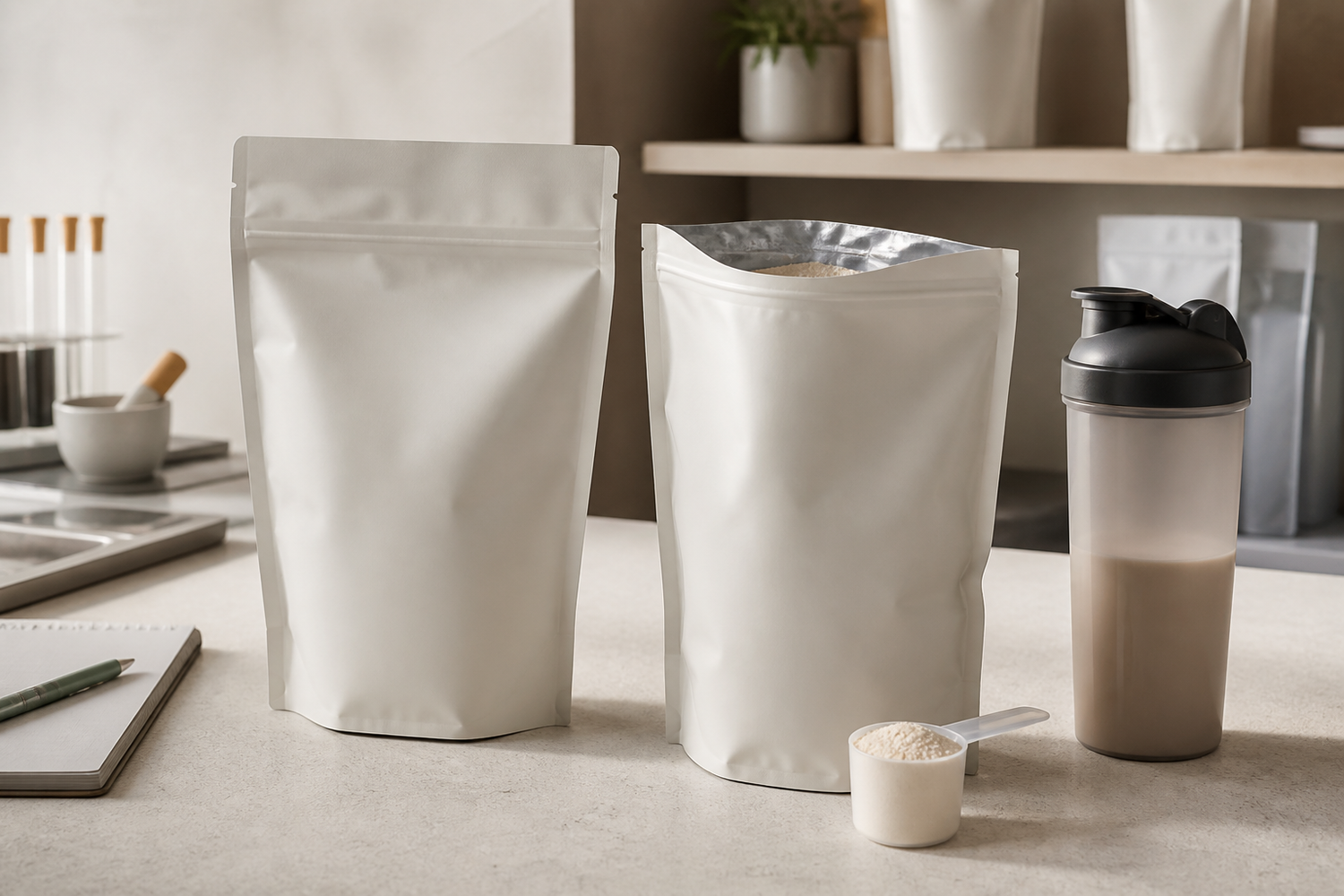
Protein powder pouch packaging should be sized around the actual powder, scoop and label—not a nominal gram capacity. Two formulas with the same net weight can occupy different volumes, settle differently after filling and leave very different working space above a zipper. A pouch can hold the target weight yet still frustrate customers if the scoop does not pass through the opening, powder collects in the closure, or required copy is squeezed into folds and seals.
This guide is for U.S. supplement founders, contract packers and operations teams preparing retail stand-up pouches. It is a packaging-planning resource, not formulation, stability, food-safety, dietary-supplement, regulatory, transport-testing or legal advice. The responsible quality unit, contract manufacturer, packaging supplier, test laboratory and qualified regulatory reviewer should approve the actual formula, process, package and label.

1. Define the product, pack size and ownership first
Begin with one controlled row per sellable SKU. Record whether the product is regulated and labeled as a dietary supplement or conventional food; that decision belongs to the responsible regulatory team and changes the required panel architecture. Also record the target net quantity, serving size, servings per container, flavor, channel and responsible formula owner.
For each row, capture:
- Formula revision, representative production powder and intended fill method.
- Target net weight and the filler’s tolerances and verification method.
- Scoop dimensions, intended serving relationship and whether the scoop is packed inside.
- Retail, gym, subscription, wholesale or direct-to-consumer route.
- Storage conditions and shelf-life protocol owned by the quality team.
- Pouch format, opening/reclosure concept, final sealing route and case pack.
- Flavor/SKU count, regulated-copy status and variable lot/date-code method.
Keep unknowns visible. Packaging should not be asked to prove a formula’s stability or safe shelf life. Instead, the brief should give the packaging and quality teams enough information to select candidate structures and define a finished-pack validation plan.
2. Size the pouch with representative powder and the real scoop

A catalog capacity is a starting point. Use representative powder from the intended manufacturing process because aeration, settling, particle distribution and inclusions affect the occupied volume. Fill several samples on the intended equipment or with a documented pilot method, then condition them as the project team specifies before measuring the filled shape.
Check more than whether the pouch closes:
- Opening width: the scoop should enter, tilt and withdraw without scraping the tear edge or dumping powder into the zipper.
- Hand access: a consumer should be able to retrieve a partially buried scoop without forcing the panels apart.
- Seal clearance: normal fill variation must remain below the zipper and final top-seal zone.
- Panel shape: the filled pouch should not distort important label copy or create an unstable base.
- Part-used condition: repeat the opening and scoop check after realistic product removal and settling.
Record the scoop diameter, handle length, usable mouth width below the tear opening, fill height, settled height and clearance to zipper and final seal. Photograph each condition. If the scoop cannot be retrieved cleanly, possible responses include a wider opening, different scoop, different placement method or alternate pack format—not an unsupported claim that one pouch size fits all powders.
3. Keep powder out of the zipper and final seal
Fine powder in a zipper track can change closing feel and consumer confidence. Powder in the heat-seal area can also affect the finished seal. The packaging supplier and filler should jointly review the candidate closure, filling head, dust extraction or containment, pouch opening method and top-seal parameters.
Build a challenge set that represents normal and reasonably adverse production conditions. Inspect for powder on the zipper, seal contamination, channel leaks, wrinkles, burns and panel damage. Record sealer settings, line speed, environmental conditions and failure mode using the method approved by the responsible quality team.
FDA’s dietary supplement CGMP guide explains that packaging and labels must meet specifications and that filling, packaging and labeling operations should protect the product and prevent mix-ups. That is a process-control requirement, not evidence that a generic zipper or laminate guarantees cleanliness, seal integrity or shelf life.
4. Reserve the principal display and information panels before decoration

The FDA’s general dietary supplement labeling guide identifies five required statements: identity, net quantity, nutrition labeling, ingredient list and the name/place of business of the manufacturer, packer or distributor. The same guide separates principal display panel and information-panel placement.
For a dietary supplement, FDA’s net-quantity chapter places the net quantity in the bottom 30 percent of the principal display panel and explains weight expression in both U.S. customary and metric terms. Its Supplement Facts chapter links serving size and servings-per-container information to the product directions and quantity.
Turn those requirements into a physical proof. Mark:
- Front-facing principal display panel and the expected filled display shape.
- Statement-of-identity and net-quantity zones approved by the label reviewer.
- Supplement Facts or Nutrition Facts area, ingredient copy and responsible-business details.
- Directions, warnings, claims and certifications only after qualified approval.
- Lot/date code zone tested on the actual print surface.
- No-copy zones for seals, zipper, tear notch, gusset folds and registration tolerance.
Print the proof at actual size, form it into a pouch and fill it. Flat artwork can look spacious while the finished pouch bends copy into a gusset or pulls the front panel around a dense fill. A flavor color change is not approval of the formula, facts panel or claims.
5. Control flavor proofs and validate the complete pack-out
Protein powder families often add flavors, sizes, sweetener systems and retailer versions. Maintain a matrix that connects formula revision, facts panel, ingredients, allergen/other required copy, net quantity, directions, claims, barcode, lot-code method, pouch size and artwork revision. Assign named approvers for regulatory copy, brand artwork, packaging feasibility and final production release.
Then test the filled pouch in its sale and distribution configuration. Observe panel scuffing, pinholes, top-seal damage, zipper function, product dust in the outer package and whether the pouch shifts or folds in the case or mailer. The ISTA 3A overview describes a general simulation for individual packaged products moving through parcel delivery. A qualified lab should select the applicable current procedure and agree acceptance criteria before testing.

Document the exact formula lot, fill weight, pouch revision, scoop placement, seal settings, carton and cushioning revision, sample count, procedure, observations and disposition. A passing result for one 500 g flavor does not automatically approve a 1 kg format or a formula with different bulk density.
6. Send a quote-ready supplier handoff
A productive request for quote contains:
- Product classification and named formula, quality and label owners.
- Representative powder, bulk-density observations, target net weight and expected fill variation.
- Scoop diameter/length, placement method and minimum usable opening requirement.
- Pouch format, candidate dimensions, zipper/opening and final sealing process.
- Storage, channel, case pack and parcel configuration.
- Food-contact documentation questions for the intended product and use.
- SKU matrix, actual-size artwork, regulated-copy approval status and variable-code plan.
- Sample stages, filled-pack tests, acceptance owners and target launch date.
Review Anacotte’s protein powder packaging options and supplement packaging collection, then request a project-specific quote with the actual fill, scoop, panel and test inputs. Treat unverified values as questions for samples—not as finished specifications.
Frequently asked questions
Can a supplier choose pouch size from net weight alone?
No reliable universal conversion exists. Use representative powder, the intended fill process and real scoop, then measure filled volume, settling, opening access and seal clearance.
Does a resealable zipper prevent protein powder from clumping?
Do not make that assumption. Formula behavior, moisture exposure, barrier, closure use, storage and shelf-life validation interact. Test the finished pack under the quality team’s protocol.
When should label panels be proofed?
Before printed samples are released. Approve regulated copy, print at actual size, form and fill the pouch, and check folds, seals, zipper, code zone and filled display shape.
What should be sent with a quote request?
Send product classification, formula owner, target fill, representative powder, scoop dimensions, pouch/closure concept, channel, artwork matrix, code method, quantities and written sample-test questions.

Hinterlasse einen Kommentar
Diese Website ist durch hCaptcha geschützt und es gelten die allgemeinen Geschäftsbedingungen und Datenschutzbestimmungen von hCaptcha.