
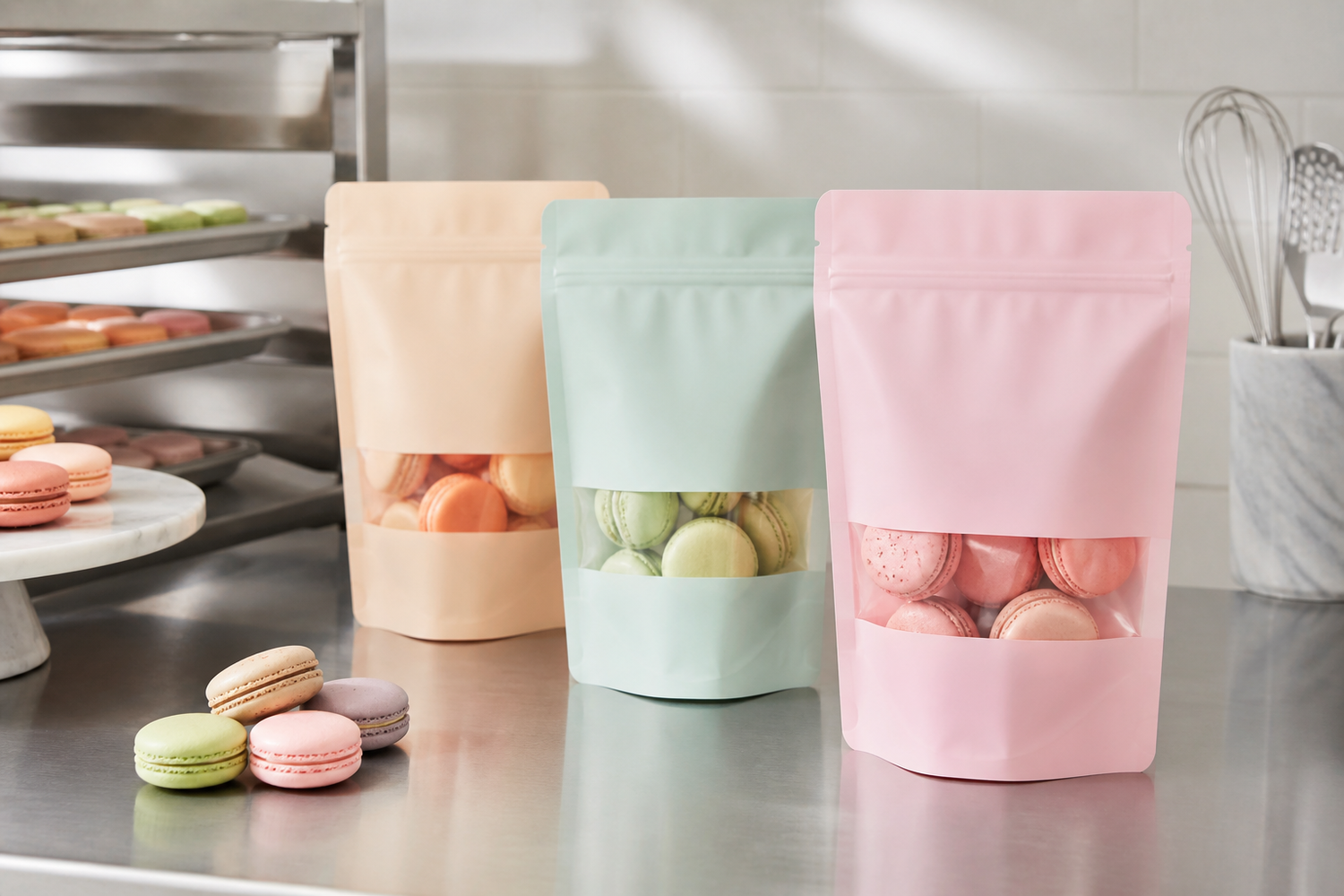
Macaron pouch packaging should be specified around a real sellable unit: the number of macarons, their diameter and height, the filling and storage route, the sales channel, and the protective packaging used after the pouch is sealed. A pouch that looks right when empty can crush shells, smear filling onto a panel, leave too little room for required label copy, or move excessively inside an ecommerce carton.
This guide is for U.S. artisan bakeries, confectionery founders, co-packers and ecommerce teams preparing custom pouches for macarons. It is a packaging-planning resource, not food-safety, allergen, shelf-life, transport-testing, regulatory or legal advice. Confirm the recipe, storage program, food-contact documentation, label and complete packaged product with the responsible food-safety team, co-packer, packaging supplier, test laboratory and qualified regulatory reviewer.

1. Define the sellable count, channel and storage route
Start with one row for each sellable or serviceable pack. “Macaron pouch” is too broad for a useful quote because a two-piece favor, a six-flavor retail assortment and a subscription refill do not share the same count, handling or secondary package.
Record the following for every row:
- Macaron count, flavor set and intended net quantity.
- Measured product diameter, height and normal variation.
- Filling, storage and distribution temperatures defined by the food team.
- Retail counter, local delivery, catering, gift, subscription or parcel route.
- Expected display orientation and whether the pouch must stand.
- Primary pouch, any tray or divider, and the protective outer carton.
- How the consumer opens, presents, recloses or disposes of the pack.
Do not ask packaging to establish the product’s safe storage period. Recipe, filling, sanitation, temperature control and stability work belong to the qualified food team. The package brief should record those conditions so the material and test plan can be reviewed against them.
2. Build filled samples around product dimensions and clearance

Capacity estimates are only a starting point. Build samples with representative macarons from the intended production process, including normal variation. Measure the product rather than relying on a nominal mold size. Then load the planned count using the real orientation and any inner tray or divider.
Review working clearance in four places:
- Panel clearance: the pouch should not press the shell or filling during normal handling.
- Seal clearance: product and crumbs must remain below the final heat-seal area.
- Opening clearance: the customer should be able to remove the product without dragging it across a rough tear edge or zipper.
- Secondary-pack clearance: the filled pouch should not slide, fold or take compression from the outer carton.
Record the filled pouch dimensions and gross weight. Photograph the loading pattern and note any chipped shells, scuffing, filling contact, crumbs in the closure, panel bulging or inability to stand. A beautiful empty-pouch mockup cannot answer these questions.
If the pouch includes a zipper, decide whether it has a real use. A pack intended to be eaten at once may not need reclosure. A larger assortment may benefit from it, but the bakery should test whether crumbs enter the track and whether the pouch still protects the remaining macarons after the first opening.
3. Match food-contact documentation and artwork to the exact use
The FDA treats food-contact authorization as use-specific. Its food packaging overview explains that packaging components can be food-contact substances and that intended use and migration matter. FDA’s food types and conditions-of-use tables distinguish bakery products with and without free fat or oil and separate room-temperature, refrigerated and other conditions.
Use those sources to frame supplier questions. They do not approve a generic “food-grade pouch.” Ask for documentation that traces the proposed sealant, film, ink, adhesive and other relevant components to the intended food type and storage/fill conditions. The responsible reviewer should decide whether the documentation is sufficient for the actual market.

Reserve the label architecture before final artwork. The FDA’s current food allergen labeling guidance explains that applicable major-allergen sources must be identified on foods regulated by FDA. Macaron recipes commonly require a careful formula review because ingredients can include tree nuts, egg, milk and other allergens; never copy an allergen line from another SKU.
Create controlled zones for:
- Product identity and accurate net quantity.
- Ingredient and allergen information approved for the exact flavor.
- Responsible-business details and other applicable information.
- Storage, handling and consumption directions owned by the food team.
- Lot, date or traceability code on a tested print surface.
- Seals, folds, zipper, tear notch and print safe areas.
A multi-flavor assortment needs an explicit rule for how the ingredient and allergen information maps to the contents. Assign owners for formula copy, regulatory review, artwork, production feasibility and final release. A color approval is not an allergen approval.
4. Test the seal without turning one number into a guarantee
The pouch supplier and filler should define a sealing window using the actual structure and equipment. Crumbs, fat or product in the seal area can change the result, so the test should include normal production challenges rather than only perfectly clean laboratory samples.
ASTM F88/F88M describes measurement of seal strength for flexible barrier materials. It also explains that the test technique and sample support influence the measured force. Use a consistent method for comparison and record the failure mode. Do not present a single peak number as proof of shelf life, freshness, leak freedom or parcel protection.
A practical release plan can combine:
- Visual inspection of seal continuity, wrinkles, contamination and burns.
- Documented sealer temperature, pressure, dwell and line speed where applicable.
- Seal-strength sampling with an agreed method and acceptance rule.
- Filled-pack observation after storage and handling conditions defined by the project.
- Opening checks so the customer can access the product without crushing it.
The food team must validate product quality and shelf life for the finished pack. Barrier values, material names and seal tests are inputs to that program, not substitutes for it.
5. Test the pouch and protective parcel pack-out together

A flexible pouch can provide branding, containment and a defined product environment, but it should not be assumed to protect fragile shells from parcel compression or impact by itself. For ecommerce, design the primary pouch, tray or divider, cushioning and corrugated carton as one system.
The ISTA 3A overview describes a general simulation for individual packaged products moving through parcel delivery. The protocol applies to the complete packaged product and includes distribution hazards such as handling and vibration. Select the appropriate current procedure with a qualified laboratory and define acceptance criteria before testing.
Useful acceptance observations can include:
- Number of cracked, chipped, shifted or smeared macarons.
- Pouch puncture, scuffing, seal damage or loss of closure function.
- Tray or divider movement and contact pressure on the product.
- Outer-carton compression, opening or internal empty space.
- Label, lot-code and presentation condition after the sequence.
Test representative flavor assortments and product sizes, not only the strongest item. Record the recipe lot, pouch revision, tray/carton revision, packing method, test procedure, sample count, observations and disposition. Passing one configuration does not automatically approve a different count, carton or product size.
6. Control flavors and send a quote-ready specification
Macaron ranges often multiply quickly through flavors, seasonal colors, gift counts and retailer editions. Use a SKU matrix with one row per distinct pack. Include flavor/count, ingredients and allergen copy status, net quantity, pouch size, print file, variable code, quantity, tray/carton, test status and named approvers.
A useful request for quote includes:
- Representative product availability and responsible food/shelf-life owner.
- Sellable count, measured product range, target net quantity and loading pattern.
- Fill, storage, retail/local-delivery/parcel conditions and intended shelf orientation.
- Pouch format, target dimensions, opening, reclosure and final sealing route.
- Any tray, divider, cushioning and outer-carton concept.
- Food-contact documentation questions and the actual conditions of use.
- SKU/flavor matrix, artwork status, label owners and variable-code method.
- Sample stages, seal and parcel test questions, acceptance owners and target date.
Review Anacotte’s artisan macaron stand-up pouch direction and snack packaging collection, then request a project-specific quote with the count, product, label and complete pack-out details. Keep unknown values visible as test questions rather than converting them into guessed specifications.
Frequently asked questions
Can a stand-up pouch stop macarons from breaking during parcel shipping?
Do not assume so. Test the filled pouch with its tray, cushioning and outer carton as one packaged-product system. Fragile products commonly need rigid secondary protection.
Is a “food-grade” material statement enough?
No. Review traceable food-contact documentation for the proposed components and intended food type, fill and storage conditions. A qualified reviewer should approve the actual use.
How should a bakery choose pouch size?
Use representative macarons, the planned count and loading orientation. Check panel, seal, opening and secondary-pack clearance with filled samples instead of relying on nominal capacity alone.
What should be ready before ordering printed samples?
Prepare product dimensions and count, storage/channel conditions, pouch and secondary-pack concept, label and allergen status, SKU quantities, representative product and a written seal and handling test plan.

Hinterlasse einen Kommentar
Diese Website ist durch hCaptcha geschützt und es gelten die allgemeinen Geschäftsbedingungen und Datenschutzbestimmungen von hCaptcha.