
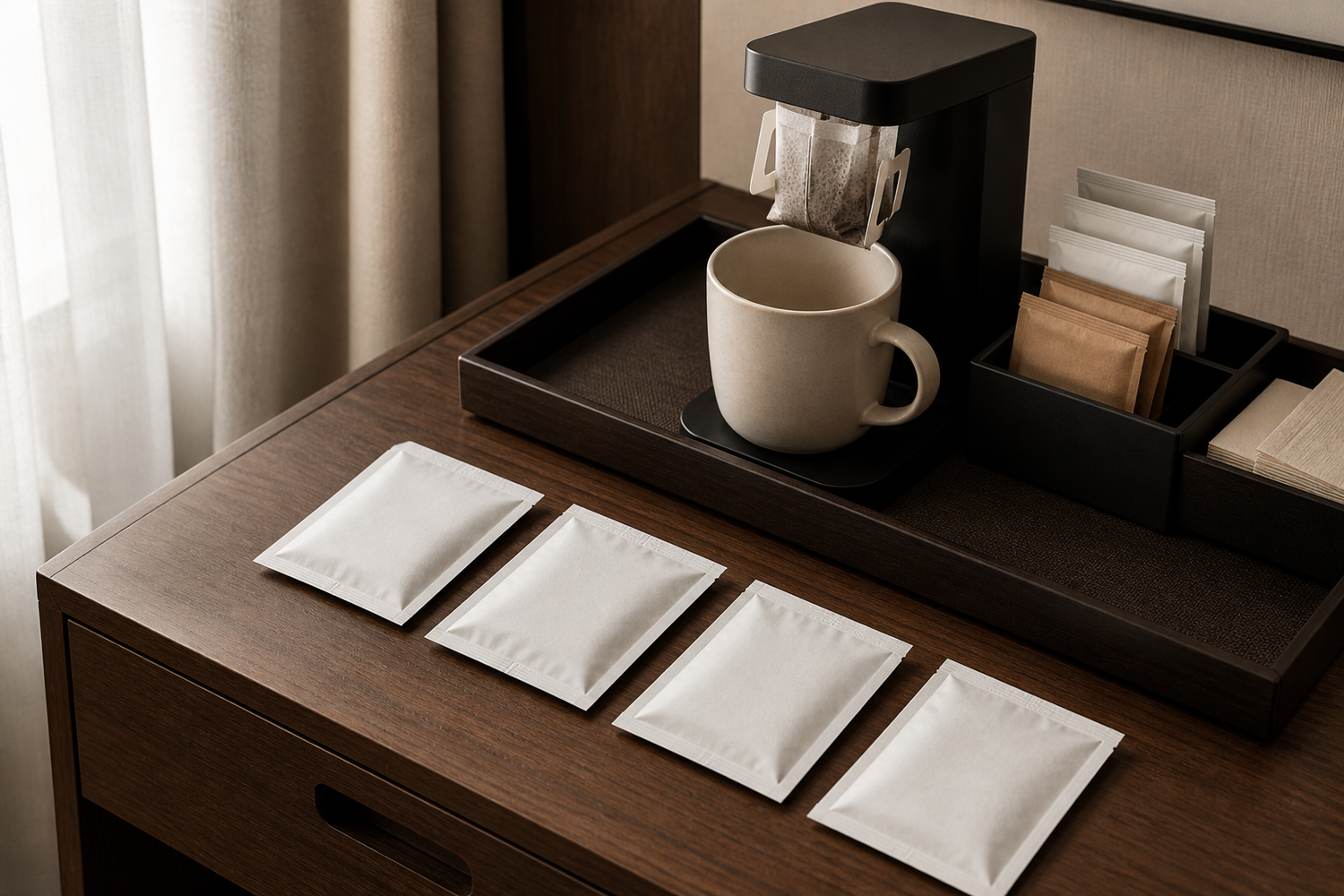
Hotel coffee sachet packaging is easiest to specify when the project begins with the room, not the empty packet. The brewer or kettle, cup volume, coffee dose, guest instructions, housekeeping routine and number of property designs all affect the brief a roaster, co-packer and packaging supplier need.
This guide is for U.S. roasters, hospitality suppliers and hotel groups preparing branded single-serve ground-coffee packets. It is a packaging-planning resource, not food-safety, labeling, brewing, shelf-life or legal advice. Confirm the coffee, fill, label and finished package with the responsible roaster, co-packer, regulatory reviewer and packaging supplier for the actual service and sales route.

1. Map the room equipment before choosing the sachet
“One serving of hotel coffee” can describe very different systems. A packet opened into a drip-brewer basket, an immersion bag placed in a cup, a pour-over filter or a soluble coffee sachet does not use the same product, dose, packet size or instruction. Create one service card for every room setup before asking for packaging dimensions.
Record:
- Property, room type and service location.
- Brewer, kettle or hot-water setup and model where relevant.
- Basket, filter, pod holder or cup dimensions.
- Available water volume and intended beverage size.
- Ground, instant, steeped or pour-over coffee format.
- How the guest opens, loads and disposes of the packet.
- Where the sachet is stored in the room and on the housekeeping cart.
Do not assume that every property in a hotel group uses the same machine or cup. A single artwork family can still need multiple packet specifications if the brew systems differ.
2. Lock the dose with a brew-device test

The roaster or co-packer should own the coffee specification. Give that team the brew device, water target, grind direction, roast or blend, desired beverage profile and expected distribution window. Ask for a documented trial instead of copying a portion weight from another hotel packet.
Build a small matrix with one row per setup. Useful columns include property, room type, brewer, water volume, coffee format, target fill weight, packet dimensions, opening method, instruction owner, test batch and approval status. Run the coffee through the exact room equipment and cup, then record the dose, water, contact time where relevant, user steps and observations.
A brew trial validates a selected setup; it does not prove that the same dose works in another machine or with another grind. If the brewer, water target, coffee, packet format or filter changes, decide whether the trial needs to be repeated.
The National Coffee Association notes that air, moisture, heat and light are relevant to coffee storage. Use that guidance to document the back-of-house, cart, room and distribution conditions. It does not establish that a named film will keep every coffee fresh for a stated duration. The roaster and qualified technical partners should define product-specific barrier and shelf-life work.
3. Reserve label, code and instruction zones early
A small sachet has little room after seals, tear notches, registration marks and production codes are considered. Build the information map before the artwork is visually finished.
The FDA Food Labeling Guide explains principal-display-panel concepts and net quantity statements for packaged foods. NIST Handbook 130 provides the current Uniform Packaging and Labeling Regulation and state-law context. These sources are starting points, not a universal hotel-amenity exemption or finished label approval. A qualified reviewer should determine what applies when a packet is complimentary, invoiced through a room package, sold in a gift shop or distributed through another channel.
Separate the flat packet into controlled zones:
- Principal display: product identity, brand and applicable net quantity.
- Information area: responsible business, ingredients and other applicable copy.
- Brew direction: device-specific steps, water target and disposal instruction approved by the responsible teams.
- Variable data: lot, date or traceability code with verified contrast and abrasion resistance.
- Production safe zones: seals, tear path, registration area and any opening or filter component.
Do not let a packaging designer invent the coffee dose, a hotel marketer approve regulatory copy alone, or the printer become the final instruction owner. Name the approver for each field.
4. Control property, language and room variants

Hospitality programs can create several nearly identical files: property logos, room tiers, regular and decaf coffee, languages, retail versions and seasonal art. A multi-property proof matrix makes the differences visible.
Use one row per sellable or serviceable packet. Record property, internal SKU, coffee, dose, brew device, language, artwork revision, barcode if applicable, code method, quantity, case label and proof owners. Separate shared design elements from fields that must vary.
Approve the packet in at least three ways:
- Data proof: coffee, dose, instructions, quantity and responsible-business details.
- Artwork proof: property identity, language, colors, images, bleed and safe zones.
- Production proof: dieline, print direction, code area, seal margins, opening and case identification.
A color-approved file is not automatically a dose-approved or legally reviewed file. Record each approval separately, especially when many properties share a common template.
5. Test the complete housekeeping and guest-room route

An empty sachet on a studio table cannot show what happens in the operating route. Build filled samples, case-pack them as delivered, move them through storage and housekeeping, and place them in the real room setup.
A practical test can include:
- Filled packet dimensions, seal appearance and code legibility.
- Case count, property identifier and first-expiry/first-out handling.
- Fit on shelving, carts, amenity trays and beside the room equipment.
- Exposure to the expected heat, light, steam and humidity conditions.
- Tear opening, coffee transfer, guest instruction and spill observations.
- Complete brew-device use with the room cup and water setup.
- Packet appearance after transport, stocking and a defined room dwell time.
Record the product lot, pouch revision, property/SKU, packing date, storage condition, sample count and decision. A trial should answer a written question. It should not be presented as proof of a universal freshness period, barrier level or guest preference.
6. Send a quote-ready hotel sachet matrix
A useful request for quote includes:
- Coffee format, roast or blend owner and representative product availability.
- Brewer, filter, cup and water setup for every property or room type.
- Approved target dose and how it was tested.
- Packet style, target dimensions, opening and filling route.
- Property/SKU matrix with quantity per design and language.
- Required label and instruction fields, proof owners and variable-code method.
- Case pack, receiving, storage, housekeeping and room-placement conditions.
- Sample stages, target date, destination and unanswered technical questions.
Review Anacotte’s hotel coffee single-serve sachet direction, then request a project-specific quote with the brew-device and property matrix above. Unknown values should remain visible as test questions instead of becoming guessed specifications.
Frequently asked questions
Can one coffee dose work across every hotel brewer?
Do not assume so. Test the coffee, dose, grind, water and packet with each actual brewer or service method, and record which setup the approval covers.
Does a single-serve sachet need a valve?
Not automatically. Product, pack timing, packet format, headspace, distribution and technical requirements should be reviewed with the roaster, co-packer and packaging supplier.
Can a complimentary room packet skip food-label review?
Do not rely on a general assumption. The responsible team should review the exact product, channel and jurisdictions, including any packets sold through a gift shop or other retail route.
What should a hotel group send before requesting samples?
Send the property and room matrix, brewer and cup details, coffee and dose owner, quantities per artwork, label and instruction status, case pack, room placement and test questions.

Leave a comment
This site is protected by hCaptcha and the hCaptcha Privacy Policy and Terms of Service apply.