
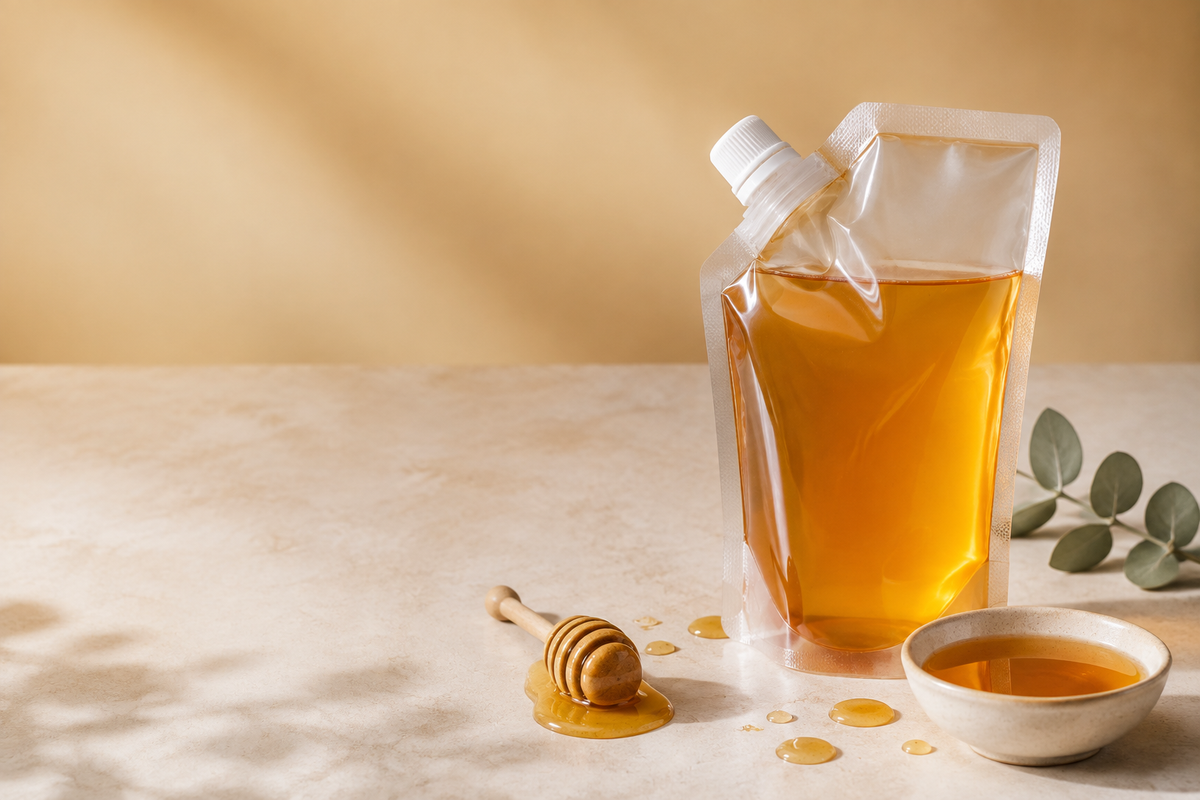
A honey or syrup pouch is not chosen by appearance alone. The product’s flow behavior, fill temperature, target volume, fitment, closure, and distribution route all affect whether a spout pouch is a sensible starting point. A smooth-looking empty sample cannot tell you how the filled pack will dispense, string, drip, or behave after transport.
Important: This guide is a packaging-planning framework, not a guarantee of leak-proof performance, food-contact authorization, shelf life, barrier, price, MOQ, lead time, or a universal “best” pouch. Final material, fitment, and test decisions should be confirmed with the packaging supplier and the responsible compliance or food-safety owner.

Start with how the product moves
“Honey” and “syrup” describe a category, not a complete packaging specification. Two products can have different viscosity, temperature sensitivity, particulates, crystallization behavior, or shear response. Before choosing a spout diameter, record a practical flow description that a filler and a package reviewer can use.
- Flow: Does the product pour in a steady stream, move slowly, stretch into a string, or need pressure to start?
- Temperature: Is it filled or dispensed at room temperature, warm, chilled, or across a range?
- Product texture: Are there crystals, fruit pieces, seeds, or other particulates that could affect the fitment?
- Fill target: What net content, headspace, and overfill tolerance are required?
- Use routine: Is the pouch single-use, repeatedly opened, squeezed, stored upright, or shipped through parcel handling?
Those answers are more useful than asking for a generic “honey bag.” They also give the supplier a reason to compare formats rather than forcing a product into a preselected pouch.
Compare the format before choosing the fitment
A spout pouch is one route. A flat sachet or bottle may be more suitable when the dispensing routine, opening size, or handling environment points elsewhere.
| Format path | May fit when | Questions to resolve |
|---|---|---|
| Spout pouch | The consumer needs controlled dispensing and may use the pack more than once. | Spout bore, cap, tamper feature, reclosure, drip/stringing, squeeze force, filled-pack stability, and cleaning expectations. |
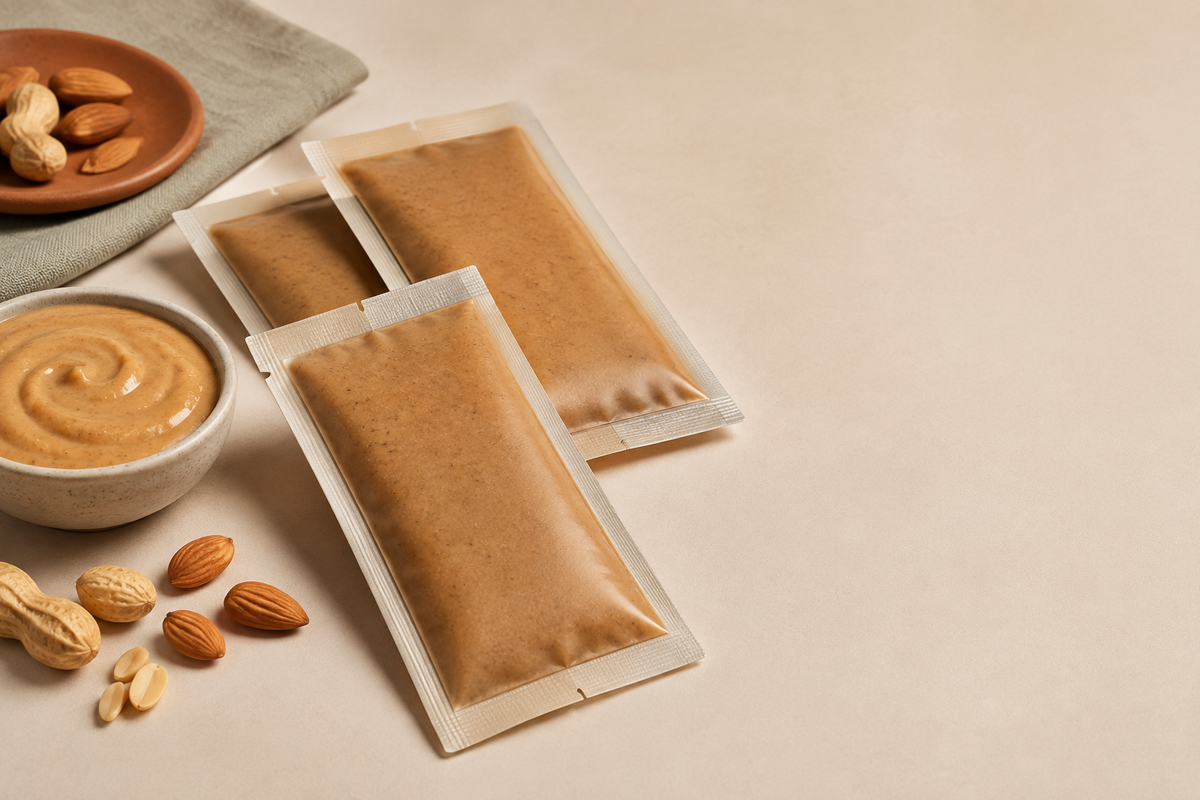
| Flat sachet | The portion is single-use and compact storage matters more than reclosure. | Tear direction, opening size, seal contamination, squeeze access, residual product, and transport protection. |
| Bottle or jar | The product needs a wide opening, utensil access, or a familiar multi-use routine. | Closure torque, dispensing control, headspace, breakage or weight, and the reason a flexible format is not the better fit. |
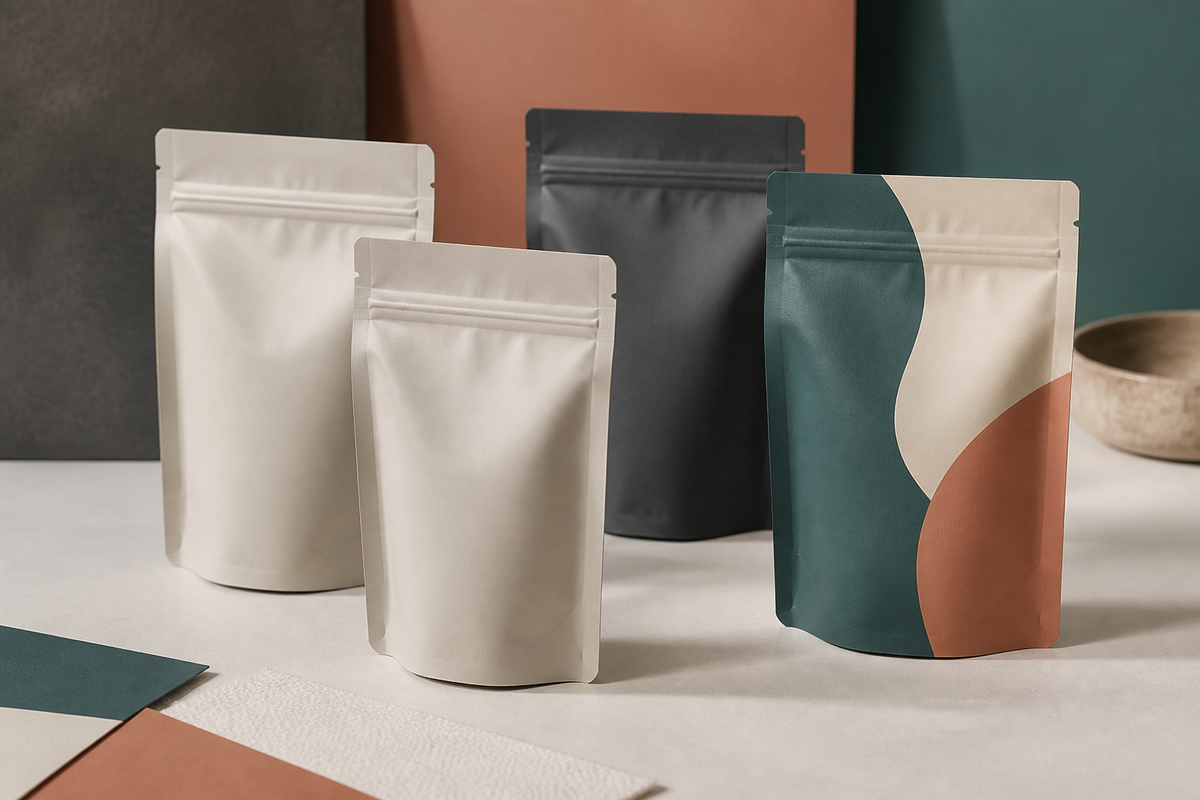
If a spout pouch is selected, do not automatically call it a stand-up pouch. Upright display depends on the actual bottom geometry and the filled pack. A side or corner spout can be practical without a bottom gusset, while an upright retail presentation needs its own filled stability review.
Specify the spout and closure as a system
The fitment, cap, pouch seal, tamper strategy, and consumer motion work together. A larger opening may reduce squeeze effort but can change control and residual product. A smaller opening may improve portion control but increase force or stringing. The correct trade-off depends on the formula and routine.
Ask the supplier to confirm:
- spout position and diameter options for the target fill and flow behavior;
- cap style, cap retention, reclosure, and whether tamper evidence is required;
- the seal band around the fitment and the pouch’s main heat-seal area;
- whether the fill line, pouch angle, or filling equipment creates a contamination risk;
- how the filled pack will be stored and displayed between uses; and
- which features are confirmed on a sample versus only shown in a drawing.

Write the anti-drip test before the quote
“Anti-drip” is not a single visual attribute. It should be translated into an observable test that uses the real formula or a representative fill. The test plan can include:
- Start and stop: Open or uncap the pouch, dispense a defined amount, stop, and observe the fitment for a defined period.
- Angle and squeeze: Repeat the motion at the angles and hand pressure a consumer is likely to use.
- Stringing and residue: Record whether the product strings, pools around the outlet, or leaves a film on the cap.
- Reclosure: Close the cap, invert or lay the filled sample down, and inspect for seepage after the chosen dwell time.
- Seal and fitment: Review the fitment weld, main seals, and any contamination from the fill process before and after handling.
- Transport: Use the distribution and storage conditions that matter to the brand, then repeat the dispense check.
Record the formula, temperature, fill level, sample count, handling sequence, and acceptance criteria with the result. An empty pouch or a water substitute may help with an early geometry check, but it should not be treated as proof of high-viscosity performance.

Keep food-contact questions specific
Food-contact suitability depends on the actual material components, food type, conditions of use, and intended process. The FDA food-types and conditions-of-use framework distinguishes categories such as aqueous and oil/fat foods and conditions such as refrigerated, frozen, room-temperature, or hot-fill use. The FDA food-packaging overview also explains why intended use, migration, testing, and authorization are specific to the substance and use case.
That means “food grade” is not a sufficient project brief. Bring the formula, process, storage, and distribution information to the supplier and the person responsible for compliance. Do not assume a structure is suitable because a different honey, syrup, sauce, or pouch uses a similar shape.
What to include in a quote request
A useful spout-pouch request can include:
- product category and a practical viscosity or flow description;
- target net content, headspace, fill temperature, and fill equipment;
- spout position, opening preference, cap, tamper strategy, and reclosure routine;
- storage, parcel or pallet distribution, display orientation, and sample destination;
- artwork status, code or label zones, SKU count, finish, and any approved reference;
- filled-pack tests, sample count, acceptance criteria, and the owner of final approval; and
- questions about film, barrier, food-contact basis, and conditions of use.

FAQ
Is a spout pouch automatically better than a flat sachet?
No. A spout can help when controlled or repeated dispensing matters, while a flat sachet may be simpler for a defined single-use portion. The product, user routine, fill process, and distribution route decide the fit.
Can I specify the pouch by the product name alone?
Usually not. Viscosity, temperature, particulates, target fill, headspace, storage, and the opening routine can change the spout, seal, and material discussion.
Does “leak-proof” mean the pack needs no testing?
No. Treat any product-page or supplier positioning as a starting point. Confirm the actual filled pack with fitment, seal, inversion, handling, storage, and transport tests tied to your formula.
What should I send Anacotte?
Start with the product behavior, target fill, intended use, storage, distribution, artwork status, and test criteria. Review the honey and syrup spout-pouch product page, then use the quote form to share the project details. For related format context, see Sauce Packaging: Spout, Sachet, and Retort Options and Stand-Up Pouch vs Flat Pouch.
Next step: Build the filled-pack brief first, then ask for a sample route that can answer the anti-drip, fitment, seal, and storage questions before final artwork or a production commitment.

Leave a comment
This site is protected by hCaptcha and the hCaptcha Privacy Policy and Terms of Service apply.