
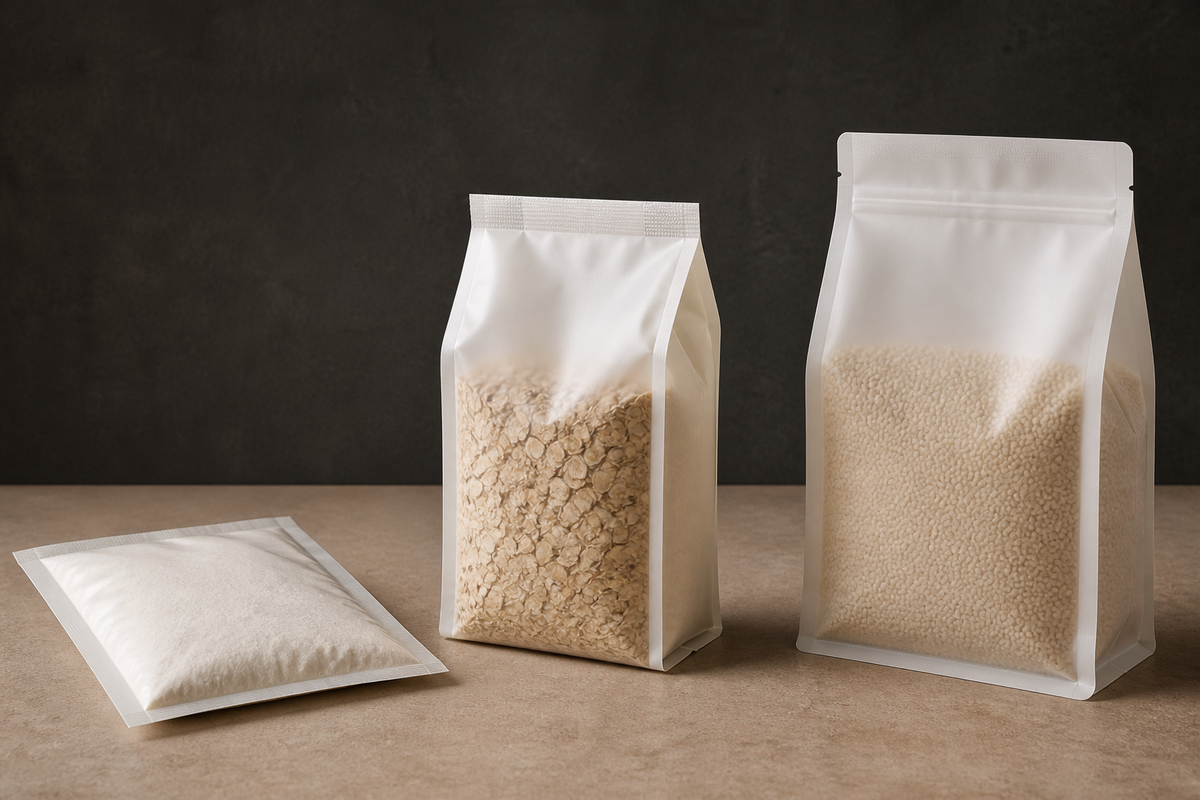
A “four side flat pouch” can mean different things depending on the supplier. One page may describe a flat pouch sealed around four edges; another may use “quad seal” for a side-gusseted bag with four corner seams; a third may call an 8-side construction a flat-bottom pouch. The safest buying brief defines the physical geometry first and the marketing name second.

Define the three structures before you request a quote
| Structure | Physical cue | Where to start |
|---|---|---|
| Flat four-side-seal pouch | Two panels sealed around all four edges; thin profile; no expandable side gusset | Portions, samples, compact dry products, and applications where a flat footprint matters |
| Side-gusseted quad-seal pouch | Four corner seam lines with left/right gussets; opens into a deeper, box-like filled body | Dry goods that need more depth, a structured filled profile, or additional side panels |
| 8-side flat-bottom pouch | Structured front, back, side, and bottom construction with a broad base for upright display | Products where base support, shelf stance, and a box-like presentation are important |
These are working definitions for a buyer brief, not a universal industry dictionary. Current supplier pages use overlapping terms. OMOPACK distinguishes its four-side-seal explanation from an 8-side flat-bottom pouch, while other supplier pages use “four-side seal” for a flat four-edge pouch. Ask for a sketch or dieline that shows the seams, gussets, base, and filled dimensions.
Match the filled shape to the dry product
Start with the product’s behavior rather than the pouch label. Flour and fine powders may need a clean filling path and careful protection of the seal area from dust. Oats, grains, nuts, and other particles can change the required depth, corner clearance, and puncture discussion. A flat sachet can be efficient for a portion, while a gusseted or flat-bottom route may make more sense when a retail pack needs depth or a stable shelf footprint.
Do not assume that a structured pouch is automatically stronger, cleaner, or better for every dry product. The filled sample still needs to show how the contents settle, how the seams behave, whether the opening remains usable, and what happens when the package is stacked or shipped.

Put these dry-product inputs in the brief
- Product state: powder, granule, flake, whole grain, nut, snack, or another dry good.
- Bulk density and fill weight: provide target net fill, tolerance, and how the product settles after filling.
- Flow and dust: describe whether fine material can migrate into the seal area and what the filler can control.
- Particle shape: note sharp edges, brittle pieces, oil content, aroma, moisture sensitivity, and any puncture concern.
- Filled dimensions: specify acceptable width, depth, height, shelf footprint, stacking, and case-pack limits.
- Opening and reclosure: decide whether a tear notch, zipper, valve, window, or other feature is truly needed.
- Artwork and codes: map front, back, and side panels, then reserve barcode, date, lot, and variable-data zones.
- Filling route: identify premade-pouch or form-fill-seal equipment, jaw limits, speed, and the top opening needed by the line.
For a food application, keep material documentation and intended use in the same handoff. The FDA describes food packaging as a food-contact context and explains that authorization and migration considerations are connected to intended use. A kraft-look exterior, a supplier’s “food-grade” wording, or a barrier adjective does not approve a material for every product or condition.

Use a geometry-ready sample sequence
- Send the sketch. Mark the front and back panels, side gussets, base, seam positions, top opening, closure, and filled width/depth/height. If you do not know the construction name, draw the shape you need.
- Fill with the real product. Record bulk density, target fill, fill speed, dust behavior, settling, and any material in the seal area.
- Check the consumer routine. Test opening force, zipper or notch use, scoop access, pour or pour-back behavior, and reclosure if required.
- Check the filled shape. Measure the actual footprint and height, then review shelf stance, stacking, compression, and whether the package collapses or distorts in the intended case pack.
- Check the distribution route. Run the filled samples through the expected parcel, pallet, or retail handling path. Inspect seals, scuffing, puncture, panel readability, and corner damage.
- Approve the evidence. Confirm the physical geometry, material documentation, artwork panel, code zone, and test notes together before a production order.

Use the Anacotte references for comparison, not assumption
Anacotte currently lists an active 9 oz / 250 g baking-ingredients flat pouch and an active kraft-paper flat-bottom pouch reference. They can help a buyer compare a flatter portion route with a deeper structured route. The product-page title or image is not a substitute for the actual seam drawing, filled dimensions, material documentation, or line review. Ask Anacotte to confirm which construction will be supplied for the exact product and fill brief.
For broader format context, see Anacotte’s guides to stand-up versus flat-bottom pouches and stand-up versus flat pouches. This article adds the terminology and seam/gusset distinction those broader comparisons do not own.
Four-side-seal and quad-seal FAQ
Is a four-side-seal pouch the same as a quad-seal pouch?
Not always. Supplier terminology varies. A flat four-side-seal pouch may have four perimeter seals and no expandable gusset; a quad-seal bag often has four corner seams and side gussets. Ask for a physical sketch, not a name alone.
Is a flat-bottom pouch the same as a quad-seal pouch?
They can look related when filled, but the base construction and seam count may differ. A flat-bottom route should be specified with the bottom shape, side panels, filled footprint, and upright-display requirement.
Which pouch is best for flour or baking ingredients?
There is no universal best format. Start with fill weight, bulk density, dust, opening and reseal routine, shelf footprint, line, and distribution. A 250 g flat pouch may suit one portion model, while a gusseted or flat-bottom sample may suit another.
What should a quote request include?
Send the product state, bulk density, target fill and tolerance, filled dimensions, desired seam/gusset/base sketch, filling route, closure, panel/code zones, material questions, distribution assumptions, and sample quantity. You can request a project-specific conversation with Anacotte using that brief.
Sources and evidence boundary
Current format examples include OMOPACK’s four-side-seal explanation, the SEE / Sealed Air quad-seal brochure, and IPS Packaging’s quad-seal page. These supplier pages and brochures establish live market formats and terminology; they do not establish Anacotte performance or a universal specification. The FDA food-contact reference is included to keep documentation and intended-use review project-specific.
Bottom line: define the seams, gussets, base, fill, and filled dimensions before choosing between a flat four-side-seal pouch, a side-gusseted quad seal, and a flat-bottom route. The right name follows the right physical brief.

Leave a comment
This site is protected by hCaptcha and the hCaptcha Privacy Policy and Terms of Service apply.