If you are choosing a baby food spout pouch, the most useful question is not “Which pouch looks best?” It is “What must the filled package prove before we approve the next step?” A pouch that looks right in a flat artwork file may still need a different fill target, headspace, closure routine, label panel, or distribution assumption.
This checklist is written for prepared baby meals and purees, including portion-controlled daycare or pilot programs. It is not infant-formula guidance, food-safety advice, or a substitute for a qualified regulatory and quality review.

Start with the real meal, not the pouch photo
Begin the supplier conversation with the product you actually plan to fill. A smooth puree, a textured meal, and a thicker recipe can behave differently during filling, squeezing, pouring, and storage. The same nominal pouch size can also create different usable label space after the package is formed.
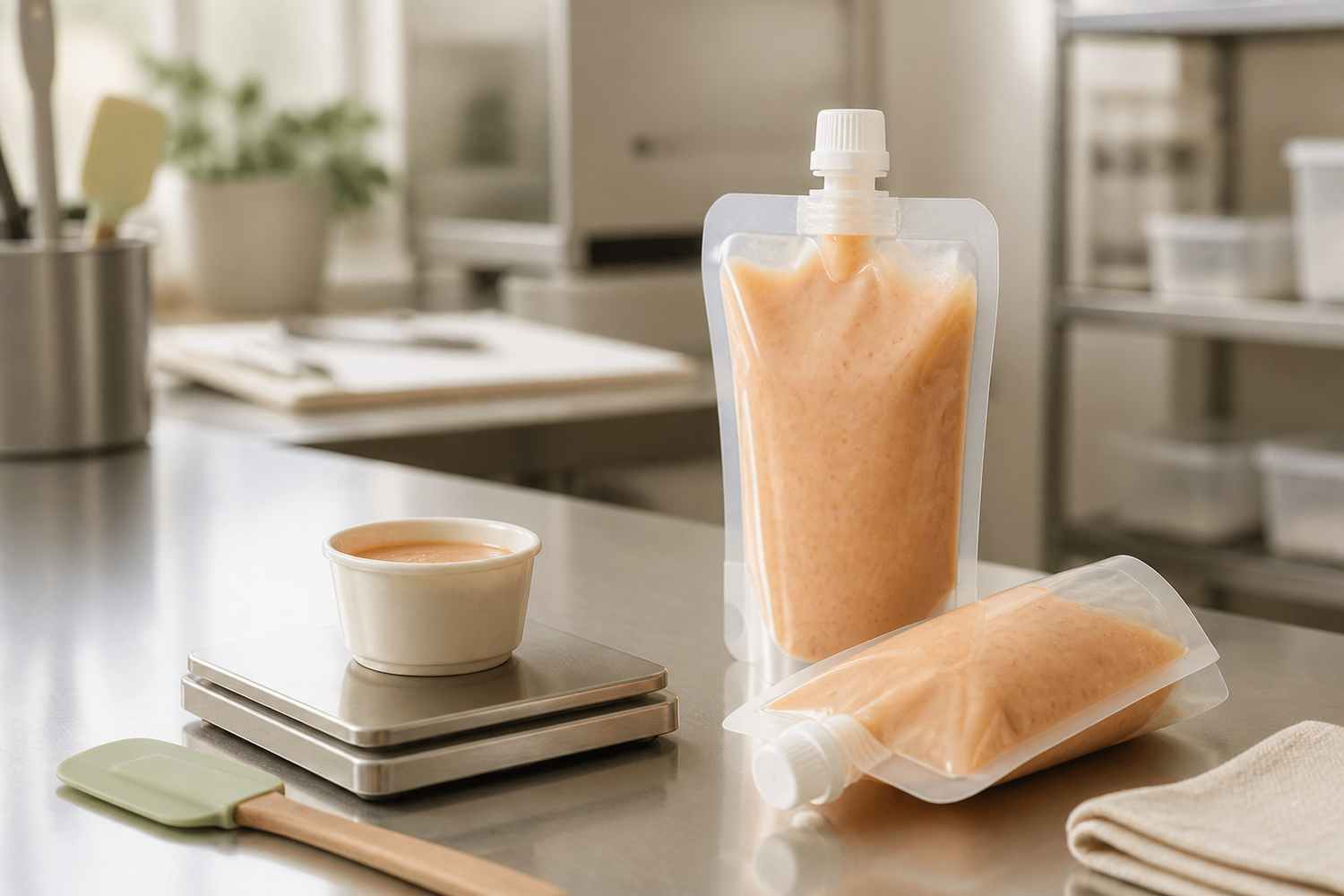
Anacotte’s current portion-control pilot pouch is presented as a planning and test-fit route. Its product guidance asks the buyer to confirm dimensions, film, closure, filling, storage, and distribution before production. Treat that as the starting brief—not as a promise that one stock configuration will fit every recipe or process.
Before asking for a quote, write down:
- Product type, texture, viscosity, and any visible particles.
- Target fill weight or volume, expected portion range, and headspace preference.
- Filling method, fill temperature if relevant, and where the pouch is filled and closed.
- How the package will be stored, transported, opened, squeezed, poured, and discarded.
- Whether the pilot is chilled, ambient, or another controlled route determined by the product owner.
1. Lock the fill target and pouch geometry
Nominal dimensions are not enough. Fill representative samples with the real puree or meal and record the actual result. Look at the package standing or lying in the position in which it will be handled. Note how the product settles, whether the spout remains accessible, how much space remains for the label, and whether the pouch shape changes when it is full.
A simple fill-proof sheet can include:
- Sample ID, recipe or batch reference, fill target, and measured fill result.
- Flat and formed dimensions, including usable front and back areas after filling.
- Headspace observation and any movement of product toward the spout.
- Photos before and after filling, plus the intended storage orientation.
- Open questions for the filler or co-packer, rather than assumptions made from a catalog image.

2. Treat the spout and cap as a use test
A spout is part of the user experience, not just a hole in the package. Your trial should observe how the cap engages, how the user holds the pouch, what happens when the package is squeezed, and whether the opening and closing routine matches the intended caregiver or staff workflow.
Ask the team to record observations such as:
- Can the intended user remove, replace, and fully engage the cap using the planned hand motion?
- Does the filled pouch remain comfortable to hold at the target portion?
- Does the puree move toward the spout in a predictable way during a gentle squeeze?
- Is there residue around the spout or cap that changes the handling routine?
- What happens after the pouch is opened, partially used, and closed again?
Commercial spout-pouch pages can confirm that the format is used for liquid or semi-liquid applications, while user discussions can surface practical questions about fit, spray, and opening. Neither type of source proves a package result for your formula. The useful next step is a controlled trial with the real product and the intended closure.

3. Proof the formed front and back label
Artwork should be reviewed on the package after it is filled, not only on a flat dieline. Curves, folds, seals, the spout, and the changing fill line can all affect what a caregiver sees. Create a front/back proof using the intended size and a representative fill.
Reserve zones for the information your responsible regulatory and quality team needs to review. The FDA’s Food Labeling Guide and Food Allergies guidance are useful starting points for label and allergen questions. They do not replace a product-specific review.
Your formed-label checklist can include:
- Product identity and front-of-pack hierarchy on the formed package.
- Net quantity and any required information zones reviewed by the responsible team.
- Ingredient and allergen information placement, legibility, and version control.
- Lot, date, or other traceability code location after filling and sealing.
- Clear separation of design placeholders from final approved copy.
Also ask for the relevant food-contact documentation for the intended use. A product photo or a generic film description is not proof of suitability for your specific food, process, or conditions.

4. Add storage and distribution assumptions
Packaging approval is easier when the sample represents the route it will take. Record the storage condition chosen by the product owner, expected time between filling and use, transport orientation, handling points, case-pack plan, and any temperature or distribution constraints that need technical validation.
Do not turn a packaging checklist into a shelf-life claim. If a product needs a defined shelf life, process control, or food-contact assessment, those are separate technical workstreams. The article’s job is to make the questions visible early enough that the supplier, filler, and quality team can address them together.
5. Use a short sample approval loop
A useful approval loop is small and repeatable:
- Send the real product, fill target, closure preference, and intended use case.
- Review an unfilled or component sample for fit and format.
- Fill representative samples and photograph the formed package from the user’s view.
- Review cap handling, front/back label zones, code location, and storage/distribution assumptions.
- Record changes by sample ID and approve the next revision only after the open questions have an owner.
This keeps a “looks good” decision from being mistaken for a production release. It also gives a supplier enough information to discuss the right pouch route, rather than quoting against an incomplete specification.
What to send with a baby food pouch quote request
When you are ready to start a packaging conversation, send:
- A representative puree or meal description, target fill, and portion range.
- Filling and closing method, plus the storage and distribution assumptions.
- Preferred spout/cap direction and the intended opening, squeezing, and reclosure routine.
- Draft artwork or a front/back information matrix, including lot and allergen review points.
- Expected SKU count, pilot quantity, timing, and any case-pack or shipping constraints.
Anacotte’s baby food packaging collection can help you compare relevant routes. For a quote, use the quote request page and include the proof inputs above. If you are still comparing formats, the spout pouch collection is a useful next stop.
FAQ
Can any puree use the same spout pouch?
No. Texture, fill target, filling method, headspace, closure, storage, and distribution assumptions can change the right package brief. Test with the real product instead of selecting only from a nominal size.
Is a pouch automatically food-safe for baby food?
No. Ask for the documentation and review appropriate to the intended food-contact use, process, and conditions. A photo, a category name, or a generic pouch description is not a product-specific approval.
Is this an infant-formula packaging guide?
No. This article is limited to prepared baby meals and purees as a packaging-development scenario. Infant formula and other specialized products can have separate requirements and need qualified review.
What is the fastest next step?
Prepare the real product description, target fill, closure preference, filling/storage/distribution assumptions, and draft front/back information matrix. That turns a pouch inquiry into a useful proof conversation.
This article is general packaging information, not legal, regulatory, food-safety, or medical advice. Confirm the final package, artwork, labeling, food-contact documentation, and process with the responsible professionals before production.

Deixar comentário
Este site é protegido por hCaptcha e a Política de privacidade e os Termos de serviço do hCaptcha se aplicam.