
Match the packaging format to product risk, filling method, and shelf channel.
Liquid packaging guide
Spout Pouch Packaging for Cleaning Products
Spout Pouch Packaging for Cleaning Products helps buyers compare packaging options, material trade-offs, MOQ paths, and quote inputs before choosing a pouch, film, or custom structure.
Need pricing for this exact packaging decision?
Share product type, fill weight, target quantity, material or barrier needs, artwork status, and launch timing. Anacotte can shortlist the practical structure before you over-spec the order.
Start an RFQCompare material, barrier, print, closure, and sustainability trade-offs before locking a spec.
Send product details, size target, quantity, and timing for a tighter quote.
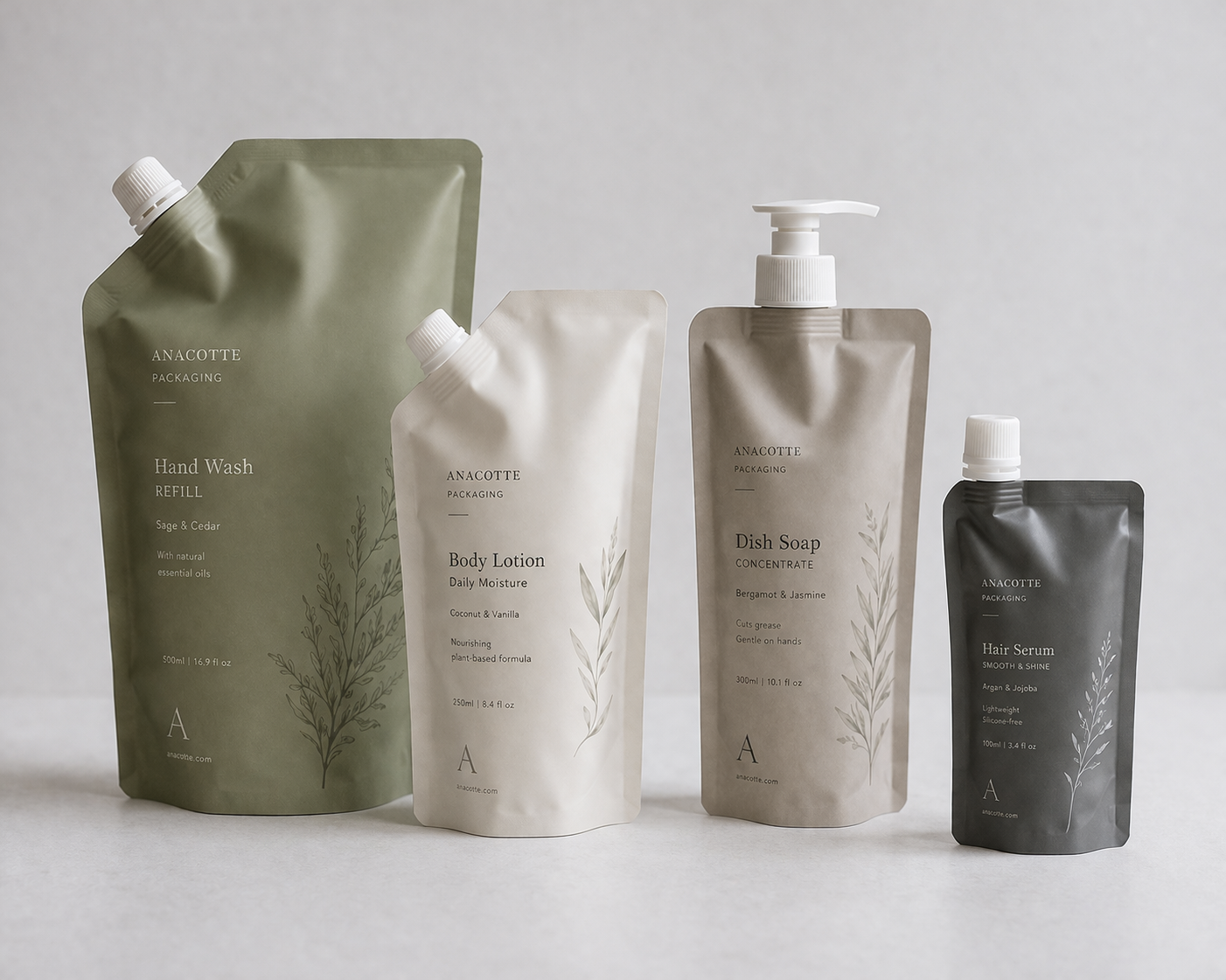
Spout Pouch Packaging for Cleaning Products
Direct answer: a cleaning-product spout pouch should be specified from the finished formula, concentration, viscosity, fill volume, target bottle or dispenser, filling equipment, fitment, cap, storage, labeling, and distribution route. Film, adhesive, ink, sealant, fitment, cap, pouch geometry, and carton must be evaluated as one filled-pack system.
This page covers surface cleaners, multipurpose cleaners, concentrated refills, fabric-care liquids, and related home-care products. Use the dedicated pages for laundry detergent refill pouches, dish-soap refill pouches, and personal-cleansing liquid soap refills.
Cleaning refill project types
| Project route | Pouch direction | Primary checks |
|---|---|---|
| Ready-to-use surface cleaner | Medium refill pouch with controlled-pour spout | Formula compatibility, bottle-neck fit, cap, leakage, drop, and pack-out |
| Concentrated refill | Smaller controlled-dose pouch | Concentration, dose instructions, clean transfer, target bottle, opening, and labeling |
| Large household refill | Higher-capacity spout pouch with strong secondary packaging | Filled weight, gusset, fitment weld, grip, compression, puncture, and carton |
| Professional-use cleaner | Application-specific pouch, fitment, or connector | Equipment interface, operator handling, storage, process, and responsible safety review |
Cleaning-product pouch specification matrix
| Input | What to provide | Decision affected |
|---|---|---|
| Formula chemistry | Product category, surfactants, solvents, oxidizing ingredients, fragrance, oils, pH if known, concentration, and compatibility concerns | Contact layer, adhesive, ink, fitment, cap, barrier direction, and test duration |
| Fill and use | Fill temperature, net content, viscosity, foam, dose, target bottle, pour rate, and number of uses | Spout bore, pouch shape, headspace, grip, evacuation, and filling route |
| Filling equipment | Through-spout or open-top fill, machine, nozzle, pouch support, capping, speed, coding, and inspection | Fitment family, dimensions, seal areas, cap supply, and tolerances |
| Safety and market | Destination, labeling, tamper requirements, child-related requirements, handling instructions, and responsible compliance review | Cap system, opening, artwork space, and qualification plan |
| Distribution | Retail or ecommerce, case count, carton support, storage orientation, pallet, climate, and shipping route | Leakage, puncture, drop, compression, and pack-out tests |
Fitment, cap, and filling-line compatibility
- Match the fitment material, flange, bore, cap, and application torque to the formula and filling process.
- Confirm whether the pouch is filled through the spout or through an open edge and how it is supported during filling.
- Share nozzle, cap-feed, capping, torque, line speed, coding, inspection, and acceptable dimensional tolerances.
- Test the refill against the target bottle or dispenser, including grip, pour angle, air return, dose, residue, and spill risk.
- Approve the filled profile and carton before finalizing artwork, handle features, gusset, or special shapes.
Compatibility and filled-pack tests
- Use the finished formula to screen film, adhesive, ink, sealant, fitment, cap, and printed surface over the intended storage period.
- Run realistic filling and capping trials at the intended temperature, viscosity, foam, speed, headspace, and contamination conditions.
- Check seal integrity, fitment weld, cap torque, leakage, drop, squeeze, compression, flexing, puncture, and storage orientation.
- Test pouring or dosing, repeated reclosure where relevant, evacuation, residue, and compatibility with the target bottle.
- Validate the pouch and carton together for the actual retail, warehouse, pallet, or parcel-distribution route.
Common project pattern: multi-formula cleaning refill range
Project brief: a home-care brand wants several cleaning formulas in a common refill shape while limiting first-run inventory.
Packaging approach: group formulas by compatibility risk, test the most aggressive boundary products, keep one geometry and fitment only where results permit, and verify the dose and target-bottle workflow before artwork approval.
Validation points: compatibility, filling, fitment weld, cap, opening, clean transfer, leakage, drop, compression, labeling, storage, and parcel shipping. This is a composite pattern without customer identity, formula, testimonial, or claimed result.
What to send for a cleaning pouch quote
- Product category, formula chemistry notes, concentration, viscosity, fill temperature, storage, and compatibility concerns.
- Fill volume, target bottle or dispenser, desired pouch dimensions, spout, cap, use pattern, and reference pack.
- Filler, machine, filling and capping route, case pack, distribution channel, destination, and required tests.
- Quantity per formula, design count, artwork stage, forecast, claim target, and launch timing.
Send the formula, equipment, and quantity for a quote. Use the household refill packaging pillar, detergent spout pouch guide, filling-machine compatibility, and leak-testing guide for related decisions.
Frequently asked questions
Can one pouch structure hold every cleaning formula?
No. Formula chemistry, concentration, storage, contact time, filling process, fitment, cap, and distribution can change compatibility and performance.
Is a water-filled drop test enough?
No. Water can support an early handling check, but final approval needs the actual formula and representative filling, storage, use, and shipping conditions.
Does Anacotte fill cleaning products?
Anacotte supplies custom flexible packaging. Formula manufacture, filling, product safety, labeling, regulatory review, and final qualification remain with the brand and its manufacturing partners.
Technical evidence for this packaging application
Anonymous project pattern: Across liquid soap and home-care refill briefs, the recurring technical question is whether the product, fitment and sealant remain compatible over time. The package also has to work with the filler and deliver controlled dispensing after repeated opening. A recyclable-direction structure should be reviewed as a separate performance route rather than presented as automatically equivalent.
What we validate before production
- Formula pH, surfactants, oils, solvents and fragrance compatibility
- Nozzle-to-spout or open-top filling workflow
- Cap torque, drop/leak testing, storage temperature and distribution exposure
Evidence boundary: This is a composite, anonymized pattern from active quotation and sampling records. It contains no customer identity, confidential formulation or claimed production outcome. Dimensions and structures are project-specific examples, not universal specifications.
Download the Packaging RFQ + Validation Checklist (PDF) to send product, filling, fitment, material, SKU and test requirements in one brief.
Request quote support
Send product specs for a packaging recommendation
Tell us your product, target pack size, barrier needs, quantity, artwork status, and timing. We will help you narrow the right packaging direction before you lock the spec.
Get direction on pouch type, film structure, closure, finish, and shelf-life risk before locking a specification.
Share your target run size so we can compare digital, custom, and bulk production trade-offs.
Include filling method, pack size, material preference, artwork status, and launch timing for a more precise reply.
Decision tools
Qualify flow, fitment, filling, and leak risk together.
Liquid refill and flowable pet products need the actual formula, viscosity and particles, fill route, closure, storage, and filled-pack test plan—not a format recommendation based on product name alone.
Updated
Method: transparent screening inputs and decision limits
Final specification requires representative samples and documented testing
01Spout × viscosity matrixScreen a candidate bore from viscosity, particles, and the filling route.
02Filling-line checklistConnect the product, pouch, fitment, machine, and test protocol.
03Barrier material selectorTurn product, process, barrier, transparency, and recycling goals into a test brief.