
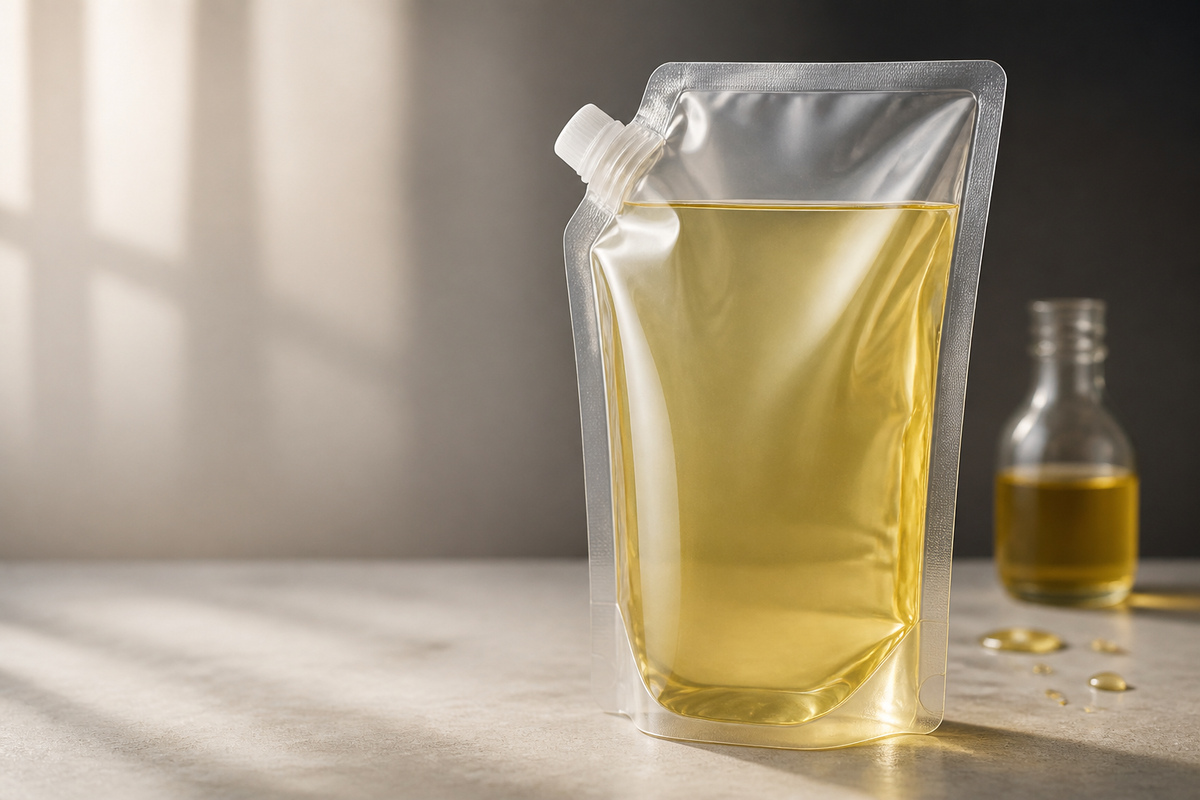
“Oil pouch” is not one packaging decision. A single-use sample, a 250 ml refill, a family-size pour pack, and a bulk foodservice format can all need different dimensions, openings, and handling assumptions. Start with the routine the customer will follow, then choose the pouch geometry that makes that routine testable.

Choose the use pattern before the pouch size
A cooking oil refill pouch usually has one of four jobs. It may deliver a small portion, refill a bottle at home, pour directly into a pan or dispenser, or move a larger volume through a foodservice routine. Each job changes the useful fill level, headspace, opening, and reclosure requirement.
| Use pattern | First format to test | Questions that decide the route |
|---|---|---|
| Single-use sample or portion | Flat three-side-seal sachet | Target dose, tear direction, seal contamination, panel and code space |
| Small refill or trial pack | Small stand-up spout pouch | Pour angle, bottle-neck fit, cap, residual oil, and whether reclosure is needed |
| Repeat-use retail refill | Stand-up spout pouch with a stable base | Fill height, grip, cap torque, storage after opening, and case-pack protection |
| Large-volume dispense | Spout pouch or another bulk route for comparison | Filling equipment, lifting, secondary packaging, dispensing speed, and distribution |
The 250 ml size is a live Anacotte product example, not a recommendation for every cooking oil. A target volume should be set from the product dose, refill frequency, density, headspace, customer grip, and the filler’s process limits.
What to specify for an oil refill pouch
1. Oil and fill behavior
Tell the packaging supplier what is actually being filled: olive, sunflower, avocado, blended, infused, or another oil; whether flavorings or particulates are present; the expected viscosity range; and the temperature at filling and storage. “Cooking oil” is useful as a category, but it is not a complete compatibility brief.
Record target net fill, allowable tolerance, headspace, and the final filled width, depth, and height you can accept. A pouch that looks right empty can feel unstable when filled, or leave too little usable panel area once the oil settles.
2. Spout, cap, and pour routine
Define where the spout sits, what bottle neck or dispenser it must reach, how the customer will hold the pouch, and whether a clean cut-off matters. Ask for the fitment drawing, orifice information, cap direction, tamper-evidence option, torque target, and the intended pour angle. These are test inputs, not details to fill in after artwork is complete.

3. Reclosure and label space
If the pouch is used over several pours, the cap and reclosure routine should be tested with the real oil. If it is a true single-use pack, a tear notch may be more relevant than a zipper or screw cap. In both cases, reserve usable front and back panels for approved copy, lot or date coding, barcode placement, and any required statement owned by the product team.
Do not turn a supplier claim into a food-contact approval
For a U.S. food application, the material conversation should include intended use, component documentation, conditions of use, and the evidence needed by the brand and filler. The FDA explains that food packaging is a food-contact context and that authorization and migration considerations are tied to the intended use. That is why a phrase such as “grease-resistant” on a product page is not, by itself, approval for a specific oil, temperature, or shelf-life target.
Ask who owns the regulatory review, which components are covered, what conditions of use apply, and what documentation must travel with the quote and sample. Keep laminate, sealant, coating, cap, and fitment decisions open until that handoff is complete.

Run a filled sample sequence before committing to print
- Fill and seal. Use the intended oil or a documented surrogate, then record fill temperature, net fill, headspace, seal settings, and whether oil reaches the seal area.
- Pour and reclose. Test the intended bottle or dispenser, opening force, pour angle, drip behavior, cap handling, and residual oil around the fitment.
- Store. Hold filled samples under the project’s planned temperature, light, orientation, and time assumptions. Check appearance, odor, seal area, cap, and panel condition. This is a project test, not a shelf-life guarantee.
- Handle and ship. Test the filled pack in the case pack and parcel or pallet route it will actually use. Check compression, drops, scuffing, leaks, and the way the pouch is removed from secondary packaging.
- Review the evidence. Approve the geometry, material documentation, artwork panel, code zone, fitment, and test notes together. Do not approve only from a product photo.

Use the current Anacotte reference as a starting point
Anacotte currently lists a Cooking Oil Refill Spout Pouch and a smaller 250 ml cooking-oil spout pouch. These active product pages are useful starting references for a conversation about stand-up geometry, corner-spout handling, sample options, and custom sizing. They are not a substitute for formula review, food-contact documentation, filled testing, or a line-compatible dimensional drawing.
For broader context, compare the format logic in Anacotte’s guides to sauce packaging formats and spout pouch versus bottle decisions. Those pages provide adjacent format context; this oil-specific brief still needs the details above.
Cooking oil pouch FAQ
Is 250 ml the right size for an oil refill pouch?
It may be a useful trial size, but there is no universal right size. Confirm the dose, refill cadence, bottle neck, customer grip, headspace, case pack, and target channel with filled samples.
Should an oil pouch have a spout?
Use a spout when controlled pouring or bottle refilling is central to the routine. A flat sachet may be simpler for single-use portions. The decision should follow the opening gesture, not the category name.
Can a “grease-resistant” pouch be approved for any oil?
No. Treat that phrase as a supplier claim to investigate. Formula, temperature, time, seal area, fitment, and intended-use documentation still need to be reviewed and tested.
What should I send with a quote request?
Send the oil type and viscosity range, target fill and tolerance, fill temperature, pouch dimensions or a filled reference, spout and cap expectations, artwork and code zones, distribution assumptions, and sample quantity. You can request a project-specific conversation with Anacotte using that information.
Sources and evidence boundary
Current format examples used for market existence include QIYU PACK’s edible-oil packaging page and Sinoflex’s edible-oil spout-pouch page. Supplier pages show available routes; they do not prove suitability for a particular oil. The FDA component and intended-use guidance is included to keep the food-contact handoff project-specific.
Bottom line: choose the cooking-oil pouch from the real pour routine, then prove size, spout, material, seals, label space, storage, and shipping with filled samples before you approve a final production specification.

Leave a comment
Situs ini dilindungi oleh hCaptcha dan berlaku Kebijakan Privasi serta Ketentuan Layanan hCaptcha.