
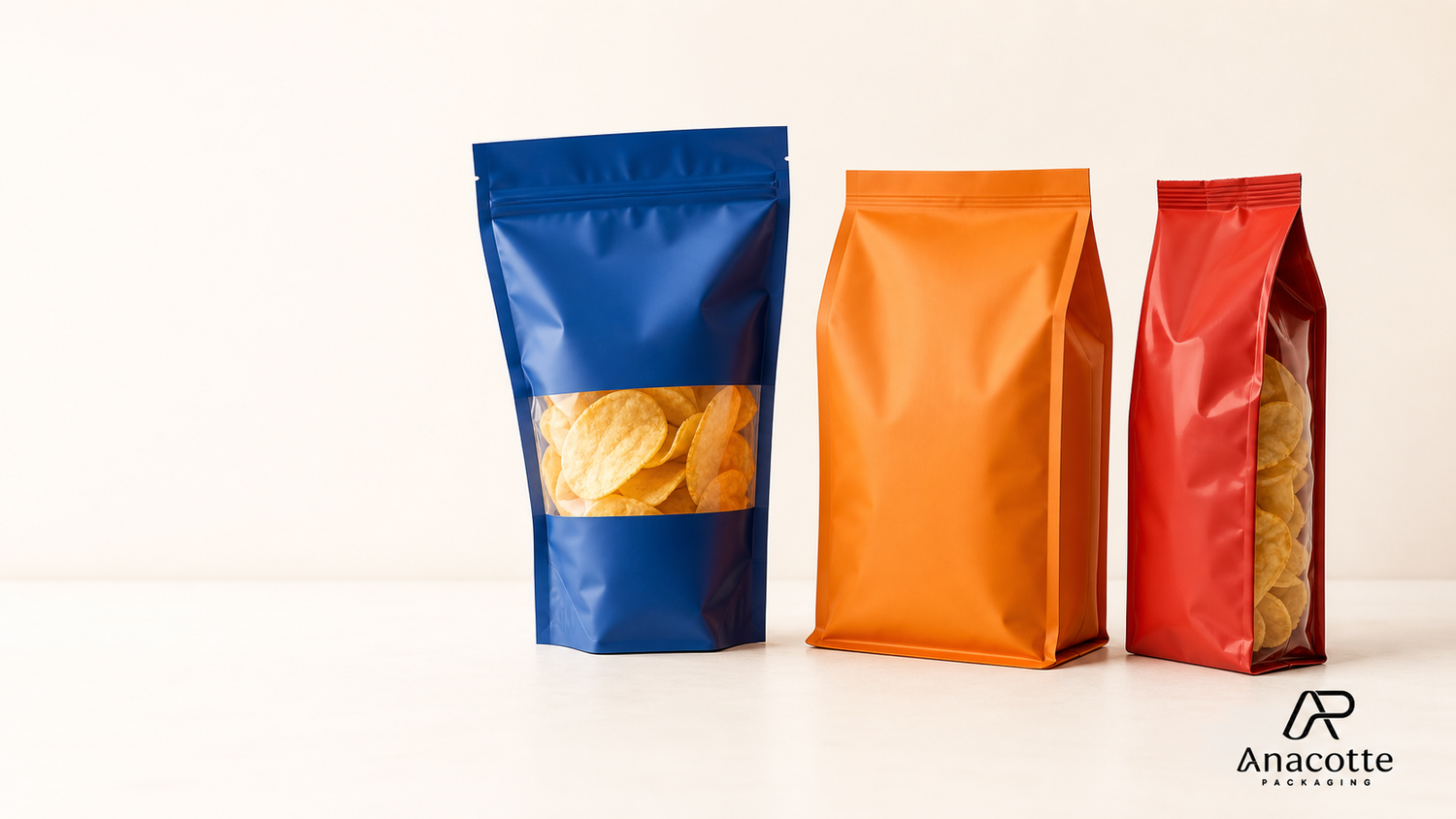
Short answer: stand-up pouches are the most flexible low-MOQ choice for new chip brands, flat-bottom pouches deliver the strongest premium shelf presence, and side-gusset bags are useful when you need a tall pack with efficient volume. The right format depends on chip fragility, fill volume, retail display, barrier needs, and how the package will be filled.
Chip packaging has to do more than hold product. It must protect crispness, limit oxygen and moisture exposure, survive distribution without excessive breakage, communicate flavor quickly, and fit the economics of your launch. This guide compares the three formats that growing snack brands ask about most often.
Quick comparison: which chip pouch should you choose?
| Format | Best for | Shelf effect | Low-MOQ fit | Main watch-out |
|---|---|---|---|---|
| Stand-up pouch | New brands, flavor tests, DTC and specialty retail | Strong front panel with a familiar snack silhouette | Excellent with digital printing | Choose dimensions carefully to avoid crushing or excess headspace |
| Flat-bottom pouch | Premium chips, giftable snacks and higher-priced lines | Wide, stable base and five printable panels | Good, but construction can cost more | More material and converting complexity than a basic stand-up pouch |
| Side-gusset bag | Larger fills, foodservice-inspired products and vertical shelf sets | Tall profile with efficient internal volume | Good for selected digitally printed structures | Front-panel presentation and closure options need early planning |
1. Stand-up pouches: the most versatile starting point
A custom stand-up pouch is usually the easiest format for an emerging chip brand to test. It gives you a broad front and back panel, a bottom gusset that supports shelf display, and optional features such as a zipper, tear notches, or a clear window.
For limited flavors, regional launches, influencer mailers, farmers markets, and first retail tests, the format works well because multiple designs can be produced without the cylinder or plate economics associated with long-run printing. A brand can keep the dimensions and material consistent while changing flavor artwork across smaller batches.
The important technical decision is not simply “stand-up pouch or not.” You still need to validate usable internal volume, top seal allowance, zipper position, fill temperature, chip size distribution, and the amount of headspace required to reduce crushing.
2. Flat-bottom pouches: premium structure and shelf stability
Flat-bottom pouches create a box-like presentation with a stable base, front and back faces, and side panels. That extra structure can help premium kettle chips, plantain chips, specialty vegetable chips, and gift-oriented snack lines feel more substantial.
The format also gives designers more panel architecture. The front can carry the brand and flavor, side panels can explain ingredients or sourcing, and the back can hold nutrition, barcode, preparation notes, and company information. The trade-off is a more complex construction that should be justified by price point, merchandising strategy, or brand positioning.
3. Side-gusset bags: efficient volume with a tall silhouette
Side-gusset packaging expands along both sides and can provide efficient volume in a relatively narrow footprint. It is worth considering for family-size products, premium kettle-style chips, snack mixes, and concepts that benefit from a tall vertical presentation.
Because the panels fold differently from a stand-up pouch, artwork must be reviewed on a physical mockup. Keep important claims, flavor names, and logos away from folds. Decide whether the bag will use a simple top seal, a reclosure feature, or another closure system before finalizing the dieline.
Barrier performance matters more than the pouch name
Chips lose quality when oxygen and moisture move through the package or when seals fail. A good specification therefore starts with the product: oil content, seasoning, expected shelf life, distribution distance, light sensitivity, and storage conditions. The laminate structure should be selected around those requirements instead of choosing material only by appearance.
- Moisture barrier: helps maintain crispness in humid conditions.
- Oxygen barrier: supports flavor and oil stability.
- Seal integrity: must match the filling and sealing process.
- Light barrier: may matter for products with sensitive oils or ingredients.
- Mechanical strength: helps the package survive packing, cartons, and delivery.
If you plan to nitrogen flush, confirm that the pouch structure, dimensions, and seal area are compatible with your equipment or co-packer. A beautiful bag that cannot run consistently is not launch-ready.
How low-MOQ digital printing changes the launch decision
Digital printing makes it practical to test more than one design without committing to a large conventional print run. That is useful for flavor validation, retailer pilots, seasonal editions, geographic tests, and packaging before a national rollout. It also reduces the risk of holding obsolete inventory after a recipe, nutrition panel, or claim changes.
Anacotte Packaging supports custom printed flexible packaging for smaller launches, including the chip packaging collection. Current examples include a potato chip stand-up pouch, a tortilla chip flat-bottom pouch, and a kettle chip side-gusset bag.
A practical decision framework
- Start with product volume. Measure the actual filled volume of representative chips, not only net weight.
- Define the sales channel. DTC, peg display, shelf display, club, and foodservice all create different format constraints.
- Set the quality target. Provide the desired shelf life and distribution conditions.
- Confirm filling. Identify your co-packer or sealing equipment and its size limits.
- Choose the format. Use stand-up for versatility, flat-bottom for premium structure, or side-gusset for efficient tall volume.
- Prototype before scale. Review fit, artwork, sealing, carton packing, and shelf appearance using samples.
Frequently asked questions
What is the best packaging for a new chip brand?
A digitally printed stand-up pouch is often the best first format because it balances shelf presence, reseal options, low-MOQ production, and design flexibility. The final choice should still be tested with the actual chip size and fill volume.
Can chip pouches start at 200 pieces?
Selected Anacotte Packaging launch configurations are offered with a 200-piece starter option. Availability, dimensions, material, finish, and shipping details should be confirmed for the specific project.
Should chip packaging include a zipper?
A zipper is useful for multi-serve packs and products that may not be consumed at once. Small single-serve formats may prioritize a clean tear-open experience and lower converting complexity.
Is a clear window a good idea for chips?
A window can build product visibility, but it changes the barrier and light-protection conversation. Use it only after confirming that the product's shelf-life requirements still can be met.
Which format looks most premium?
Flat-bottom pouches often create the most structured premium impression. Strong artwork, material finish, print quality, and proportion can make any of the three formats feel premium.
Next step
Send Anacotte Packaging your target fill weight, sample product dimensions, preferred format, number of designs, desired finish, and expected launch date. The team can help narrow the pouch structure before you commit to production artwork.

Laisser un commentaire
Ce site est protégé par hCaptcha, et la Politique de confidentialité et les Conditions de service de hCaptcha s’appliquent.