

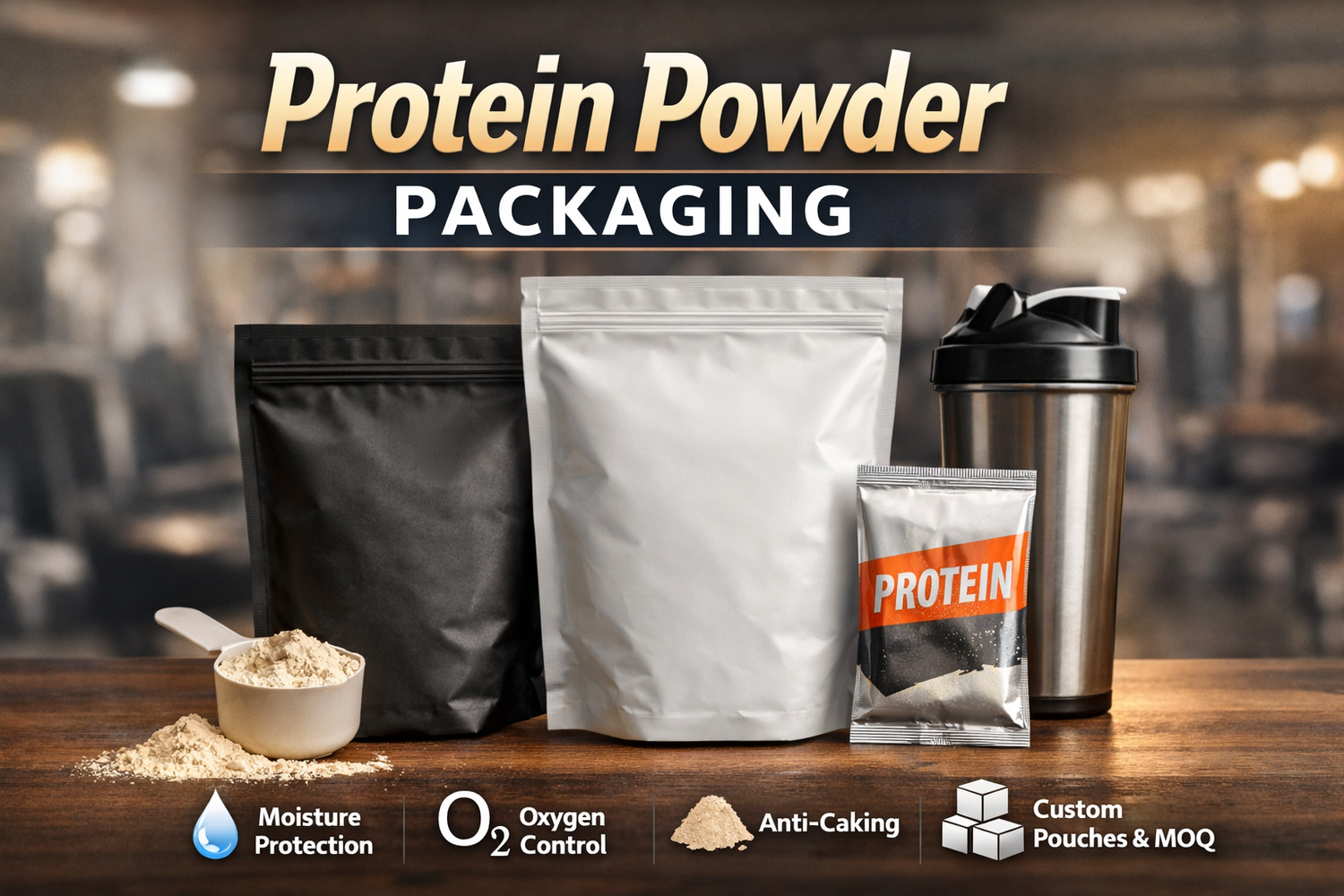
Packaging must do more than look good on a shelf. For supplement brands, packaging needs to keep powders away from moisture and oxygen to avoid clumping, packaging needs to withstand the filling and shipping process, and packaging needs to fit the brand’s target MOQ and print budget. When sourcing supplement packaging, the decision can usually be made by assessing the barrier level, pouch format, print method, and order model.
More simply put, packaging for protein powders is flexible packaging keeping powders dry, flowable, and retail-ready from the filling process to final use. For most buyers, it’s not about looking pretty. They want to ensure the structure of the bag is appropriate for the projected shelf life, fill weight, and sales channel.

What is protein powder packaging, and why does it differ from the general design?
Protein powder is often more demanding than many dry-food powders because it is highly sensitive to humidity pickup, repeated end user opening, and physical handling during fulfillment. Whey protein, plant protein blends, meal replacement powders, and functional supp mixes may all look similar in a product brief, but differ in flow behavior, aroma retention, and barrier needs.
Protein powder packaging is usually specified around barrier performance then the more convenient features such as zippers, tear notches, finishes, window options, and shape. Buyers commonly want packaging that offers:
Protection against moisture ingress
Lower oxygen exposure during shelf life
Reduced caking and flowability issues
Seal and leak resistance
Brand presentation that works online and in brick and mortar stores
Practical MOQ and print options for commercial viability
For many emerging brands, the protection complexity does not need to be beyond one requirement.
What’s most critical for protein powder packaging?
1.Moisture protection
Of all potential issues for protein powder, moisture protection is a leading concern for the overall purchasing consideration. Excellent packaging design and powder manufacturing will be counterproductive if moisture ingress is present during storage, transport, and repeated consumer use.
These will lead to clumping, a change in powder texture, and a poor consumer experience.
This is why many supplement buyers first consider whether a standard barrier is suitable packaging, or whether the product would require a more high barrier packaging structure. This is especially true for products with long shelf-life, humid distribution conditions or the premium formulations that require consistency.
2.Oxygen control
Oxygen impacts flavor and shelf-life of a product especially when it is incorporated in blends with fats, flavor systems or sensitive functional ingredients. A robust barrier structure would help minimize oxygen ingress and maintain product quality throughout the shelf-life. When buyers compare materials, it is common practice to consider with packaging design as much as the aesthetics and gauge of the materials, as they would with the shelf-life.
3.Anti-caking performance
When it comes to packaging and powdery products, caking is a concern. It is a controlling packaging concern, rather than the formulation alone. A powder that is prone to compaction and or absorbs hygroscopic ambient moisture, will have packaging, especially with resealable closures, strong seals, and suitable barrier levels that will be more important. This is why many procurement teams tend to look at product and packaging as one consolidated partnership rather than in siloed workstreams.
In regards to protein powder, the first step to combating caking is to first control moisture ingress to the product and maintain the integrity of the packaging, rather than just a thicker gauge material.

Which pouch style works best for protein powder packaging?
The most common choices are stand up pouches, flat bottom pouches, and sachets. The right option depends on pack size, shelf presentation, consumer use pattern, and channel strategy.
Stand up pouches
Stand up pouches for supplements are one of the most versatile formats for protein powder brands. They balance shelf presence, shipping efficiency, and user convenience. They are commonly chosen for direct-to-consumer launches, refill programs, mid-size fill weights, and brands that want a clean printable front panel without moving into a boxier bag style.
- Good for flexible fill ranges and everyday retail presentation
- Works well with zippers, tear notches, and matte or gloss finishes
- Useful when brands want a lighter, space-efficient alternative to rigid packaging
- Often practical for lower-volume launches when paired with digital printing
Flat bottom pouches
Flat bottom pouches are often selected for larger fill weights, stronger shelf impact, and a more premium retail look. Their shape can offer better panel structure for branding and nutritional layout, especially when the pack needs to stand securely in physical retail or communicate a more established brand position.
- Well suited to larger-format protein powder SKUs
- Offers strong shelf presence and efficient front/back/side printing space
- Can support premium positioning for sports nutrition or lifestyle supplements
- Often preferred when a brand wants a more structured appearance than a standard pouch
Sachets and single-serve packs
Sachets are a strong option for trial packs, sampler sets, gym distribution, subscription inserts, and travel-friendly serving formats. They are particularly useful when the goal is customer acquisition, product testing, or portion control rather than pantry storage. For some supplement brands, sachets complement larger pouches rather than replace them.
- Useful for sample campaigns and first-order conversion
- Supports single-serve convenience and controlled dosing
- Can be paired with larger pouch SKUs for a broader line architecture
- Helpful when brands want to validate flavors before scaling larger packs

What should customers confirm before seeking pricing?
Procurement delays in supplement packaging most frequently occur when buyers request pricing before they have completed packaging briefs. For packaging protein powders, vendors typically need more than a product name and projected order quantity.
It’s useful to confirm the following before seeking pricing:
- Fill weight or target serving count
- Approximate product density and powder behavior
- Required barrier level
- Desired pouch format and dimensions
- Closure type, such as zipper or heat-seal only
- Finish preferences, including matte, gloss, metallic, or clear window requests
- Print method preference or expected order volume
- Target launch timing and replenishment planning
| Use Case | Typical Format Preference | Key Packaging Priority |
|---|---|---|
| Starter supplement brand | Stand up pouch | Balanced barrier, lower MOQ flexibility, easy brand launch |
| Premium retail protein line | Flat bottom pouch | Stronger shelf impact, larger printable area, structured appearance |
| Samples or promo distribution | Sachet | Portion control, low-commitment trial, fast testing of flavors |
| Humidity-sensitive formulation | High-barrier pouch structure | Moisture and oxygen management |
Buyers also frequently ask questions regarding scoop-packed products. For packs that are expected to include a scoop and be accessed multiple times, it tends to be more important to assess both barrier and closure performance. A large format bag that is accessed repeatedly poses a different exposure risk than a single serve packed that is sealed.

Do protein powders with scoops need high barrier packaging?
Yes, in most cases. It depends on the required shelf life, regarding packaging, expected real-world use. With the inclusion of scoops, the pouches are used multiple times. Therefore, the pouches are continually exposed to air and humidity. This does not mean that every scoop pack should possess the strongest barrier possible. However, it does mean that they shouldn't treat the packaging like it’s a 1-2 use sample sachet.
Buyers often consider the following factors in determining if a scoop pack should have a stronger barrier:
- How long the product needs to remain stable after filling
- Whether distribution includes humid or warm environments
- Whether the powder is especially prone to clumping
- How often the consumer will open and reseal the pack
- Whether the brand is positioning the product as premium or performance-focused
For most of the supplement projects, reliable zippers with good barrier performance are a good starting points. This is why purchasers considering high barrier supplement pouches often begin conversations with barrier materials, not after the artwork is completed.
Which printing method makes sense for protein powder packaging?
The packaging of protein powders has to be attention grabbing, in a marketing sense, and offer a degree of customizability. The ideal method of printing will be determined from the order size, artwork limitations, product differentiation, and the anticipated speed in which changes are expected to be made.
Digital Printing
Digital printing is a useful option for smaller projects with short lead times and changing graphics. This is often the right choice for new supplement launches, testing new flavors, seasonal drops, or for brands trying to gauge a demand and not wanting to lock in large volume purchases.
Generally Printing for Scale
Once demand is established and becomes larger, the traditional printing methods begin to make more sense economically. With a conventional print, one can make high volume purchases with the same artwork across multiple reorderable SKUs. When evaluating these options, people look at how economically viable the option is in terms of short and long-term for the volume of SKUs that are needed to be managed and the overall scale of the range.
Choosing a printing method often involves evolving product lines. It is sometimes beneficial to choose a less economical option if the product line continues to rapidly evolve.

What Role Do MOQ and Lead Time Play in the Buying Decision?
The lead times and minimum order quantity are very important for the cash flow and inventory risk during a product launch. In the context of protein powder packaging, these factors are determined by pouch style, printing method, type of materials, and design.
As a general procurement rule of thumb:
- Lower-MOQ programs are often attractive for newer brands, pilot launches, or SKU testing
- Higher-volume projects may open up different print economics and material planning options
- Lead time is rarely just a production question; it also depends on artwork readiness, sampling, and approval speed
Most buyers find value in packaging roadmap clarity far in advance, especially if time and flexibility are initial objectives. This contrasts a program in a more mature state, which is program anchored on cost savings.
What steps should supplement brands take for sampling and approvals?
Especially for protein powders, sampling is critical because appearance is not indicative of packaging effectiveness. In many cases, buyers want to confirm dimensions, closures, panel layout, fill, and overall look, before placing the bulk order.
1.Be certain of the target format, fill weight, and barrier.
2.Internally, artwork layout, claim space, and the inclusion of regulatory text should be reviewed.
3.Request samples or mockups to evaluate size, handling, and overall look.
4.Before giving approval, make decisions on sealing, closure, and packaging.
5.Move to production only if structural and visual details are agreed upon.
For a brand with several flavors or sizes, sampling can also help prevent structural mistakes from being repeated across the line.
What are the capabilities of Anacotte Packaging in relation to protein powder?
Anacotte Packaging specializes in flexible, barrier, and demanding shelf-life supplements packaging. Partnering with Anacotte Packaging is extremely beneficial for Proteins powder brands, as there is precise packaging structure with formats prioritizing design, clever print, and supply frame.
For your first comparison of packaging formats for a new supplement launch or most strategic packaging structure, consider the custom supplement packaging design and the associated pouch options. This provides your team with a valuable base-level understanding of how well pack shape and barrier are aligned with your end product objectives.
It is advisable, even before you reach your final sourcing, to have an idea of whether a flexible stand up pouch design or a fully flat bottom pouch structure would be most appropriate for your estimated target weigh, merchandising, and reorder model.
Are you planning a protein powder project? If so, please contact Anacotte Packaging with your project specifications so we can begin your quote based on your protein powder project plan.
Anacotte Packaging FAQ
What is the most suitable pouch type for protein powder?
It is not accurate to state a preference for any one packaging type as this would not apply to all brands. Generally, flat-bottom pouches are considered a more premium shelf presence option, whereas stand up pouches tend to allow for more versatility. For trial and travel campaigns, sachets are more appropriate.
Do you think all protein powders need high level barrier packaging?
Not all protein powders need high level barrier packaging, but strong moisture and oxygen barriers are helpful for many of the protein powder projects. The best barrier will depend on shelf-life targets, product vulnerability, the environment the packaging will be exposed to, and how the end user will be using the pack after it has been opened.
Is it possible to begin with a lower MOQ for a new protein powder brand?
It is common for newer protein powder brands to first validate their flavors, packaging, and distribution channels. The most common packaging options available to new brands dictate the Minimum Order Quantity (MOQ). It is best to define your packaging options first before discussing different order models.
What information should I have ready before requesting a quote?
What you should be ready with is your intended fill weight, size, and dimensions, as well as the type of pouch you would like to have, the level of barrier you need, closure options, how far along you are on the artwork, and your desired launch date. A fully detailed brief helps to regulate your quote to align with your timelines and production needs.


Dejar un comentario
Este sitio está protegido por hCaptcha y se aplican la Política de privacidad de hCaptcha y los Términos del servicio.