
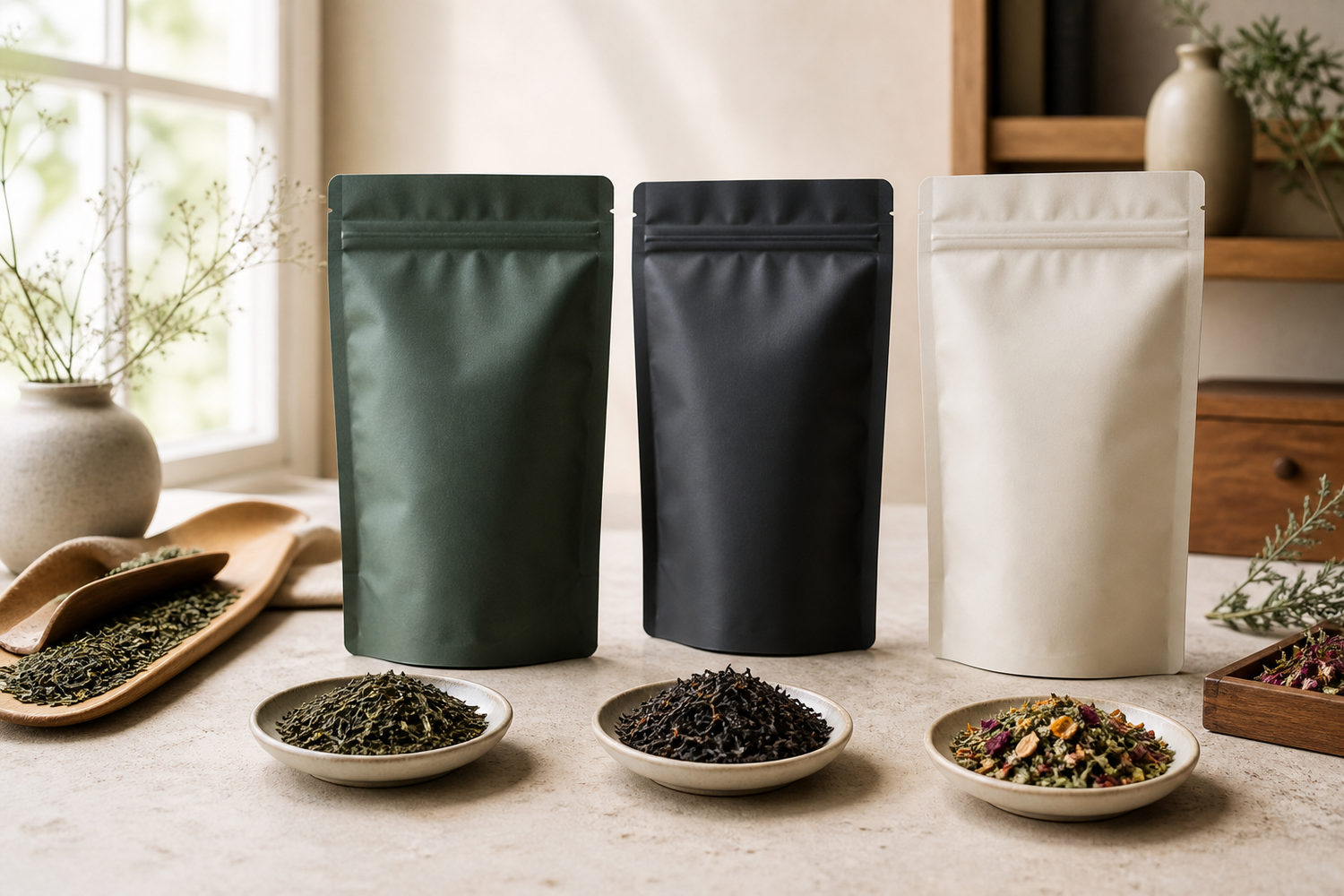
Loose-leaf tea pouch packaging should be tested with the real blend, not chosen from net weight alone. Thirty grams of a compact broken-leaf tea can occupy a different volume from thirty grams of a large whole-leaf or botanical blend. Leaf shape, stems, flowers and fruit pieces also change filling, headspace, opening behavior and the way a pouch stands.
This guide is for U.S. specialty tea founders, blenders, co-packers and subscription teams preparing custom pouches. It is a packaging-planning resource, not food-safety, sensory, shelf-life, food-contact, labeling, transport-testing, regulatory or legal advice. Confirm the exact tea, inclusions, processing, storage, label and finished package with the responsible food team, co-packer, packaging supplier, test laboratory and qualified regulatory reviewer.

1. Separate tea format, blend and sales channel
“Tea pouch” is not one specification. Create a row for each materially different blend and pack size. Separate whole leaf, broken leaf, fannings, powdered tea, tea bags and blends with large botanicals or sticky inclusions. Record whether the package is a sample, daily-use retail pouch, gift assortment, subscription refill or foodservice pack.
For every row, define:
- Blend name, formula revision and representative production lot.
- Target net weight, expected variation and fill method.
- Leaf/particle range, fragile inclusions and expected settling.
- Storage, display, subscription, parcel and foodservice conditions.
- Consumer access: pouring, spooning, pinching or use of an infuser measure.
- Reclosure expectation and expected number of opening cycles.
- SKU artwork, lot/date coding and responsible label owner.
Do not combine all blends into one sample because their behavior may differ. A chamomile-heavy blend may need more headspace than a dense black tea at the same weight, while fine particles may enter the zipper more readily. The sample plan should deliberately include the most different blends.
2. Measure actual fill volume and leaf handling

Weigh representative samples using the project’s approved method, then fill candidate pouches using the intended equipment or a documented pilot method. Allow the samples to settle under defined conditions before measuring the filled pouch. Record fill height, headspace, clearance below zipper and final seal, base stability and the dimensions of the finished pack.
Inspect the tea as well as the pouch:
- Does the opening allow product to be filled without excessive leaf breakage or spillage?
- Do stems or large botanicals bridge at the opening?
- Do fine particles collect in the zipper or final seal?
- Can the consumer remove a serving without crushing the remaining leaves?
- Does the filled panel remain suitable for display and readable label copy?
Use photographs and retained samples rather than relying on a capacity chart. If one blend occupies much more volume, decide whether it needs its own pouch size, a different fill target or a deliberate family-size rule. Avoid hiding excessive empty space behind marketing language.
3. Turn aroma and freshness claims into test questions
Tea quality can change with storage variables, but one material name does not establish a universal result. A 2024 Food Frontiers study on packaged green tea evaluated packaging material, oxygen scavenger and temperature and identified changes in freshness-aroma-related quality during its reported storage conditions. That supports treating packaging and temperature as variables. It does not set a shelf life, oxygen-transmission target or scavenger requirement for every green, black, oolong or herbal tea.
Build a controlled comparison with the responsible quality or sensory team. Define candidate structures from the product’s sensitivity and distribution conditions, then compare sealed finished packs at planned intervals. The protocol can record aroma, flavor, color, leaf appearance, moisture-related observations, seal/closure condition and any cross-odor concern using a documented method and trained or qualified assessors as appropriate.
Also review food-contact suitability for the intended use. FDA’s food-packaging overview explains that packaging components and migration are evaluated for intended use. Its food types and conditions-of-use tables include dry solids and room-temperature storage categories. Ask for traceable documentation for the proposed film, sealant, ink and adhesive; a generic “food grade” statement is not a finished-use approval.
4. Test opening and zipper function through repeated use

A resealable pouch should be evaluated after the tamper-evident top is opened and throughout the expected use period. Make samples at the lowest, typical and highest practical fill conditions. Have representative users open, dispense and reclose the pack using the intended method.
Record:
- Tear initiation, opening direction and loose fibers or rough edges.
- Usable opening width for spoon, pinch or pour access.
- Leaves or dust trapped in the zipper and the effort required to close it.
- Whether the user can confirm closure by touch or sound.
- Panel creasing, delamination, zipper detachment or loss of standing stability.
- Condition after the planned number of cycles and storage intervals.
Do not translate a pleasant first closure into a shelf-life claim. Reclosure is only one part of the finished package system, and real users may leave powder or leaves in the track or store the pouch under different conditions.
5. Reserve label zones and control every blend proof
The FDA Food Labeling Guide provides the U.S. framework for statement of identity, net quantity and information-panel labeling. A qualified reviewer should determine the exact requirements, exemptions, ingredient declarations, allergen information, claims and directions for each tea or botanical blend.
On the formed, filled pouch, mark zones for:
- Statement of identity and accurate net quantity on the principal display panel.
- Ingredient and applicable allergen copy for the exact blend.
- Nutrition labeling or documented exemption decision as applicable.
- Responsible-business details, preparation/storage directions and approved claims.
- Lot/date code on a surface verified for contrast and durability.
- Seals, zipper, tear notch, gusset folds and print tolerances.
Use a blend matrix linking formula, net weight, ingredients, front name, color system, barcode, code method, pouch size and artwork revision. Botanical illustrations and similar color families can increase mix-up risk if proof names are ambiguous. The release process should compare the printed roll or pouch to the approved master for that exact SKU.
6. Validate the secondary pack-out and send the supplier brief

For ecommerce and subscriptions, test the filled pouch with its mailer, dividers, gift carton and other contents. Look for puncture from rigid accessories, abrasion between pouches, compression of delicate leaves, opening of the top seal, zipper damage and odor transfer among strongly aromatic blends. The ISTA 3A overview describes a general parcel-delivery simulation for the complete packaged product; select the applicable current test and acceptance criteria with a qualified laboratory.
A useful quote request includes:
- Representative blends and named food, sensory/shelf-life and label owners.
- Target net weights, actual fill-volume observations and leaf/particle ranges.
- Fill equipment or manual process, dust/leaf-control issues and final sealing route.
- Pouch format, candidate dimensions, opening method and reclosure expectation.
- Storage, display, subscription/parcel and foodservice conditions.
- Food-contact documentation and candidate-barrier questions.
- Blend/SKU artwork matrix, code plan, quantity by design and proof owners.
- Filled-sample, sensory, reseal and pack-out tests with decision owners.
Review Anacotte’s 1 oz tea and sample flat pouch and tea packaging collection, then request a project-specific quote with the actual blends, fill volumes, artwork matrix and test questions. Preserve unknowns as validation work rather than unsupported claims.
Frequently asked questions
Can the same pouch size hold the same weight of every tea?
Not necessarily. Whole leaves, broken leaves, flowers and fruit inclusions can occupy different volumes. Fill and measure representative blends before freezing dimensions.
Does a foil or metallized pouch guarantee tea freshness?
No. Material structure, seals, filling, residual headspace, storage temperature, product characteristics and consumer use interact. Validate the actual finished pack against a defined shelf-life and sensory protocol.
How should a zipper be tested?
Test it after the top is opened and across repeated dispense/reclose cycles at several fill levels. Record trapped leaves, closing effort, user confirmation and physical damage.
What should a tea brand send before sampling?
Send representative blends, target weights, fill-volume observations, fill method, storage/channel, opening/reseal needs, artwork matrix, code plan, quantities and written sensory/handling questions.

Dejar un comentario
Este sitio está protegido por hCaptcha y se aplican la Política de privacidad de hCaptcha y los Términos del servicio.