
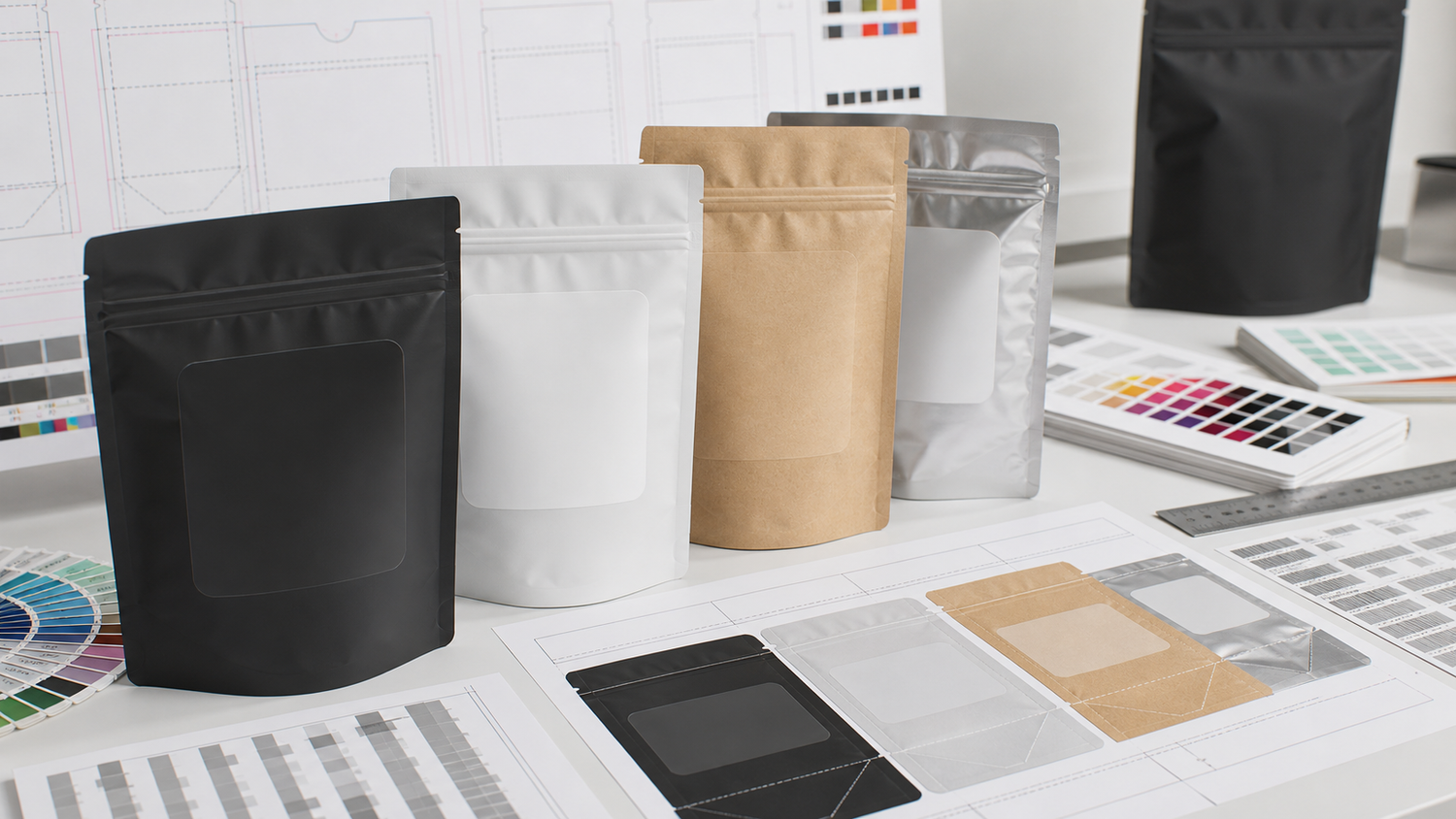
Dispensary Packaging Bags: Artwork and Label-Space Checklist Before Printing
Artwork for dispensary packaging bags should start with space planning, not color. The pouch has physical zones that cannot be treated like a flat poster: zipper, tear notch, seal area, gusset, batch code, barcode, and variable information all need room.
This is packaging-preparation guidance only. It does not provide legal advice or conclusions about required statements in any market.
Use Anacotte's customized packaging and low-MOQ packaging options when several artworks need to share one pouch platform.
Lock the pouch before final artwork
Start with the physical format. A stand-up pouch may give enough front-panel space for small SKUs. A flat-bottom pouch can add panels and shelf structure, but it also changes the dieline.
Film choice matters too. Odor resistance, moisture control, light blocking, and puncture resistance belong in the material brief before artwork approval. Use high-barrier packaging as the comparison point when the product requires stronger protection.

Mark fixed and variable areas
Separate the design into fixed and variable layers:
| Area | Planning note |
| Brand artwork | Keep stable across SKUs if possible |
| Product/SKU name | Reserve a clean variable panel |
| Barcode | Keep quiet zone and scan angle in mind |
| Batch/date code | Avoid seams, folds, and dark backgrounds |
| Review panel | Leave space for market-specific review |
| Closure instructions | Keep away from zipper distortion |
The GS1 US Database page is a useful reminder that product identification data should be handled carefully. Barcode placement is a production decision, not only an artwork decision.
Keep child-resistant evidence separate from artwork claims
If the bag uses special packaging features, the evidence should match the finished pouch. The CPSC PPPA guidance provides federal context, and 16 CFR 1700.20 describes the testing protocol.
Do not turn that evidence into broad artwork claims. Keep the file focused on the exact closure, pouch size, and structure being quoted.

Watch environmental wording
If the pouch uses a recyclable-oriented or kraft-look structure, keep material facts separate from claims. The FTC Green Guides summary explains why broad unqualified environmental statements are risky.
Anacotte's recyclable packaging can be reviewed early, but final artwork language should match the actual pouch structure and target market.
Use approval gates
A clean artwork workflow has three gates:
1. Dieline approval: size, seal zones, closure, gusset, and code space.
2. Proof approval: color, finish, barcode, variable panels, and readability.
3. Final review: market-specific text, artwork version, and production file naming.

Send a print-ready brief
Send the supplier the dieline, artwork files, color expectations, barcode area, batch-code area, fixed and variable layers, quantity per artwork, proof owner, and target delivery date.
When the file is ready, submit it through Anacotte's get-a-quote page. For unresolved structure or review-space questions, use the contact page first.

Dejar un comentario
Este sitio está protegido por hCaptcha y se aplican la Política de privacidad de hCaptcha y los Términos del servicio.