

How to Launch Multiple SKUs Without Paying Plate Fees
Launching one product is already hard.
Launching five SKUs at the same time is even harder.
For many CPG brands, the product ideas are there. A coffee brand may want to launch three origins. A snack brand may have five flavors. A pet food brand may want chicken, beef, salmon, and lamb recipes. A supplement brand may need vanilla, chocolate, matcha, and strawberry formulas.
The challenge usually starts when packaging comes into the conversation.
Each SKU needs its own artwork.
Each flavor needs its own color system.
Each recipe needs its own product information.
Each design may require its own printing setup.
With traditional packaging production, this can quickly become expensive — especially when plate fees are involved.
At Anacotte Packaging, we help emerging CPG brands launch multiple custom pouch designs with digital printing, low MOQ from 200 pcs per size or design, no plate fee, and support from AI packaging design to production and delivery.
Quick Answer: Can You Launch Multiple SKUs Without Plate Fees?
Yes. CPG brands can launch multiple SKUs without paying plate fees by using digital printing instead of traditional plate-based printing methods.
Digital printing allows brands to print different designs, flavors, recipes, and limited-edition SKUs without creating separate printing plates for each design. This makes it much easier to launch small batches, test new products, and build a full product line without committing to high MOQs.
In simple terms:
If your brand needs multiple SKUs, digital printing helps you avoid plate fees and test each design in smaller quantities before scaling.

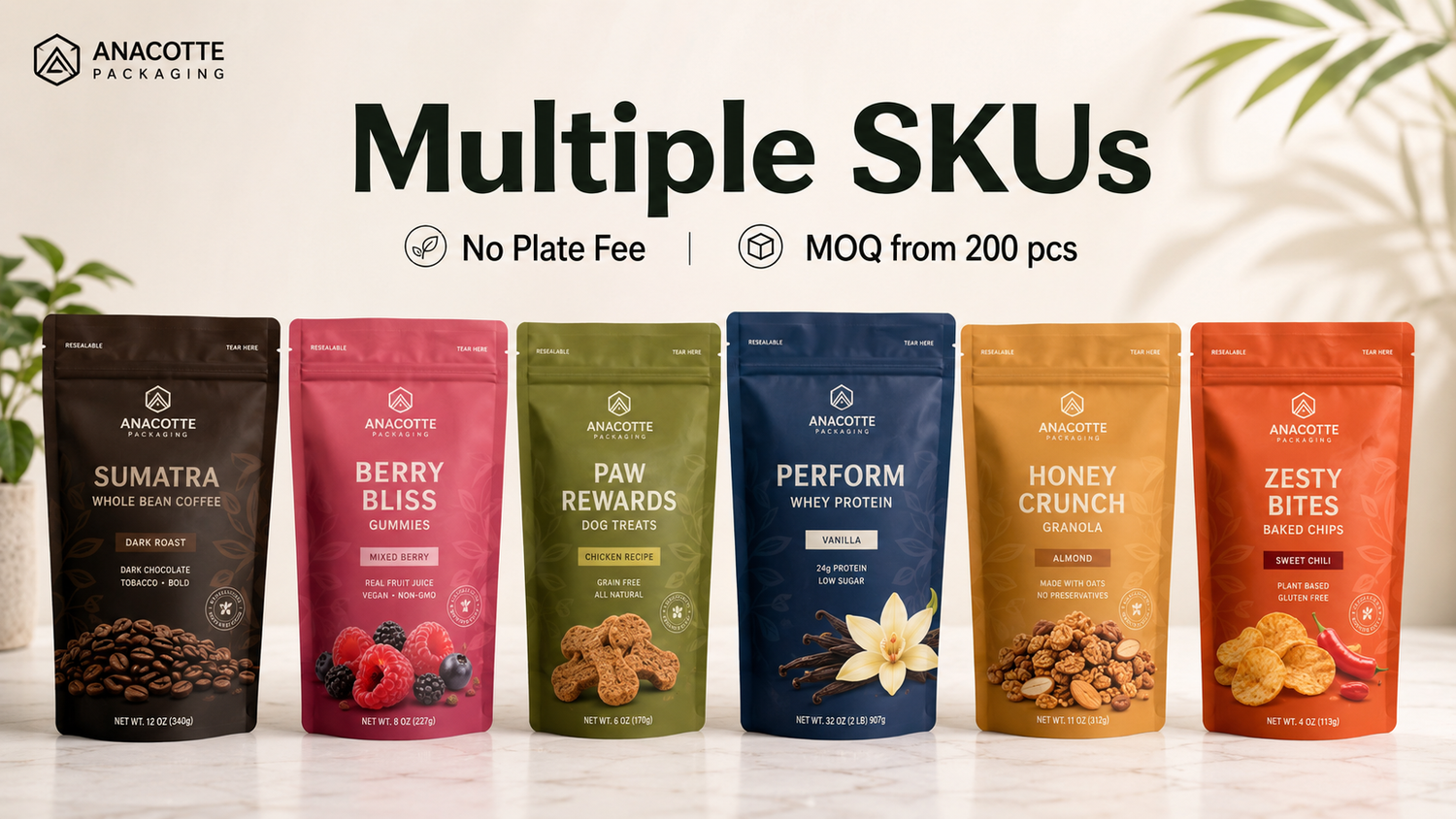
Multiple custom pouch packaging designs for CPG brands with no plate fee and low MOQ from 200 pcs
Why Plate Fees Become a Problem for Multi-SKU Brands
A plate fee is the setup cost required to create printing plates or cylinders for a specific packaging design.
For one large-volume product, this cost may be acceptable. If a brand is printing hundreds of thousands of identical bags, the setup cost gets spread across a large number of units.
But for a small brand launching multiple SKUs, the math can become painful.
Let’s say you want to launch five flavors:
- Strawberry Gummies
- Lemon Gummies
- Peach Gummies
- Berry Gummies
- Watermelon Gummies
Each flavor needs different artwork. With traditional printing, each design may require its own setup. That means the cost is not just about the bag itself — it is also about paying to prepare each design for production.
Now imagine the same situation for a coffee brand with multiple origins, or a pet food brand with different protein recipes.
The problem is simple:
The more SKUs you launch, the more plate fees can multiply.
For early-stage brands, this creates unnecessary risk. You may not know yet which flavor will sell best. You may still be refining the design. You may need to show retail buyers a professional product line before placing a large order.
That is why plate fees can slow down product testing.
What Counts as a SKU in Packaging?
A SKU is not only a completely different product. In packaging, anything that requires different artwork usually counts as a separate design.
For example:
| Product Line | Different SKUs Could Include |
|---|---|
| Coffee | Different origins, roast levels, seasonal blends, grind types |
| Gummies | Different flavors, functions, sizes, limited editions |
| Pet Food | Different proteins, life stages, recipes, dog vs cat products |
| Snacks | Different flavors, pack sizes, variety packs, seasonal drops |
| Supplements | Different flavors, formulas, serving sizes, product claims |
| Tea | Different blends, origins, herbal functions, gift editions |
This is why packaging flexibility matters.
A brand may think it is ordering “one product line,” but from a packaging production perspective, it may actually be ordering several different printed designs.
If each design has a plate fee and high MOQ, launching a full product family becomes expensive very quickly.
Traditional Printing vs Digital Printing for Multiple SKUs
| Factor | Traditional Plate-Based Printing | Digital Printing |
|---|---|---|
| Plate fee | Usually required for each design | No plate fee |
| SKU flexibility | Lower flexibility for small runs | Strong flexibility for multiple designs |
| MOQ | Usually higher per design | Can start from 200 pcs per size or design |
| Best for | Large-volume stable SKUs | New flavors, limited editions, testing |
| Design changes | More difficult after setup | Easier to update before the next run |
| Inventory risk | Higher if one SKU does not sell | Lower because brands can test smaller batches |
| Launch speed | Slower setup for multiple designs | Faster for small-batch multi-SKU launches |
The key difference is not just printing technology. It is how much freedom your brand has to test.
Traditional printing rewards stability.
Digital printing rewards flexibility.
For growing CPG brands, flexibility is often more valuable than committing to the lowest possible unit cost too early.

Traditional printing versus digital printing comparison for launching multiple SKU packaging designs
Why Digital Printing Works Better for Multi-SKU Launches
Digital printing prints packaging artwork directly onto flexible packaging film without traditional plates.
This means your brand can print different designs without paying a separate setup fee for every SKU. It also means you can launch smaller quantities, test product-market fit, and adjust your packaging after real feedback.
This is especially useful for brands that are still learning:
- which flavor customers prefer
- which design looks best online
- which pouch size is easiest to sell
- which product is worth scaling
- which SKU retail buyers like most
- whether a limited edition should become permanent
For small CPG brands, this is a more practical way to launch.
Instead of guessing which SKU will win, you can test several options in smaller quantities.
A snack brand can test five flavors.
A coffee brand can test three origins.
A dog treat brand can test two protein recipes.
A supplement brand can test four flavor systems.
Then the brand can reorder the winners with more confidence.
This is where low MOQ custom packaging becomes a real growth tool, not just a packaging option.
Example: Launching Five Flavors Without Plate Fees
Let’s say you are launching a better-for-you gummy brand.
You want to test five flavors:
- Strawberry
- Lemon
- Peach
- Blueberry
- Watermelon
With traditional printing, you may need to pay setup costs for each flavor and meet a high MOQ for each design. If one flavor does not sell well, you may be left with thousands of unused bags.
With digital printing, you can start with a smaller test run.
For example:
| SKU | Starting Quantity |
|---|---|
| Strawberry Gummies | 200 pcs |
| Lemon Gummies | 200 pcs |
| Peach Gummies | 200 pcs |
| Blueberry Gummies | 200 pcs |
| Watermelon Gummies | 200 pcs |
Now you have a complete five-SKU product line with professional packaging, but without overcommitting to one design or flavor too early.
This approach works especially well for custom flat bottom pouches, stand-up pouches, snack pouches, and candy packaging.

Five custom printed pouch packaging designs for different flavors without plate fees
Product Categories That Benefit Most from Multi-SKU Packaging
Some CPG categories naturally need multiple SKUs.
If your brand sells only one product in one size, plate fees may not be a major issue. But if your brand depends on variety, seasonal drops, or product testing, no-plate-fee digital printing becomes much more valuable.
Coffee Brands
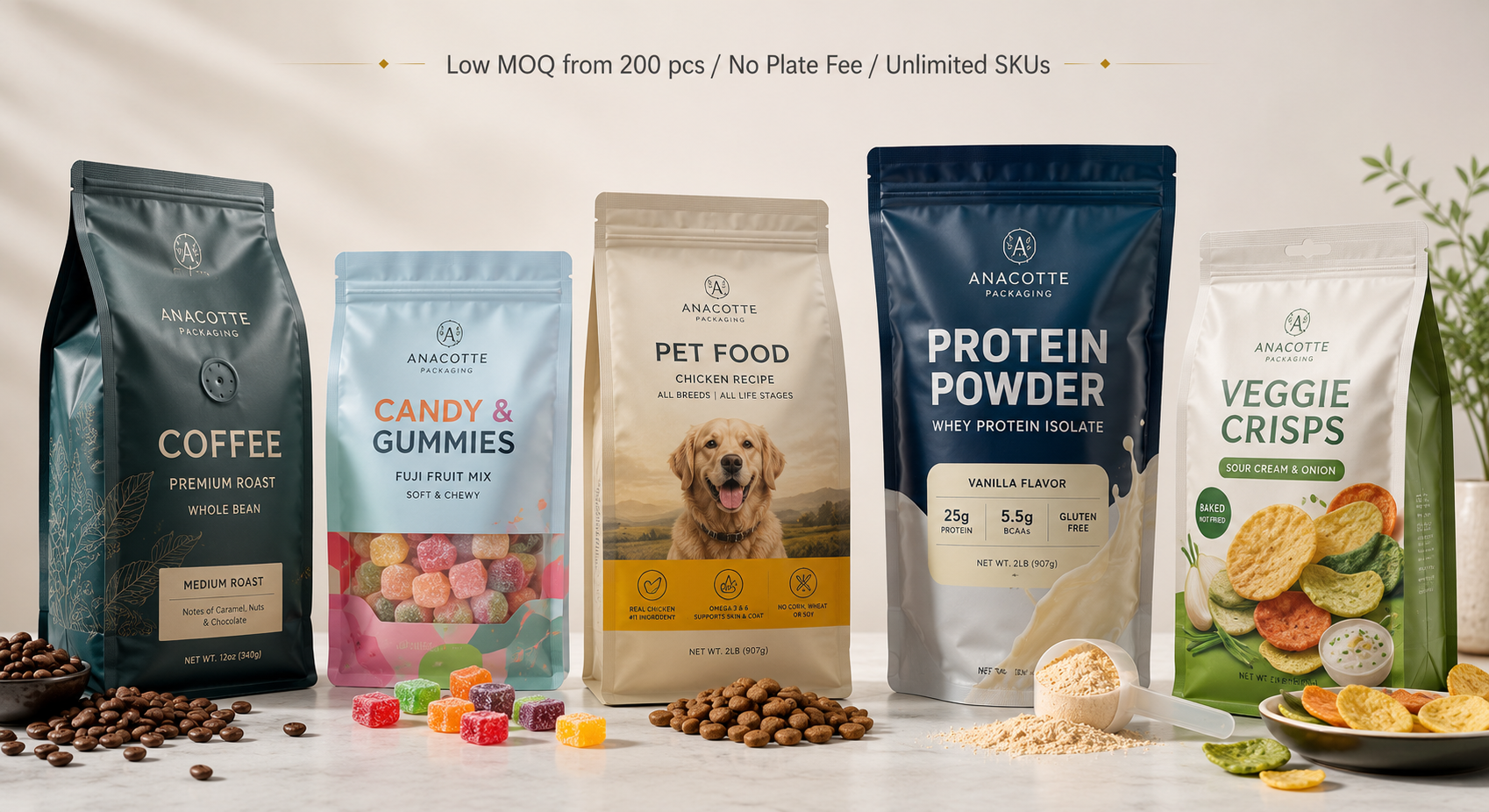
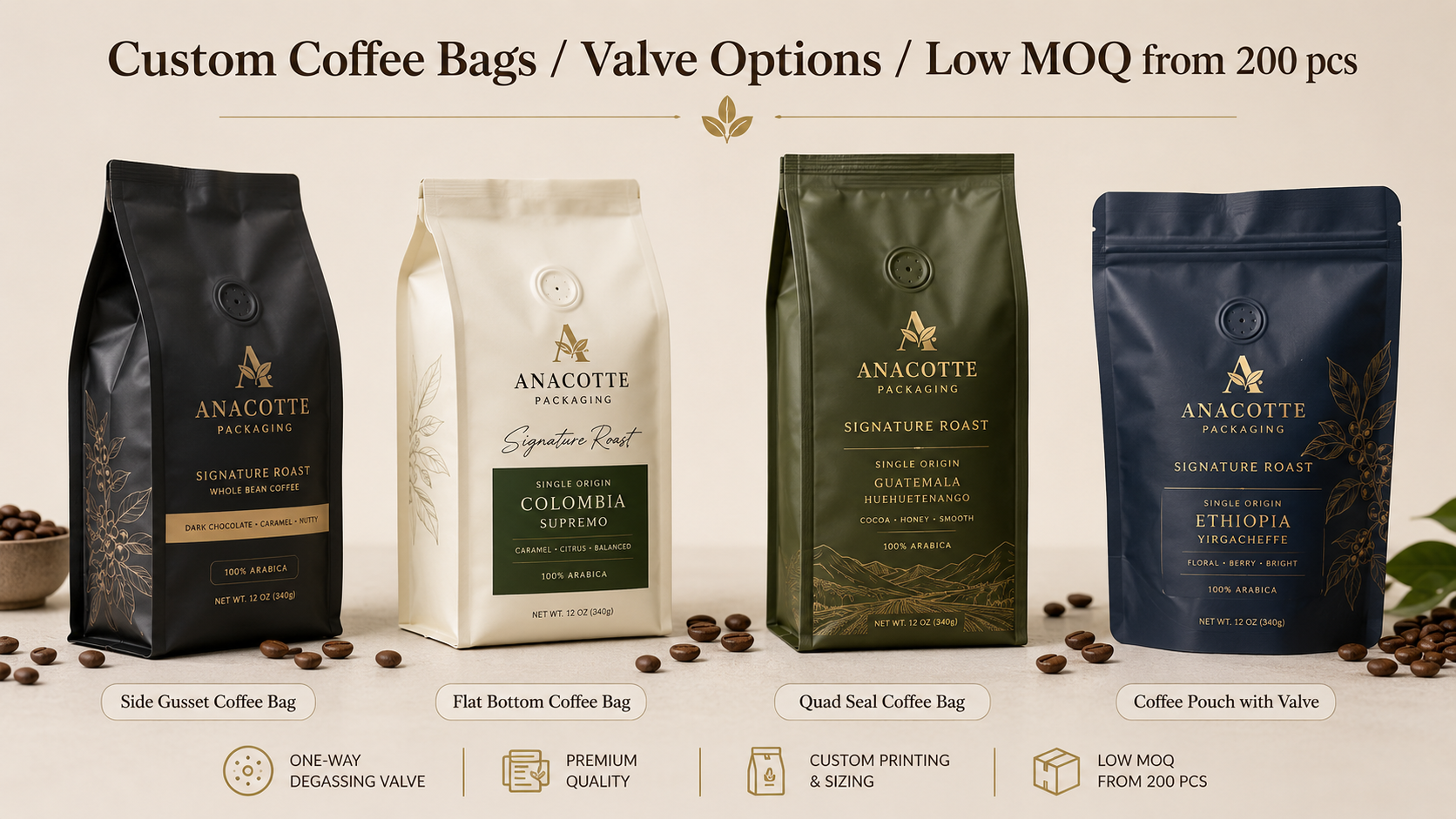
Coffee brands often launch different origins, roast levels, seasonal blends, and subscription-exclusive drops. A roaster may need separate bags for Ethiopia, Colombia, Guatemala, House Blend, and Decaf.
Digital printing makes it easier to test multiple coffee SKUs with unique artwork and tasting notes.
Recommended formats include side gusset coffee bags, flat bottom coffee bags, and coffee bags with valves.
Snack Brands
Snack brands often grow through flavor expansion. Chips, popcorn, granola, dried fruit, nuts, jerky, and trail mix all depend on clear flavor differentiation.
Digital printing allows each flavor to have its own color, ingredients, and shelf identity.
Pet Food and Treat Brands
Pet food brands often need different packaging for proteins, pet types, life stages, and functional benefits.
For example:
- Chicken Recipe
- Salmon Recipe
- Beef Recipe
- Puppy Formula
- Senior Formula
- Sensitive Digestion
This is a strong use case for quad seal pet food bags, flat bottom pet food pouches, and side gusset pet food bags.
Supplement Brands
Supplement brands often launch multiple flavors and formulas at the same time. Protein powder, collagen, creatine, greens powder, matcha, and electrolyte blends all need strong SKU differentiation.
Digital printing helps brands test flavor systems without committing to high-volume packaging for each one.
Candy and Gummies Brands
Candy and gummies are highly visual categories. Each flavor can have a different color system, ingredient graphic, and mood.
This makes them a strong fit for multi-SKU packaging with digital printing.
How to Plan a Multi-SKU Packaging Launch
A multi-SKU launch should not start with artwork. It should start with a clear product and packaging plan.
Before ordering custom packaging, decide:
- How many SKUs are you launching?
- What is the target fill weight for each SKU?
- Will all SKUs use the same pouch size?
- Which information changes between designs?
- Which design elements stay consistent?
- Which SKUs are test runs and which are core products?
- What sales channel will you test first?
This planning step matters because a good multi-SKU packaging system needs both consistency and differentiation.
The brand should feel like one family.
Each SKU should still be easy to identify.
For example, a supplement brand may keep the same logo, typography, and layout across all flavors, but change the color, flavor name, ingredient illustration, and product callouts.
That is how you build a product line that feels professional.

Multi-SKU custom packaging system showing consistent branding and different flavor designs
What Should Stay the Same Across SKUs?
When launching multiple SKUs, consistency is important. If every pouch looks completely different, the product line can feel messy.
Usually, these elements should stay consistent:
- brand logo placement
- typography system
- pouch structure
- main layout
- product category location
- claims and icons style
- nutrition or information panel structure
- overall brand tone
These elements help customers recognize the product family.
What Can Change Between SKUs?
At the same time, each SKU needs to be easy to tell apart.
These elements can change:
- flavor name
- recipe name
- color palette
- ingredient illustrations
- tasting notes
- product benefits
- limited-edition badge
- seasonal artwork
- origin story
- product photography
This balance is what makes a strong multi-SKU packaging system.
Digital printing supports this well because the artwork can vary between designs without forcing brands to pay plate fees for each one.
AI Packaging Design Can Help Build SKU Families Faster
One of the hardest parts of a multi-SKU launch is creating a design system that works across several products.
A single pouch design may look good on its own, but the real test is whether the system can expand.
Can it work for five flavors?
Can it work for seasonal editions?
Can it work for different sizes?
Can it work for retail and ecommerce?
Can the customer identify each SKU quickly?
This is where AI packaging design can help.
At Anacotte Packaging, brands can send us a product link, logo, flavor names, and reference styles. We can help create AI packaging concept directions that show how a full SKU family could look before moving into print-ready artwork and production.
A brand can test visual directions early, choose the strongest concept, and then apply it across multiple SKUs.
You can also explore Anacotte’s AI packaging customization platform.

AI packaging design workflow for launching multiple custom pouch packaging SKUs
When Multi-SKU Digital Printing Makes the Most Sense
Digital printing is especially useful when you are launching:
- new flavors
- seasonal drops
- small-batch product lines
- subscription-exclusive SKUs
- retail buyer samples
- influencer kits
- holiday packaging
- regional test products
- Kickstarter or Indiegogo products
- first production runs
In all of these cases, the goal is not to lock yourself into a huge packaging order. The goal is to test, learn, and scale what works.
This is why digital printing is a strong fit for Shopify brands, DTC brands, emerging CPG brands, and product teams that need speed.
When Plate-Based Printing May Still Make Sense
No-plate-fee digital printing is not always the answer.
If your brand already has one stable best-selling SKU and needs a very large quantity of the same design, traditional plate-based printing may become more cost-effective at scale.
For example, if you need hundreds of thousands of identical pouches and the artwork will not change, a high-volume printing method may make sense.
A practical packaging strategy is:
Use digital printing to test multiple SKUs. Use high-volume printing later when the winning SKUs are proven.
This keeps your early-stage risk lower while still leaving room to optimize cost later.
Best Pouch Types for Multi-SKU Launches
Different product categories need different pouch formats. If you are launching multiple SKUs, try to keep the pouch format consistent within the same product family.
| Product Type | Recommended Pouch Type | Why It Works |
|---|---|---|
| Coffee | Side gusset bags, flat bottom coffee bags, coffee bags with valve | Good for origin, roast, and subscription SKUs |
| Gummies and candy | Stand-up pouches or flat bottom pouches | Strong visual differentiation across flavors |
| Pet food | Quad seal bags, flat bottom pouches, side gusset bags | Good for protein recipes and larger fill weights |
| Protein powder | Quad seal pouches or side gusset bags | Better for larger powder volumes and flavor systems |
| Granola and snacks | Flat bottom pouches or stand-up pouches | Strong shelf presence for flavor lines |
| Tea | Side gusset bags or flat bottom pouches | Good for blends, origins, and premium tea formats |
You can compare Anacotte’s flat bottom pouches, quad seal pouches, and side gusset bags when choosing the right structure.

Best pouch types for launching multiple custom packaging SKUs with digital printing
Common Mistakes When Launching Multiple SKUs
Mistake 1: Making Every SKU Look Too Different
Customers should be able to recognize that all SKUs belong to the same brand.
Mistake 2: Using the Same Color for Every Flavor
If every SKU looks too similar, customers may struggle to tell them apart quickly.
Mistake 3: Ordering Too Much Before Testing
Do not assume every SKU will sell equally. Start smaller, then scale the winners.
Mistake 4: Forgetting About Future SKUs
Your design system should leave room for new flavors, seasonal editions, and larger sizes.
Mistake 5: Choosing Packaging Based Only on Unit Price
Low unit cost does not help if you end up with unused packaging or designs that need to change.
FAQ: Launching Multiple SKUs Without Plate Fees
Can I print different packaging designs without paying plate fees?
Yes. With digital printing, brands can print different designs without traditional plate fees. This makes it easier to launch multiple SKUs, flavors, recipes, and limited-edition products.
What is the MOQ for multiple SKU packaging?
At Anacotte Packaging, MOQ starts from 200 pcs per size or design, depending on pouch type, material, and project details.
Can each SKU have a different color and artwork?
Yes. Digital printing is ideal for different colors, flavor names, ingredient illustrations, product claims, and seasonal artwork.
Is digital printing suitable for retail packaging?
Yes. Digitally printed custom pouches can look premium and retail-ready when the right material, finish, and design system are used.
What product categories are best for multi-SKU packaging?
Coffee, snacks, candy, gummies, pet food, pet treats, protein powder, supplements, tea, granola, dried fruit, nuts, and functional food products are all strong fits.
Should I use digital printing or gravure printing for multiple SKUs?
For early-stage or growing brands, digital printing is usually better for multi-SKU testing because it avoids plate fees and supports smaller starting quantities. Gravure printing may make sense later when demand is stable and order volume is much higher.
Launch More SKUs with Less Risk
Multiple SKUs can help a brand grow faster, but only if the packaging process stays flexible.
If every new flavor or recipe requires high MOQ and plate fees, testing becomes expensive. Brands may delay launches, reduce their product variety, or over-order packaging before knowing what customers actually want.
Digital printing gives CPG brands a more practical way to launch.
You can test flavors, build a full SKU family, create seasonal packaging, and prepare retail-ready samples without paying plate fees for every design.
At Anacotte Packaging, we help brands go from AI packaging concept to digital printing, pouch production, and delivery to the US/EU.
MOQ starts from 200 pcs. No plate fee. Unlimited colors. Multiple SKUs supported.
Ready to launch multiple SKUs?
Send us your product link, logo, or flavor list. We’ll help create a free AI packaging concept and recommend the right pouch type, material, and starting quantity.

Launch multiple custom pouch packaging SKUs with no plate fee and low MOQ from 200 pcs by Anacotte Packaging

Leave a comment
This site is protected by hCaptcha and the hCaptcha Privacy Policy and Terms of Service apply.