

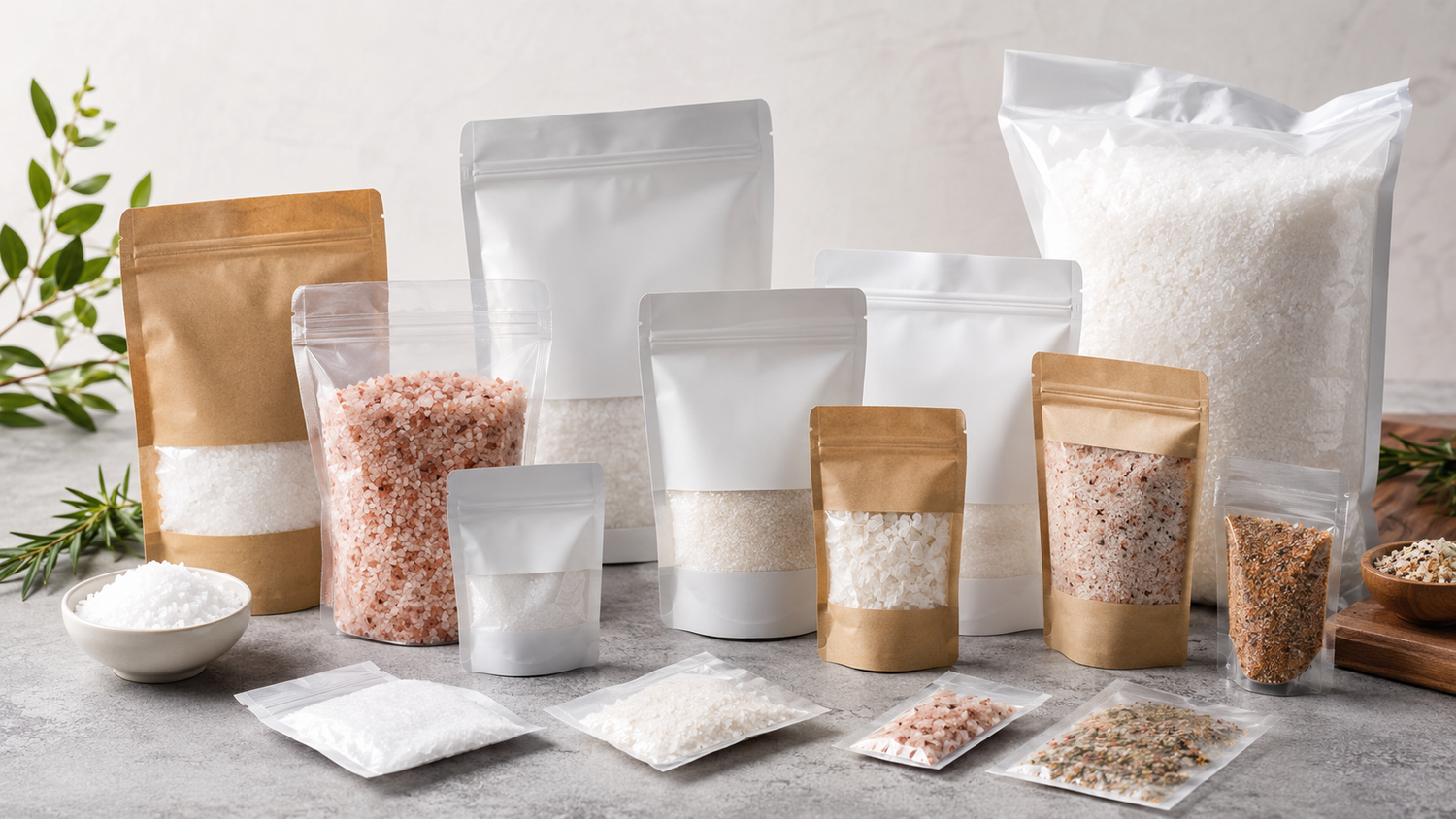
Sea salt packaging needs to protect edible sea salt, seasoning salt, coarse salt, fine salt, and flavored salt from moisture, clumping, leakage, and shipping damage. For retail brands, the pouch should look clean and shelf-ready. For ecommerce and wholesale buyers, the priority is stronger seals, carton-safe durability, and easy pouring. Anacotte Packaging supports low MOQ custom options for seasoning packaging, sachets, refill pouches, and bulk salt packaging projects.
What does sea salt packaging need to prevent?

Salt is highly sensitive to humidity. Good packaging should help reduce moisture exposure, protect the product from leaking through weak seals, and keep the pouch easy to use after opening. However, packaging alone cannot guarantee that every salt product will never clump. Storage environment, formula, anti-caking approach, seal quality, and humidity control also matter.
For edible salt and seasoning products, buyers should confirm food-contact material suitability and local labeling requirements before production. The FDA provides resources on food contact substances, and its sodium labeling resources remind brands that packaged food labeling may involve sodium information depending on the product and market.
For brands starting with flexible retail packaging, matte stand up pouches for dry goods and spices can be a practical reference format for shelf display, heat sealing, and repeat opening.
Pouch, sachet, refill, or bulk pack: which format fits sea salt?

Different salt products need different packaging formats. A premium sea salt brand may need an attractive retail pouch, while a restaurant supplier may need larger refill or bulk packaging. Common options include:
- Stand up pouches: suitable for 100 g, 250 g, 500 g, and 1 kg retail packs, with zipper and heat-seal options.
- Sachets and flat pouches: useful for 1 g, 2 g, 5 g, and 10 g single-serve salt, seasoning samples, meal kits, and hospitality packs.
- Refill pouches: suitable for refilling jars, grinders, or pantry containers, often in 1 kg, 2 kg, or 5 kg formats.
- Bulk packs: designed for wholesale, foodservice, or ingredient supply where strength and carton performance matter.
For portion-control projects, Anacotte’s powder sachet packaging is relevant when fine salt, seasoning powder, or sample-size dry products need cleaner seals and controlled dosing. For larger refill behavior, custom refill pouches help brands plan easier pouring, storage efficiency, and repeat-purchase formats.
What materials work for sea salt packaging?

Material choice depends on salt type, particle size, humidity exposure, shipping method, and shelf-life expectations. Common structures include PET/PE for standard dry goods, PET/VMPET/PE or PET/AL/PE for higher moisture barrier needs, Kraft/PE for a natural retail look, and recyclable PE-based options when the product and recycling pathway support that structure.
A clear window can help when the salt has visual appeal, such as coarse sea salt, flake salt, pink salt, or colorful seasoning blends. If the product needs stronger moisture protection or better light blocking, the clear window area should be reduced or replaced with a higher-barrier material. For natural shelf presentation, kraft paper stand up pouches with clear windows are useful when buyers want both visibility and a paper-style appearance.
The Flexible Packaging Association explains that flexible packaging can support convenience, product protection, and efficient distribution. For sea salt, the practical goal is to match that flexibility with a laminate and seal design that handles moisture risk and product weight.
Why ecommerce sea salt packaging needs stronger seals

Ecommerce shipping creates extra risk for salt packaging. Salt is heavy for its volume, and fine particles can move into zipper tracks, corners, and heat-seal areas. Common complaints include salt leaking during delivery, zipper clogging, corner breaks, weak heat seals, window surfaces looking dusty, and refill packs being hard to pour into jars.
For ecommerce orders, brands should pay close attention to seal width, pouch thickness, carton fit, puncture resistance, and whether the zipper is meant for consumer reclosure rather than initial shipping protection. A zipper is useful after opening, but the first-use heat seal should still protect the product during fulfillment and transit.
For heavier dry goods and seasoning lines, custom dried food packaging bags can help buyers compare stand up, flat, quad seal, and high-barrier structures for salt, spices, grains, tea, and other dry products.
Low MOQ custom sea salt packaging

Low MOQ sea salt packaging is useful for gourmet seasoning brands, private-label food sellers, ecommerce startups, farmers’ market products, refill programs, and new flavor launches. Brands can test pouch size, clear window placement, zipper performance, sachet tear notches, refill pouring behavior, and artwork layout before scaling into larger production.
For single-serve or sample formats, a small flat pouch format for tea, snacks, and powder samples can be a useful reference when planning compact salt sachets or seasoning pouches. Final pouch size should always be customized based on filling weight, salt granule size, packaging equipment, and sealing method.
Sustainability claims should be made carefully. The EPA’s sustainable packaging resources emphasize considering production, use, and disposal together, while How2Recycle provides standardized disposal instructions for packaging in North America. Recyclability depends on the final structure, local collection systems, and package components.
Get a quote for sea salt packaging

To quote sea salt packaging accurately, send your salt type, target fill weight, retail or wholesale use, pouch format, quantity, window preference, material requirement, shipping channel, and artwork status. If you are not sure whether to choose stand up pouches, sachets, refill pouches, or bulk packaging, Anacotte Packaging can recommend options based on moisture risk, shelf display, ecommerce handling, and low MOQ launch needs.
Ready to create custom sea salt packaging? Request a quote for low MOQ pouches, sachets, refill packs, or bulk packaging for edible sea salt and seasoning salt products.

Frequently Asked Questions
What is the best packaging for sea salt?
Stand up pouches are often a good retail choice because they display well and can include zipper and heat-seal options. Sachets work for single-use portions, while refill pouches and bulk packs are better for larger quantities.
Can sea salt packaging prevent clumping?
Packaging can help reduce moisture exposure, but it cannot guarantee that sea salt will never clump. Product formula, storage humidity, seal quality, and handling conditions also affect clumping.
Should sea salt packaging have a clear window?
A clear window is useful when the salt has visual appeal, such as coarse crystals, flake salt, pink salt, or seasoning blends. If moisture control or light protection is more important, a smaller window or high-barrier structure may be better.
Can I order low MOQ custom sea salt packaging?
Yes, low MOQ options are suitable for new sea salt brands, private-label seasoning launches, ecommerce trials, refill tests, and sample sachets. Final MOQ depends on size, material, printing method, closure type, and customization needs.


Leave a comment
This site is protected by hCaptcha and the hCaptcha Privacy Policy and Terms of Service apply.