

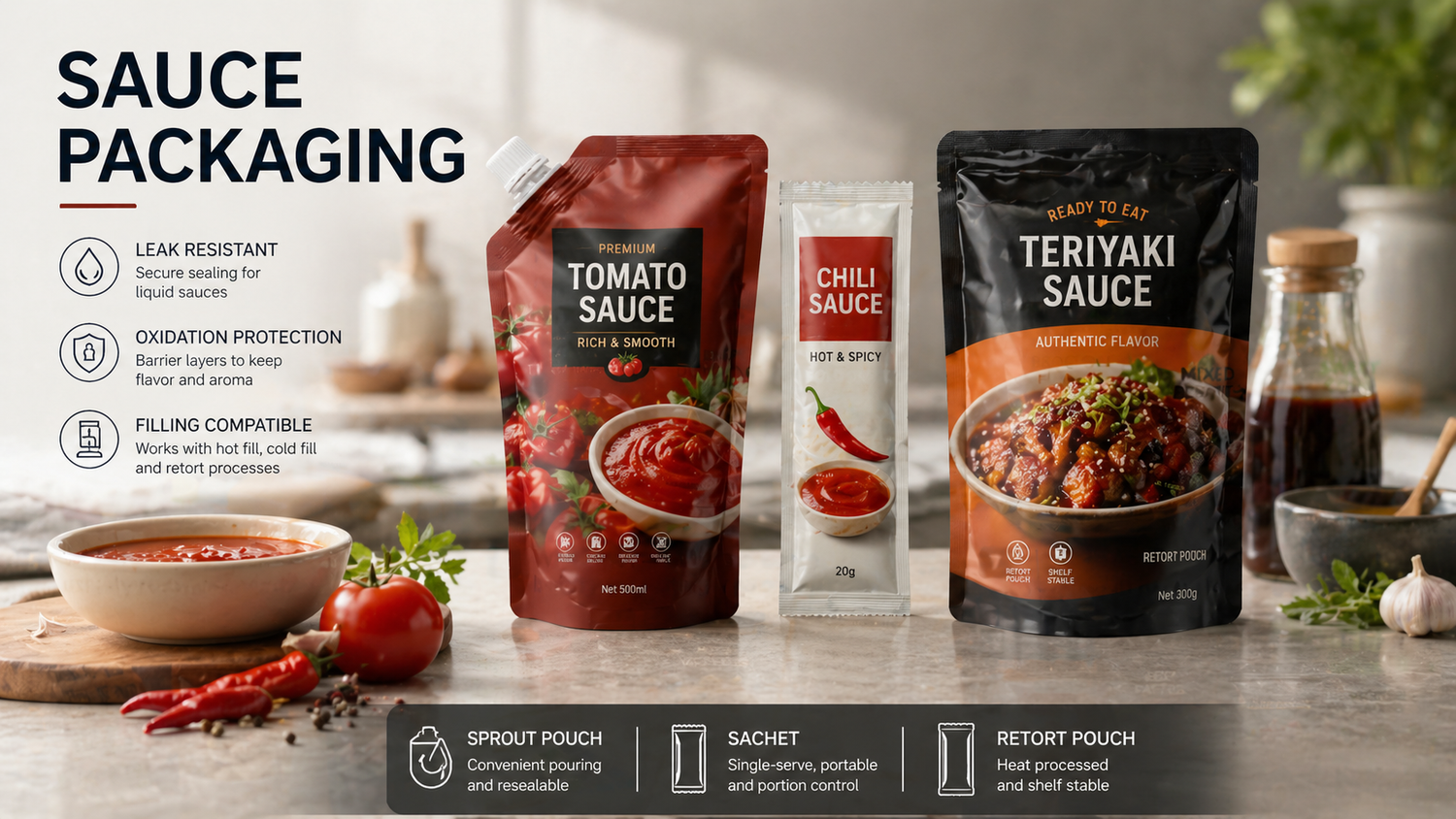
Sauce packaging needs to serve multiple purposes to ensure it protects product quality during filling, shipping, and everyday use. For brands that sell cooking sauces, condiments, dressings, marinades, and liquid seasonings, packaging comes down to problems with leakage, risk of oxidation, and compatibility with filling lines. For hot, shelf-stable, or export-bound sauces, these issues become more pressing. Buyers typically begin these sorts of packaging issues by comparing spout pouch options, retort pouch structures, and smaller sachet style packaging.
Sauce packaging can be broken down as flexible packaging that comfortably holds liquid or semi liquid contents, protects against exposure to air, and accommodates the filling type. The FDA differentiates between food-contact use conditions when it comes to packaging and stick filling system use. This is why shelf stable, hot filled sauces, and pour spouts as filling systems become relevant during inner pack design, rather than after artwork has been placed on the carton.

What is most important for sauce packaging?
Packaging sauce is very unlike packaging dry food products. This is because sauce can leak, and stains can impact seals. Products with different levels of acidity, oil content, and viscosity react very different to heat and oxygen. This is why most consumers identify the following three points when drafting a packaging brief:
- Prevention of leaks — Douche and seals must hold their integrity throughout filling, shipping, and handling.
- Control of sulfide oxidation — When the shelf life or flavor shelf-stability is a concern, the packaging structure must minimize oxidant exposure.
- Control of sulfide oxidation — When the hyperthermic shelf life of the product is of concern, the packaging structure must minimize oxidant exposure.
For hot-fill-and-hold products, sauces, FDA filing guidance differentiates hot-fill and hold, and other process modes. This is why, sauces in hot-fill-and-hold configurations should establish process conditions as a priority before determining their package format. Compliance with food-contact safety requirements and criteria of the European Commission also becomes important when the product is intended for this market, particularly when materials intended to come into contact with food in the EU must not jeopardize food safety or change the food in any way.

Which packaging format is most suitable for sauce?
Spout Pouches
Spout pouches for sauce packaging are preferred when the ability to control pours, the ability to re-seal the pouch, or the needs of the consumer for convenience differ. They are preferred for larger, retail, refill, and clean dispense user experience packaging. Buyers compare the use of spout pouches to the use of bottles when they desire a lighter and more flexible pack shape.
Sachets
Sachets are designed for single-serve condiments, trial packs, meal kits, and food service portions. They come in handy when your product line has many low-volume SKUs. Your collection path is for powder sachets, but similarly, small format sourcing logic may apply when buyers look at sachet-style packaging for portion control, sampling, or export-friendly secondary packs.
Retort Pouches
Retort pouches are often explored for shelf-stable sauces and ready-to-eat products that are temporarily heat processed in a sealed container. The USDA provides guidance for shelf-stable foods that include meat or poultry products in retort pouches. Due to this guidance, retort formats remain crucial for sauces that are meant to be distributed at ambient temperatures, when compared to sauces that are for cooler storage (simplicity USDA shelf-stable food guidance).

What are the common questions regarding production capacity, printing options, and minimum order quantities (MOQ)?
Typically, capacity (usually a volume range) is the first point of commercial comparison for buyers and competitors. This question is usually phrased, "Should we utilize small sachets, mid-size spouted pouches, or large retort packs?" It is usually channel and application dependent. Here are some suggestions that categorize these:
- Small sachets: servings, sauces, and condiments. They are perfect for a meal kit, takeaway, or travel condiments.
- Mid size pouches: retail products, sauces, and paste or liquid seasonings.
- Larger spout or retort packs: family-size, food service, and export refill programs.
Print choice is usually dependent on market and company lifecycle. New brands usually want a lower MOQ for flexibility and ease of adjustments, whereas brands with international programs want consistency. Between convenience-led retail packaging (spout pouch) and a shelf-stable process packaging (retort pouch), buyers usually favor the process packaging.

What do buyers want to know before they receive a quote?
- Are sauces cold-filled, hot filled, or retorted?
- What are the required capacity ranges?
- Are the products valued at a domestic or international level?
- Is there a requirement for formula variants to be more robust to secure delivery or aromas protecting?
- Should the spouted pouch, retort ready pouch, and sachet formats be the packages selected?
Due to FDA regulations, food emulsions classified as food products must be reported for citing purposes. This is another reason international and processing-sensitive sauce products must have their order compliance reviewed on the company launch end. The FDA provides an overview of food and food-contact packaging.

What valuable attributes do Anacotte Packaging offer regarding packaging for sauces?
Focus on sauces and liquid seasonings packaging projects for which you need to ensure filling fit, reliable sealing, and commercial clustering for your offerings. For projects where your team are choosing among retail pouches, formats for export, or shelf stable processes, consider upfront, spout pouches and simple retort pouches, as well as small sachet packages.
Looking for packaging guidance for sauces, condiments, or liquid seasonings like sauces? Get a Quote along with your filling technique, desired capacity, export market, and activist preference so a packaging system is designed to meet your product and production line requirements.

Frequently Asked Questions
What is the best packaging for sauce?
Choosing the best packaging material is determined by the sauce's viscosity, the product's filling process, and your sales channel. Several products choose spout pouches for packaging solutions. For portion control, sachets are preferred. For products requiring shelf-stable thermal processing, retort pouches are the solution of choice.
Can sauce be packed in a spout pouch?
When the filling process and the pouch's structure are appropriately aligned, sauces can be packed in a spout pouch. This packaging solution is used for products that are pourable, where re-sealability and controlled dispensing are priorities.
When should I choose a retort pouch instead of a standard pouch?
When a sauce for a retort pouch requires sealing and ambient shelf stability, a retort pouch is preferred. Thus, a retort pouch is a process-driven choice, as opposed to a standard pouch that is a visual packaging choice.

Leave a comment
This site is protected by hCaptcha and the hCaptcha Privacy Policy and Terms of Service apply.