

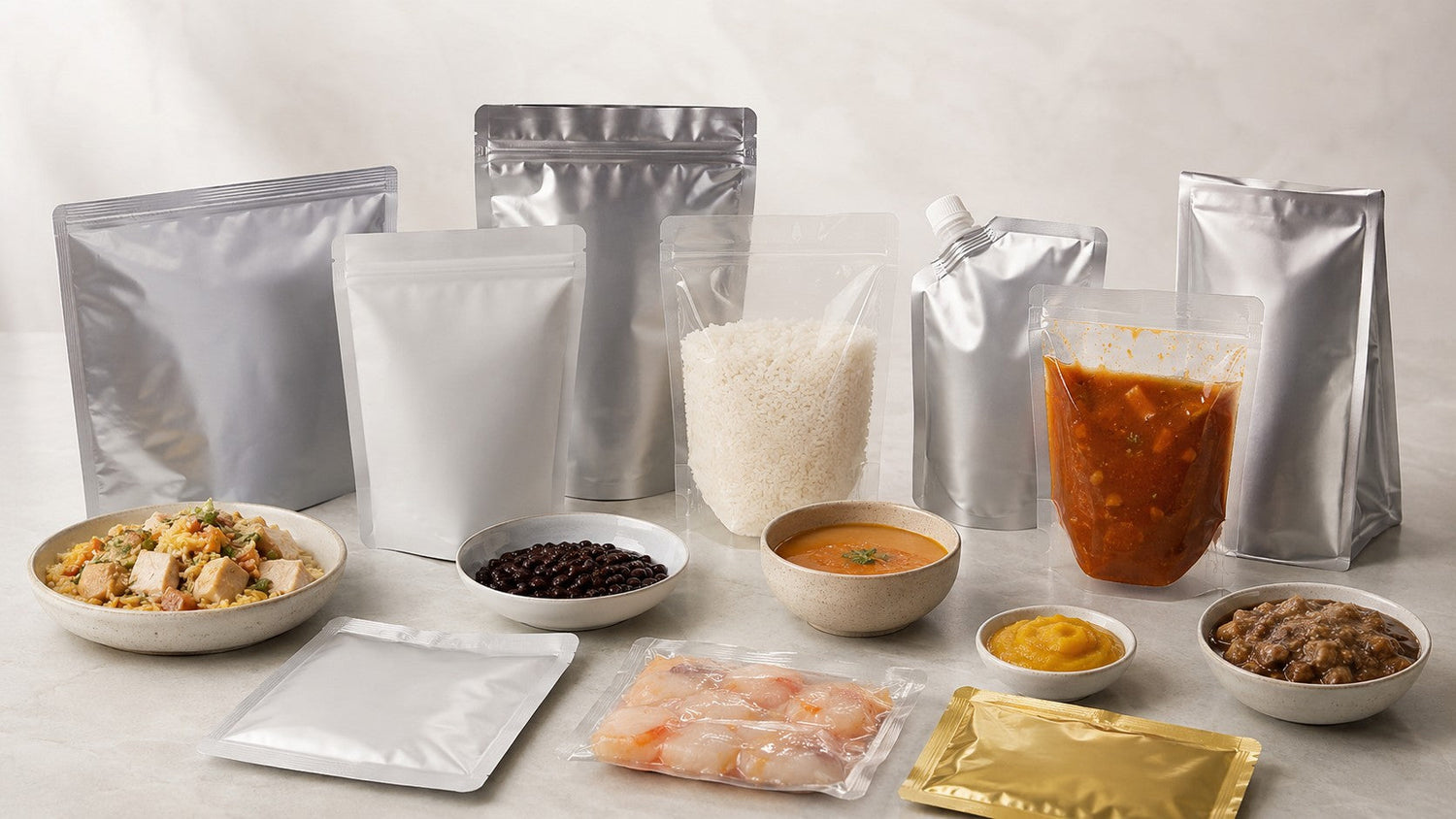
Retort pouches are flexible, high-barrier food packages designed for products that go through high-temperature thermal processing. They are commonly considered for ready meals, sauces, soups, beans, seafood, pet food, baby food, rice, grains, and other shelf-stable food products. Compared with rigid cans or jars, a retort pouch can offer a lighter format, printable surface, compact storage, and flexible retail presentation. However, the pouch alone does not make food shelf-stable. The full product formulation, filling method, heat seal, retort process, cooling process, and validation must work together.
Anacotte Packaging supports custom retort pouch projects for brands that need heat-resistant flexible packaging, high-barrier film, and sample evaluation before scaling. Buyers can compare retort pouches, high-barrier packaging, compliance and certification support, and custom spout pouch options depending on the product, process, and target market.
What is a retort pouch?
A retort pouch is a laminated flexible pouch made to withstand thermal processing in a retort system. In many projects, the package is filled, sealed, processed under heat and pressure, cooled, and then distributed as a shelf-stable product after the scheduled process has been validated. Retort pouches are often used for wet or semi-wet foods such as ready meals, curry, sauces, soups, rice, beans, seafood, tuna, pet food, baby food puree, and outdoor or military-style meals.

Low-acid foods, acidified foods, high-acid foods, and refrigerated pasteurized products may require different processing conditions and regulatory review. In the United States, low-acid foods packaged in hermetically sealed containers are covered by FDA regulations and guidance. Buyers selling in the United States, Canada, Europe, or global export markets should confirm food-contact material suitability, process requirements, process authority review, and local labeling rules before production.
Commercial sterilization is often associated with temperatures above 212°F, commonly around 240–250°F depending on product and process. Actual retort temperature, time, pressure, and cooling conditions must be validated for the specific food, pouch size, fill weight, headspace, and retort equipment.
Retort pouch formats and applications
Different products need different pouch formats. A flat retort pouch is compact and can be efficient for ready meals, rice, tuna, beans, and seafood. A stand up retort pouch improves retail display but needs additional stability, seal, and drop testing. A gusseted retort pouch can support larger fills, while a three-side seal retort pouch is often used for compact single-serve or portion-controlled products.

Spout retort pouches are used for liquid or semi-liquid foods such as sauces, puree, baby food, and some pet food applications. The spout, cap, and fitment materials must match the target retort process. A pouch film may be retort-ready, but that does not automatically mean the fitment is suitable for the same temperature, pressure, and cooling cycle.
| Format | Best For | Buyer Notes |
|---|---|---|
| Flat retort pouch | Ready meals, tuna, rice, beans | Compact format and often efficient for heat transfer. |
| Stand up retort pouch | Retail meals, soups, sauces | Better shelf display, but needs stability, seal, and drop testing. |
| Spout retort pouch | Sauces, puree, baby food, liquid pet food | Spout, cap, and fitment must withstand the target retort process. |
| Gusseted retort pouch | Larger fills and pet food | Check bottom seal, expansion behavior, and drop resistance. |
| Three-side seal retort pouch | Single-serve meals and compact packs | Useful for portion packs where flat storage and seal control matter. |
| Transparent retort pouch | Products needing visibility | Barrier, shelf life, and product sensitivity must be reviewed. |
Material structures for retort pouches
Retort pouch materials must be selected for heat resistance, seal strength, barrier performance, and post-retort appearance. Common structures may include PET/AL/RCPP, PET/NY/AL/RCPP, PET/NY/RCPP, NY/AL/RCPP, retort-grade CPP or RCPP sealant, foil retort laminate, and transparent retort film where suitable. Foil structures are often selected when stronger oxygen and light barrier are needed, while transparent retort film may be considered when product visibility is important.

| Material Structure | Typical Use | Consideration |
|---|---|---|
| PET/AL/RCPP | Standard high-barrier retort pouch | Strong oxygen and light barrier for many shelf-stable food projects. |
| PET/NY/AL/RCPP | Heavier or textured foods | Nylon layer can improve puncture resistance and toughness. |
| PET/NY/RCPP | Transparent retort options | Supports visibility, but barrier may be lower than foil structures. |
| NY/AL/RCPP | Flexible high-barrier applications | Confirm retort resistance, sealing range, and food-contact suitability. |
| Retort-grade spout and cap | Sauce, puree, baby food, pet food | Fitment must be tested with the actual process. |
For products that require stronger oxygen, moisture, aroma, or light protection, buyers can also review Anacotte’s high-barrier packaging collection and custom barrier solution page before selecting the final laminate.
When retort pouches are a good fit
Retort pouches are suitable when the product and process are designed for thermal processing. They are often considered for shelf-stable ready meals, wet pet food, sauces, soups, beans, rice and grains, seafood, baby food puree, and outdoor meals. They can help reduce packaging weight, improve storage efficiency, and provide more printable branding area than some rigid formats.

For sauce and liquid projects, Anacotte’s sauce packaging guide is useful because fitment choice, seal strength, fill method, and barrier strategy all affect leakage risk and product performance. For liquid dispensing, spout pouches can support easier pouring and controlled use, but retort compatibility must be confirmed separately.
Common sizes may include 50 g, 80 g, and 100 g single-serve packs; 150 g, 200 g, 250 g, and 300 g ready meal pouches; 100 ml, 150 ml, 200 ml, and 250 ml sauce or puree pouches; 85 g, 100 g, 150 g, and 200 g pet food packs; plus 500 g, 1 kg, or custom sizes. Final pouch dimensions should be customized based on fill weight, headspace, product viscosity, retort rack design, seal width, and heat penetration requirements.
When retort pouches may not be suitable
Retort pouches may not be suitable for every food. Carbonated products, products with sharp bones or hard particles, products needing the rigid feel of cans, products with high package swelling risk, and products that have not been validated for retort processing require additional review. Refrigerated pasteurized products may need a different packaging and processing strategy than shelf-stable retort foods.

Spouted retort pouches also need special care. If the spout, cap, or fitment is not rated for the target retort process, leakage, deformation, or seal failure may occur. Buyers should not assume that a standard spout pouch can be used for retort simply because it holds liquid.
Common retort pouch issues include delamination after retort, seal failure, pouch swelling, wrinkle or curl, spout leakage, pinholes, print distortion, weak corners, and drop damage after processing. These risks should be checked during sample testing and pilot runs before mass production.
Testing, validation, and compliance documents
Retort packaging requires more than visual approval. Buyers should evaluate seal strength, delamination resistance, puncture resistance, drop performance, burst resistance, heat resistance, pressure resistance, migration requirements, food-contact suitability, spout fitment integrity, and post-retort appearance. A process authority or qualified thermal processing expert should validate the scheduled process for the actual food, fill weight, pouch size, and retort equipment.

For food products, buyers should confirm food-contact material suitability, migration requirements, retort compatibility, and local labeling requirements before production. Useful documentation may include material specifications, food-contact declarations, technical data sheets, COA documents where applicable, migration compliance where required, and retort test reports if available.
Anacotte’s Compliance & Certification Hub can help buyers review packaging documentation during material selection. External regulatory sources such as FDA low-acid food guidance, 21 CFR Part 113, USDA FSIS shelf-stable food resources, and extension food safety materials should also be reviewed when the product is intended for shelf-stable distribution.
Low MOQ sample evaluation and lead time
Low MOQ may be available for sample evaluation and pilot runs, but retort packaging requires material confirmation, sample testing, and process validation before mass production. This is especially important for new ready meal products, sauces, baby food, seafood, pet food, and shelf-stable food projects where heat, pressure, filling behavior, and package integrity all matter.

Lead time depends on material structure, pouch size, spout or no-spout design, artwork, sample approval, retort testing, and order quantity. Buyers with an urgent launch should prepare product details, fill weight, viscosity, target process, artwork files, compliance requirements, and testing expectations as early as possible.
Get a quote for retort pouches
To quote retort pouches accurately, send your product type, target market, fill weight, pouch format, spout or no-spout preference, material requirement, target retort process, shelf-life goal, artwork status, documentation needs, sample testing plan, and order quantity. Anacotte Packaging can help compare flat retort pouches, stand up retort pouches, gusseted retort pouches, three-side seal retort pouches, spout retort pouches, foil laminates, transparent retort film, and high-barrier retort structures.

Ready to develop custom retort pouches? Request a quote for sample evaluation, pilot runs, and scalable retort-ready flexible packaging for ready meals, sauces, soups, beans, seafood, pet food, baby food, rice, grains, and shelf-stable food products.
Frequently Asked Questions
What are retort pouches used for?
Retort pouches are used for foods that go through validated thermal processing, such as ready meals, sauces, soups, beans, seafood, rice, grains, baby food, and pet food.
Does a retort pouch automatically make food shelf-stable?
No. The pouch alone does not make food shelf-stable. Product formulation, filling, sealing, scheduled thermal process, cooling, and validation must work together.
What temperature do retort pouches need to withstand?
Commercial sterilization often uses temperatures above 212°F, commonly around 240–250°F depending on the product and process. The actual temperature, time, pressure, and cooling conditions must be validated for the specific product and equipment.
Can retort pouches have spouts?
Yes, spouted retort pouches can be used for sauces, puree, baby food, and some pet food applications. The spout, cap, and fitment must be selected and tested for the target retort process.
Can I order low MOQ retort pouches?
Low MOQ may be available for sample evaluation and pilot runs. However, retort pouch projects still require material confirmation, sample testing, and process validation before mass production.


Leave a comment
This site is protected by hCaptcha and the hCaptcha Privacy Policy and Terms of Service apply.