

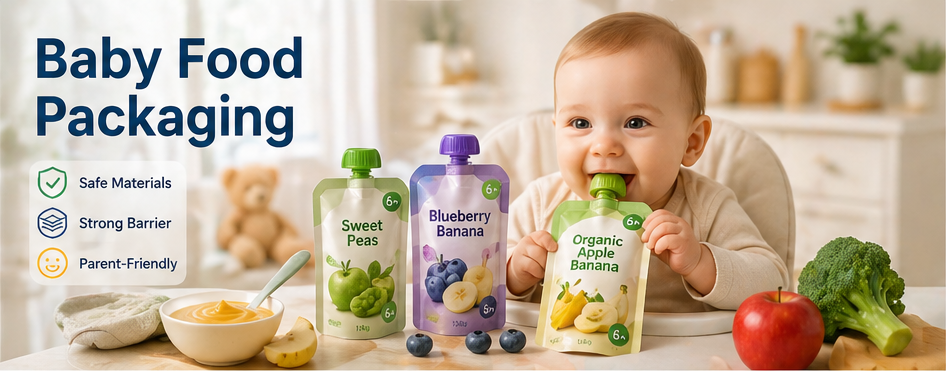
Baby food packaging should be more restrictive than adult food packaging. For packaging that protects consumer content, safety, barrier performance, and ease of use when informing the consumer are the primary concerns. The difference in packaging concerns is because infant food in a pouch, including purees, fruit pouches, and yogurt-based snacks, comes with different feeding and compliance packaging concerns. It is because of these factors that companies, before finalizing a design, take a close look at different high barrier packaging and pouch spout formats, as well as a centrally located compliance and certifications center, while examining these spout pouch offerings.
To summarize, infant food packaging is a type of flexible packaging that is designed to contain infant food while making it easy for the caregiver to feed the child. Because the FDA controls safety to others from packing and handling, packaging materials that are food contact substances, according to the FDA, must contain food safely and easily. The FDA also makes it clear that safety and chemical exposure are the primary concerns for food safety.

What regulations exist for baby food packaging?
When it comes to infant and toddler packaging, baby food packaging regulations are stricter. Parents and retailers want to make sure products are protected, easily portable, and trustworthy. They also want to make sure products are help to keep their taste and texture and that people newly exposed to it are able to use it without a hassle as easily as possible when it comes to packaging.
- Product safety: the packaging materials and food-contact use conditions should be appropriate for the product and intended market.
- Packaging Barrier: puree and similar formulations may require stronger oxygen, aroma loss, or moisture specialized packaging to keep them from changing due to exposure to air.
- User Experience: let the consumer use your product how it is supposed to be used. Make sure product features are clear, packaging is easy to use, easy to dispense, and easy to control.
For buyers selling into the U.S., Europe, or multiple export markets, this is also where compliance planning begins. The European Commission’s food-contact materials framework requires packaging to be safe and inert enough not to endanger health or change food composition, taste, or smell.

Is the best design baby food packaging a spout pouch?
Baby food pouches are the best option for in this case. Ease of use for the consumer and the product placed in the packaging are the primary features of many products. These pouches are also great for puree style products.
That being said, spout pouches are just one option. Depending on the type of product, channel, and process, brands can also consider other pouch options such as higher-barrier sealed pouches or other pouch formats that are designed around the pouches thermal processing and/or carton pairing and/or secondary packaging. What is the best option will be dependent on the filling of the product, how it is to be stored, and what parents will be expecting from the pouch.

What do brands need to understand about the claims of BPA-free and other compliance claims?
With this, there are also many questions on BPA especially from the maternal and baby retail channels. In the U.S. BC BPA is no longer permitted to be used in baby bottles and disposable cups as the BC BPA provision no longer appears in the industry (FDA BPA use in food contact applications). In Europe, there is also a ban on BPA in infant bottles and other products, as the Commission adopted a larger ban on BPA in materials of food contact in December 2024 with an extended timeline for the majority of products (European Commission BPA ban update; EFSA BPA overview).
What this means for baby food brands is that ‘BPA-free’ cannot be used as a marketing gimmick. It is pertinent that companies correlate their claims with the materials used, the target markets, and any information provided by the suppliers along with the compliance checking process. For buyers operating in multiple markets, it is crucial that they understand compliance claim terminology that is acceptable in each market.

How do materials, barriers, and printing choices impact a project?
The main reasons for selecting material during development are how consumers will react and how the company will benefit, e.g., branding. Baby food materials often utilize a stronger barrier to protect the flavor, freshness, and shelf stability of the food. This is why brands, in the early stages of developing their puree pouches, utilize the directions of high barrier packaging for baby food rather than putting off structure decisions to the later stages.
Designing in the baby food market means printing with care. They want packaging design with soft and simple visuals, with printing that clearly communicates the product. They also expect the packaging design to adhere to food contact and market documentation requirements. To eliminate ambiguity, it is best to identify the market, compliance requirements, and pack design first, and then identify printing and material needs.

What do buyers need to know before requesting a quote?
- What is the target market for the product?
- What type of baby food is the product? Puree, snack, yogurt, etc.?
- Which type of pouch is desired for the project: a spout pouch or something else?
- Which material statements are required from the channel: are BPA-free statements needed?
- Is stronger protection against oxygen or aromas needed?
- What compliance documentation is required for retail or export?
The answers to these questions typically indicate whether to pursue a baby food spout pouch project, a high barrier solution, or a broader discussion regarding compliance.

How does Anacotte Packaging help with baby food packaging?
Anacotte Packaging is able to help with baby food packaging projects that have requirements to balance protection, functionality, and compliance. If you are exploring pouch options for baby or toddler food, you can start by looking at our spouted pouches, high density barrier packaging, and compliance and certification center for our target market and product type.
Looking for guidance with packaging baby food, puree pouches, or toddler snacks? Request a Quote based on your market, product, compliance, and barrier needs and we will ensure our recommended structure fits your product and your channel.
Frequently Asked Questions
What kind of packaging is best for baby food?
The ideal baby food packaging is dependent on product form, packaging machinery, and market demands. For puree style foods, spout pouches are recommended due to their on-the-go, convenient, and highly visible packaging.
Do baby food pouches need high barrier packaging?
Oftentimes, it is necessary for barrier protection from taste, staleness, and dangerous gas permeation. For a baby food pouch, the barrier levels will be determined by product formulation, storage conditions, and the duration for which the product has been designed to remain on the shelf.
When should a baby food packaging include a BPA-free claim?
Inclusion of a BPA-free claim should only be done once it is BPA-free in the packaging, and the target market demands that claim. In order to maintain the “BPA-free” credibility, it is best to have the claim be in actuality, and in due course, better to have that language in a sealed document, rather than to have that language be a blanket marketing statement.

Leave a comment
This site is protected by hCaptcha and the hCaptcha Privacy Policy and Terms of Service apply.