
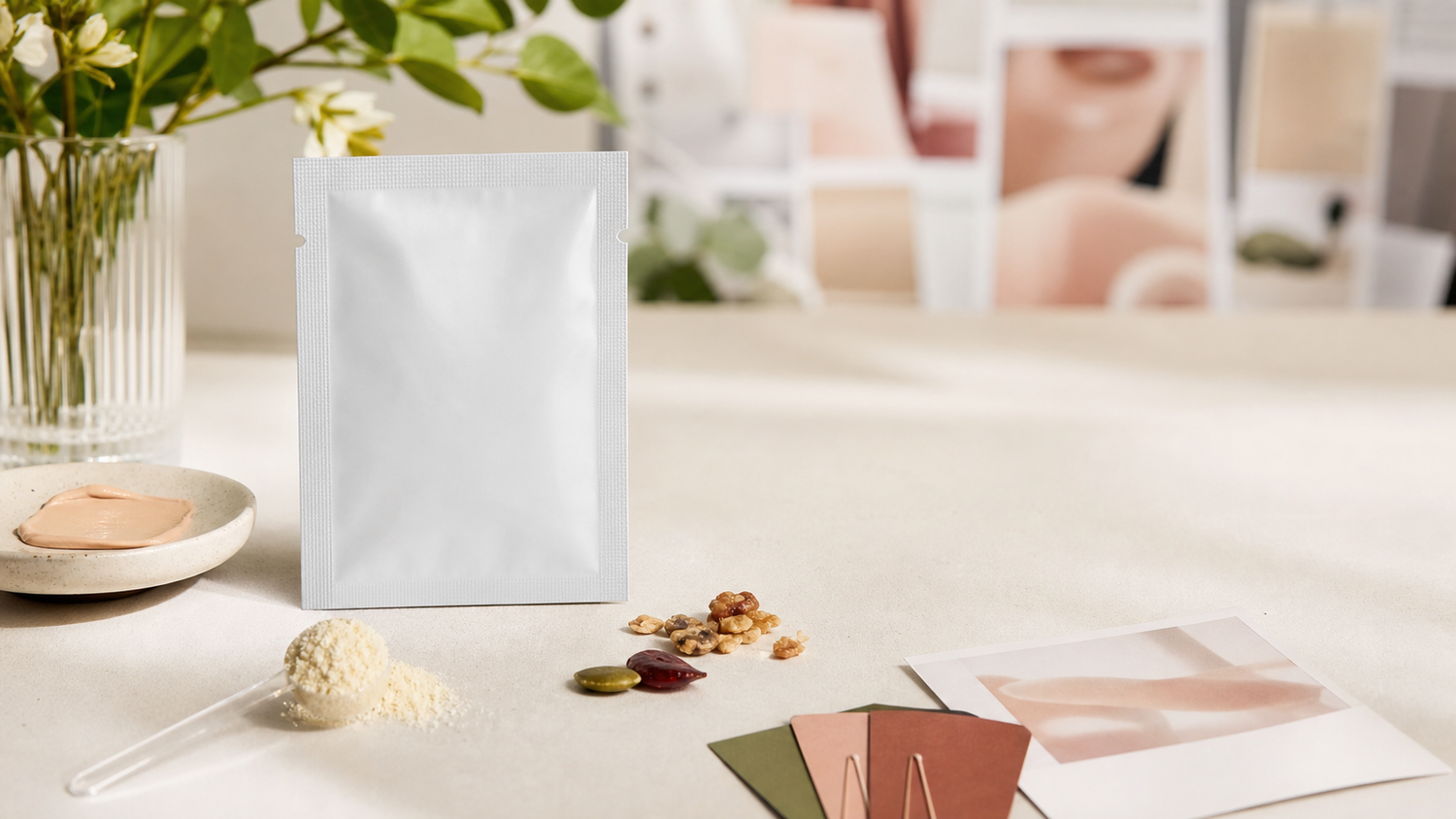
Custom sample sachets let a small brand put a real product into a buyer meeting, influencer kit, subscription box, event giveaway, trial bundle, or customer order before the brand is ready for a large printed packaging commitment. The value is not simply that a sachet is small. A successful sample pack has a clear job, enough product for that job, a practical opening experience, accurate artwork, and a route into the full-size product or next commercial step.
Low MOQ can reduce printed-inventory risk, but it does not remove filling, seal, compatibility, label, or proof requirements. Beauty formulas, supplement powders, snacks, coffee, pet products, and household samples each create different technical and regulatory questions. This guide helps founders prepare a quote-ready sample program while keeping product claims and technical performance within proper review.
Quick Answer: Choose the sample goal first, then define product form, dose or trial quantity, sachet dimensions, barrier and compatibility needs, opening method, filling process, artwork variants, distribution channel, and next-step CTA. Use blank samples and filled test packs before printing. Low MOQ works best when the sample program has a measurable conversion or learning objective.
Sample Sachet Goals and Pack Decisions
Different sample goals need different quantities, artwork, and user experiences.
| Sample Goal | Pack Priority | Useful Metric |
|---|---|---|
| Retail buyer meeting | Professional finish, clear product identity, sell-sheet link | Buyer follow-up or pilot order |
| Influencer seeding | Portable format, unboxing fit, campaign code | Posts, saves, attributed traffic |
| Subscription insert | Compact size, shipping efficiency, next-purchase CTA | Conversion to full-size order |
| Product formulation test | Accurate dose, neutral artwork, batch traceability | Structured user feedback |
| Event giveaway | Fast handout, simple opening, memorable offer | Scans, email capture, sample-to-sale rate |
| Wholesale sample kit | Multiple SKUs, organized map, reorder information | Account qualification and quote request |
1. Give Every Sample a Commercial Job
A sample can generate awareness without producing useful learning or revenue. If the brand has not defined what should happen after use, the pack may become an expensive giveaway with no measurement plan.
Choose one primary goal: buyer evaluation, conversion to full size, formula feedback, influencer content, event lead capture, or retailer pilot. Let that goal determine product amount, artwork, insert, QR destination, and follow-up timing.
Write the intended next action
Write a one-sentence success definition and one metric before requesting packaging. Assign an owner to collect the results.
Decision boundary: A low unit cost does not make an unmeasured sample program efficient.
2. Choose a Trial Quantity That Completes the Experience
A cosmetic sample that covers only half an application, a coffee sample that cannot brew a normal cup, or a supplement sample without a clear serving can disappoint the user. Overfilling, however, can increase cost and shipping without improving learning.
Define the minimum product amount needed for the intended experience and any required repeat uses. Note density, viscosity, piece size, serving instruction, and acceptable headspace.
Match amount to use occasion
Run the actual use case with neutral sample packs. Observe opening, dispensing, mess, storage after opening, and whether the amount supports a fair evaluation.
Decision boundary: The smallest possible sachet is not automatically the best sample.
3. Select a Format Around Product and Filling
Three-side-seal sachets, zipper flats, stick packs, and small spout pouches use different equipment and closures. A visually attractive choice can be impractical for a startup co-packer or manual filling process.
Ask who fills the product, on which equipment, at what temperature, with what seal process, and at what minimum batch. Review whether the filler can handle the selected dimensions and material.
Start with operations
Include the co-packer before artwork. Request blank samples and conduct a fill-and-seal trial using the real process.
Decision boundary: Packaging MOQ and filling MOQ are separate constraints.
| Format | Best Fit | Watch Item |
|---|---|---|
| Three-side-seal sachet | Powders, snacks, wipes, dry samples | Seal area and tear path |
| Flat zipper pouch | Multi-use trial or larger samples | Zipper clearance and material cost |
| Stick pack | Measured powders or granules | Specialized filling and narrow artwork |
| Small spout pouch | Liquid, gel, puree, concentrate | Fitment, cap, filling, compatibility |
| Label-first stock pouch | Very early validation | Less custom print impact but faster iteration |
4. Plan Barrier and Compatibility Without Guessing
Powders can absorb moisture, coffee can lose aroma, oily snacks can challenge seals, and beauty formulas can interact with films or fitments. The word sample does not reduce the need for product-package review.
State product ingredients or risk profile, intended sample life, storage, temperature, light exposure, and distribution. Ask the supplier which tests and evidence support the proposed structure.
Identify the dominant risk
Fill test packs and observe them through the intended sample period. Use qualified technical and regulatory support for food, supplements, cosmetics, or chemical products.
Decision boundary: Short-term use does not guarantee compatibility.
5. Build Artwork for a Small Printable Area
Sachets have limited space, and shrinking a full-size label often makes ingredients, instructions, warnings, or brand cues unreadable. A beautiful front panel can still fail if required information has no planned location.
Create a hierarchy: product identity, use instruction, required content, traceability, and next action. Use a dieline with safe zones, seals, tear notch, and variable areas clearly marked.
Prioritize the information hierarchy
Print the artwork at actual size and review it in hand. Scan codes from realistic distance and lighting. Route required content through qualified review.
Decision boundary: A screen preview does not prove legibility or scannability.
6. Use Multi-SKU Printing With a Controlled System
Low MOQ digital printing can support several flavors or formulas, but each artwork adds proof and version-control risk. A wrong ingredient panel or mismatched variant name can erase the inventory advantage.
Build a SKU map with artwork filename, product, quantity, variable copy, barcode, batch plan, and approval owner. Lock shared elements and review differences systematically.
Create one source of truth
Use a proof checklist and have one person approve every variant against the SKU map. Keep final files in a controlled folder.
Decision boundary: Similar-looking designs still require separate content checks.
Common Mistakes and Better Decisions
The best sample programs connect product experience, operational feasibility, and a measurable next step.
| Mistake | Consequence | Better Approach |
|---|---|---|
| Choosing the smallest sachet | Incomplete or messy product trial | Test the full use occasion |
| Ignoring the filler | Format cannot run or seals are inconsistent | Confirm equipment and conduct a line trial |
| Shrinking full-size artwork | Unreadable copy and weak hierarchy | Design for the actual sachet dieline |
| Printing every idea | Obsolete low-MOQ inventory | Use label-first validation for unstable concepts |
| No post-sample action | Awareness without measurable conversion | Link the pack to a maintained destination and metric |
What to Prepare Before Requesting a Quote
A supplier-ready sachet brief should join product, format, artwork, filling, and campaign information.
- Sample objective and distribution channel
- Product form, formula risk, fill weight or volume
- Target dimensions or reference sachet
- Preferred format, opening, zipper, or spout
- Filling partner, equipment, fill temperature, and seal process
- Storage, sample life, shipping, and compatibility test needs
- SKU map, artwork status, barcode or variable data
- Quantity per SKU, delivery date, reorder plan, and approval owner
If several items remain unknown, request blank samples or a stock-pouch pilot before approving custom print.
Authoritative Checks and Internal Next Steps
For ingestible samples, consult FDA food-contact substances resources for food-contact context and use qualified regulatory review for product labels and claims. Use GS1 US when retail identification is needed. Environmental wording should be checked against FTC Green Guides and applicable market requirements.
Continue with the relevant Anacotte Packaging resources: flat pouches, low-MOQ packaging, stand-up pouches, spout pouches, request a quote. These links help buyers move from education to a format comparison, sample request, or production quote without treating a general guide as a finished technical specification.
Frequently Asked Questions
What is a good MOQ for custom sample sachets?
The right MOQ depends on print route, dimensions, material, number of artworks, filling partner, and supplier setup. Evaluate the total program, not packaging alone. Ask for quantity per SKU and compare that with the number of samples you can distribute and measure.
Can several sample SKUs share one sachet size?
Yes when fill amount, product behavior, seal needs, and filling method are similar. Use a SKU map and test each materially different formula or product shape. Shared dimensions simplify printing, but should not create an underfilled or difficult pack.
Do I need custom print for the first test?
Not always. Stock sachets or flat pouches with labels can be better when the formula, name, message, or size is still changing. Custom print makes more sense after the physical experience and core artwork are stable enough to learn from a branded run.
How should I choose the sample amount?
Start with the real use occasion. The user should be able to complete a fair trial, such as one brew, one serving, one application, or an intentional multi-use test. Then confirm that amount fits, dispenses, opens, and seals cleanly.
Can sample sachets be used for liquids or gels?
Yes, but liquids and gels require compatibility, viscosity, fill, seal, leakage, and sometimes fitment review. A small spout pouch may be more practical for certain multi-use samples. Test the actual formula and distribution conditions before printing.
What should be measured after the sample run?
Track distribution, conversion, feedback, damage, leakage, code scans, buyer responses, cost per qualified action, and performance by SKU or channel. Use the results to decide which artwork to repeat, revise, pause, or scale.
Next Step: Turn the Decision Into a Supplier-Ready Brief
If your sample goal, formula, fill amount, and artwork are stable, request a low-MOQ custom sachet quote with a complete SKU map. If they are still changing, start with blank or stock sample packs, validate the use experience, and move to custom print after the learning questions are clear.

Hinterlasse einen Kommentar
Diese Website ist durch hCaptcha geschützt und es gelten die allgemeinen Geschäftsbedingungen und Datenschutzbestimmungen von hCaptcha.