
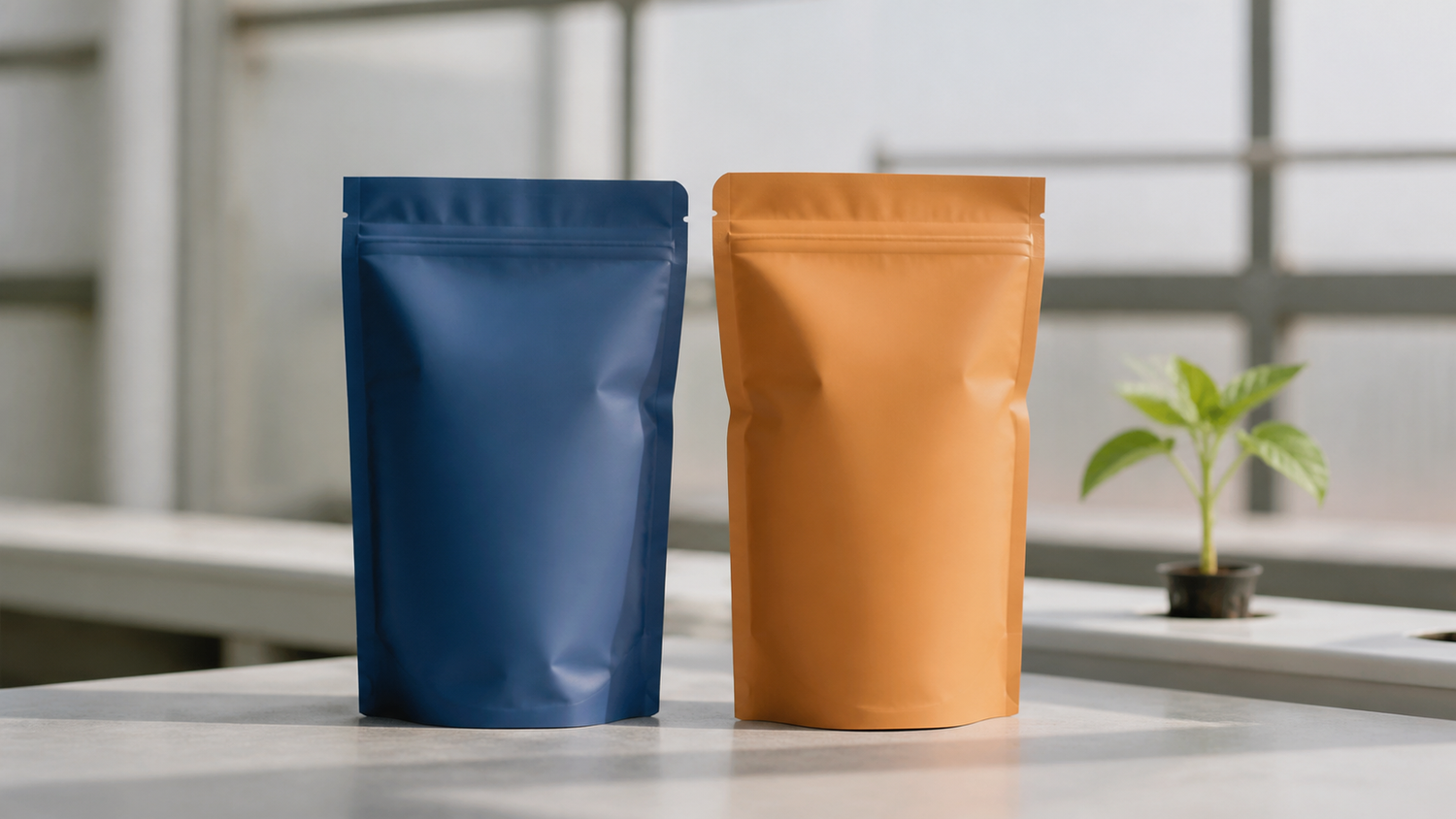
Two-part hydroponic nutrient products create a packaging problem that a single-SKU pouch does not: the buyer has to keep a matched pair clear from concept through shipment. The packaging should help the brand control component identity, artwork versions, fill weights and kit pairing without making unsupported claims about the formula.
This is a packaging-planning guide, not agronomy, mixing, hazardous-material or regulatory advice. The formula owner and qualified advisers must define the product classification, labels, storage instructions, safety requirements and applicable market rules.
1. Treat A and B as a controlled pair

Published hydroponic guidance commonly tells users to keep A and B components separate until dilution. For example, the HiGroponics nutrient guide describes separate concentrate handling, and published manufacturer instructions show paired A/B products with product-specific mixing steps. That supports a practical packaging principle: component identity should remain clear throughout the supplier workflow.
It does not prove that every A/B formula has the same composition, moisture sensitivity, storage needs or label obligations. Those properties belong in the product owner's technical brief.
2. Build a component map before artwork

Start with a simple one-page map for the two pouches. Give each component an internal SKU, approved name, pack size, color direction, artwork revision and carton-pairing rule. The goal is not to rely on color alone; it is to give the packing team several reliable checks.
- Component A and Component B names and internal SKU codes.
- Target net contents and any permitted pack-size variations.
- Approved front-panel differentiation and version-control process.
- Required label copy supplied by the formula owner.
- Lot, date-code and traceability locations.
- Whether pouches ship as one kit, as separate replenishments, or both.
This map prevents a common late-stage failure: treating one pouch as a visual variation after the artwork, fill and shipment process are already locked.
3. Specify pouch and fill questions separately for each component
A paired kit can share a pouch style, but it should not assume that both components have identical physical behavior. Ask the formula owner and filling team to define each product's powder flow, target fill, particle characteristics, dust-control needs, closure preference and storage assumptions. A supplier can then evaluate sample directions without being asked to infer chemistry from a product name.
For every sample, record the pouch size, structure, closure, fill target, sealing conditions and artwork revision. If a scoop is included, define whether it travels inside the pouch, in the kit, or separately. If the product needs a special barrier, child-resistant feature, or hazardous-material label, treat that as a formula- and market-specific requirement to verify—not a default property of any stand-up pouch.
4. Test the paired workflow, not only each pouch

Sampling should include the kit workflow. Check that the right A and B pouches are picked together, the correct artwork revisions reach the correct fill line, and the final carton or mailer preserves the pair. Weigh-fill verification, seal inspection and shipment-fit testing can reveal issues that a flat artwork proof cannot.
Useful pilot questions include:
- Can operators distinguish the components before and after filling?
- Does each pouch reach its documented fill target?
- Are seals clean and consistent for the actual powder and fill process?
- Does the kit remain paired during packing, warehousing and shipment?
- Can the brand trace the final kit to the correct component and artwork revisions?
Manufacturer directions such as this published A/B nutrient instruction sheet are useful evidence that mixing directions are product specific. Preserve those owner-approved directions as controlled copy; do not rewrite or invent them in packaging artwork.
5. Prepare a quote-ready paired-SKU brief

Bring these inputs to a pouch supplier:
- Product category, target market and confirmed label inputs for each component.
- Number of components, pack sizes and quantity per SKU.
- Powder handling and fill details for each pouch.
- Pouch style, closure and desired shelf or shipment behavior.
- Artwork status, controlled copy, color strategy and version process.
- Kit pairing, carton configuration and fulfilment route.
- Sample-test questions, target date and shipping destination.
A clear brief lets the supplier focus on pouch options, sampling and production feasibility while the brand retains responsibility for formula and labeling decisions. Review Anacotte's A/B fertilizer powder trial-pouch direction, then request a project-specific quote with the paired-SKU information above.
Frequently asked questions
Should A and B use different pouch colors?
Color can be a helpful cue, but it should sit inside a controlled component-identification system that also includes approved names, SKU handling and artwork-version checks.
Can one pouch structure work for both powders?
Possibly, but it should be confirmed against each component's actual fill, storage and handling requirements. Do not assume physical behavior from the fact that products ship as a pair.
Who decides safety and labeling requirements?
The formula owner and qualified advisers. A packaging supplier needs the approved requirements to evaluate feasible pouch and artwork options.

Hinterlasse einen Kommentar
Diese Website ist durch hCaptcha geschützt und es gelten die allgemeinen Geschäftsbedingungen und Datenschutzbestimmungen von hCaptcha.